Blame Gandhi: Did the great pacifist kill India, Inc.?
To avert a disastrous impending labor shortage, India needs to train 500 million skilled workers by 2022.
Jason Overdorf
NEW DELHI, India — Not too long ago, a scandal of sorts hit Indian newspapers.
Though millions of Indians remain unemployed or underemployed, the country's lagging brick-and-mortar industries had imported tens of thousands of Chinese workers — on business visas, no less — to build and operate power plants, steel mills and telecommunications towers.
"The Delhi airport was built by Chinese labor," said Dilip Chenoy, chief executive of India's National Skill Development Corporation, referring to the most prominent example of India's efforts to improve its dismal infrastructure.
But the uproar didn't last long for the simple reason that India can't afford to shut down.
Despite its huge working-age population, India faces a potentially debilitating shortage of skilled workers.
According to one emerging vocational education firm, only about 5 percent of India's 400-million strong labor force has received any formal training, compared with 70 percent in Germany and 95 percent in Korea. Importing skilled workers from China — on or off the books — is only the most dramatic manifestation of the problem.
Across the board, the shortage of skilled laborers has reduced productivity and cut into profits. Poaching workers from competitors has become a common practice that drives up wages, threatening to derail India's manufacturing revolution before it has even begun.
The wrong revolution
The crux of the problem is that India has never really industrialized.
India's service-related businesses account for more than half of GDP, while manufacturing contributes only 15 percent. And though China's economy is only four times larger than India's, its manufacturing sector is 50 times larger. Meanwhile, China has some 500,000 vocational training centers, compared with India's 10,000 obsolete Industrial Training Institutes.
Blame revolutionaries. Brutal Mao Zedong killed millions with his Great Leap Forward in China, but his drive for steel and obsession with collectivization arguably kickstarted the country's industrialization. China's ghastly Cultural Revolution terrorized intellectuals, but it also lionized laborers and solidified the building blocks of the nation.
Meanwhile, in India, there was Mohandas K. Gandhi, pacifist with a spinning wheel. Gandhi's insistence that his followers spin their own cloth as a protest against British imperialism laid the groundwork for decades of socialist policies.
While these policies provided the poor with jobs that saved them from starvation, they also discouraged technology and restricted companies from developing economies of scale. This more robust growth may have pulled India's masses out of poverty once and for all.
Gandhi's kinder, gentler revolution also left the caste system intact, assuring that there would be no prestige in physical labor for the rest of his century.
For decades India's industrial policies channeled Gandhi. Hundreds of products were reserved for small-scale companies to manufacture. Because these small-scale companies were too numerous to regulate, the policy effectively nurtured hundreds of thousands of sweatshops.
Thanks to India's ongoing economic reforms, many products — including some with a high growth potential, like apparel — are no longer reserved for small-scale industry. Still, many of the sweatshops persist.
Where large companies make money through economies of scale, sweatshops increase profit margins by paying low wages and cutting corners. And the Indian workers — and Indian industrialization drive — continue to pay the price.
That's because at the same time that India inadvertently created a breeding ground for sweatshops, it also passed strict labor laws that set minimum wages, mandate safety standards and make it very difficult to fire workers.
Sweatshops are only economically viable as long as they flout India's strict rules. But large companies can't fly under the radar and must comply. If they can't fire workers when the going gets tough, it doesn't make much sense to hire them in first place. What does make sense is contracting the work out to the very sweatshops that flout the rules.
The upshot is that only a handful of industries — like automobile and motorcycle manufacturing — have managed to attain economies of scale and begun to compete on the global stage.
More than 90 percent of India's work force is still employed in the so-called "unorganized sector," where neither safety standards nor minimum wage laws can be enforced. Where there is no money for boots and hardhats, there is surely none for technology or training.
"It varies a lot by sector, but we are seeing shortages anecdotally in several areas," said Ramya Venkataraman, head of the India education practice at the consulting firm McKinsey. "In some cases it [the skilled labor shortage] is constraining growth, and in some cases it is increasing the cost of doing business.
"At the current capacity, we'll be able to skill about 50 million people in 10 years," said Venkataraman, "versus the 500 million we need to train. So there's a severe shortage."
The opportunity in crisis
To avert disaster, India's normally ponderous policy makers have acted with speed and creativity.
Recognizing that the country needs to train 500 million skilled laborers by 2022 if its current economic growth is to continue, the government has mobilized private industry to solve its own impending crisis. A new corporation has emerged to identify and fund vocational education businesses, much like a development bank.
Economic planners may well have turned India's biggest headache into its most lucrative business opportunity — estimated at more than $20 billion.
Designed to help create large-scale, for-profit vocational training companies and funded with around $300 million in seed capital, India's National Skill Development Corporation (NSDC) has already lured companies like Global Talent Track, TeamLease Services and Manipal Education's IndiaSkills into the sector. The hook: NSDC offers low interest-rate loans and support in developing certification standards, providing financial aid for students and promoting vocational education.
Among the largest players, Centum Learning, an associate company of telecom billionaire Sunil Mittal's Bharti Group, has partnered with NSDC to form Centum Workskills India, a joint venture that aims to train 12 million people across 11 states by 2022. Similarly, Everonn Education has teamed up with NSDC to train another 15 million. And Infrastructure Leasing & Financial Services has inked a joint-venture deal with NSDC to build 100 skill development centers over the next five years.
In all, NSDC has so far approved $150 million in funding for 29 ventures that will train 40 million youth in diverse trades over the next 10 years. But this isn't by-the-numbers government work — with companies looking to get their front feet in the trough. And it's not charity work, either.
With 51 percent private sector funding and eight out of 12 of its board members representing private industry, NSDC offers better terms than commercial banks, but it takes a hefty 27 percent stake in exchange. It also demands that its partners guarantee job placement for 70 percent of their trainees.
Meanwhile, the big guns aren't getting into the business out of so-called "corporate social responsibility." They're in it to make money.
"It's not easy to monetize this space, so the motivation cannot be only revenue and profit," said Sanjeev Duggal, chief executive of Centum Learning Ltd. "But definitely our objective is by our fourth year to be crossing 500 crores [$110 million] in revenue."
The most needed job skills indicate how high the stakes are for India's economy.
According to estimates by ICRA Management Consulting Services, by 2020 India's construction industry will need 33 million more skilled crane operators, electricians, welders, masons and so on; the textiles and clothing industry will need 26 million loom and sewing machine operators; and the automobile and autoparts manufacturing industries will need 35 million machinists, mechanics, salesmen, etc.
In short, India's aspirations of boosting manufacturing output to 25 percent of GDP by 2025 — creating 100 million jobs and bringing hundreds of millions more people out of poverty in the process — may well hang in the balance.
"We have to build in skill-training capacity now," said NSDC's Chenoy. "We can't wait. In the next two to three years we have to put in place a skill-training capacity of at least 40 million people a year."
By connecting training programs more closely to employers, India hopes to ensure that courses are designed to meet industry's needs and to introduce an effective certification system so that employers recognize the value of a trained and certified welder, say, and are willing to pay more for him than for an someone who went through the informal apprentice system.
Changing the image of skilled labor
But those in the vocational education market say there are many more challenges to overcome, starting with convincing young people that a marketable skill can be more valuable than a college degree — at least when industry considers three out of four engineering graduates unemployable.
"Over the years vocational training has always been looked down upon and thought of something that's meant for losers," said IndiaSkills' chief executive Hari Menon, who expects his business to grow tenfold in its second year of operations. "Everybody chases a Bachelor's of Commerce or Bachelor's of Arts, however unemployable that makes them."
Monday, June 20, 2011


The EPA assault on Texas
The EPA assault on Texas
by J.E. Dyer
The necessary precondition for Texas’s unique economic success – a beacon in a deep recession – is energy. And the EPA is closing in for the kill.
This would be one thing if Texas were an outlier among the 50 states in terms of dirty air or an otherwise demonstrably imperiled environment. But the truth is closer to the opposite: the air in Texas has been getting cleaner; in the urban areas, much cleaner. And in spite of being by far the largest electric power producer of the 50 states, and heavily reliant on coal, Texas has been steadily reducing its emissions of the EPA’s least-favored compounds from coal combustion (e.g., sulfur dioxide and nitrous oxide). Its emissions of NOx and SO2 are substantially lower than the national average; Texas is ranked the 11th lowest in NOx emissions (.098 lb/mmBtu in 2009, versus a national average of .159 lb/mmBtu), and 24th in SO2 (.309 lb/mmBtu in 2009, versus a national average of .458 lb/mmBtu).
But the EPA isn’t really making the argument that Texas is an environmental pigsty. It’s not putting any data or findings behind that premise, at any rate. Instead, it is simply acting high-handedly, assuming an authority that nothing in written law confers on it, to pronounce Texas’s procedures in violation of EPA rules – even when there is no basis for making that claim. To put it bluntly, the EPA is making a power grab.
Overriding the state air-permit system
There are three principal facets to the power grab. One began with an EPA decision in January 2010 that the Texas air-permit program was invalid, and that every facility operating under such a permit in the state would have to be re-permitted. The argument was not that Texas plants were emitting too much. Rather, as the Wall Street Journal puts it, the Texas “air-permit program … caps emissions of air pollutants from an entire facility, but the EPA wants to scrutinize and restrict emissions from every polluting unit of a plant.” Texas, along with a number of other states, is concerned that regulating on the EPA’s basis will cost considerably more, without improving air quality.
Neither of the two approaches can claim to be the obvious intent of the Clean Air Act. In default of a clear intent in written law, the point at issue is whose judgment ought to prevail in this matter. Texas argues that federalism was a key component of the Clean Air Act, and properly so; that’s how things work in the United States. The EPA is supposed to set air quality standards, and then the states choose their methods to meet them. Other states agree.
The EPA has made no philosophical arguments to justify its regulatory ukase – but, of course, it doesn’t have to. It is currently operating under a chief executive who endorses its approach and doesn’t require it to justify what it wants to do. Reining it in would require concerted action from Congress, and/or a favorable ruling for the states in a lawsuit.
Keep in mind that throughout the 16 years in which Texas issued its industrial air permits, air quality in Texas improved – a lot. The Texas system wasn’t failing to produce a compliant outcome. And it took the EPA 16 years to decide, in spite of that record of success, to invalidate all the existing state-issued permits. The motivation was clearly political.
The war on coal; New draconian air-quality standards
The permit invalidation was just the beginning, however. The second facet of the power grab, the Obama EPA’s war on coal, will have at least as damaging an effect on Texas as on other states, and in some ways perhaps more. The war on coal is part of a larger regulatory assault on emissions and industrial byproducts of all kinds, which will, if implemented as intended, ensure life as we know it cannot continue in the United States. The impact on Texas is discussed in the testimony submitted to Congress by the Texas Public Policy Foundation (TPPF) in March.
The findings include the likelihood that the new regulations adopted by the Obama EPA will shut down more than 5700 MW of electrical generating capacity in Texas, or about one-twelfth of the peak demand levied by state users in the last couple of years. Meanwhile, based on economic trends, Texas expects to need as much as 25% more capacity by 2020. TPPF cites industry and independent think-tank estimates that the cost of compliance with the new EPA standards will be in the hundreds of billions of dollars, and will thus drive utility costs – and therefore the cost of living – up significantly, while at the same time eliminating thousands of jobs in many industries.
From regulating the naturally-occurring fine dust in the countryside, to treating the byproducts of coal combustion as hazardous waste, and preventing them from being sold for use in cement, the EPA’s proposals would shut down one aspect of human economic life after another.
TPPF gets in a number of good points about both the politics and the data; for example, it observes on p. 6 of the document that the EPA got around the rules governing its implementation of the new regulations by deeming its proposed action (dramatically tightening air quality standards) to be deregulatory. How did it do that? By positing that a comprehensive scheme of regulation would involve issuing permits for 6 million sources of emissions, and deciding instead to “tailor” its program to cover only large sources (e.g., the 12,000 emitters that currently require permits to operate).
Just imagine how we could fleece our fellow men if we all had the power to declare it “deregulation” – mercy, relief, a benefit to the regulated – when we don’t do as much as we could have done. There is a distinctly mafia-like ring to that thought process.
The TPPF testimony also alludes to the EPA’s extremely shaky case that fuel-burning plants need to have their mercury emissions reduced by 91% (mercury emissions from US industry have already been reduced considerably in the past 30 years). A number of studies suggest that many coal-fired electrical plants will simply find this impossible.
And there doesn’t appear to be a pressing need for it anyway. Besides the facts that the entire United States power sector emits only 1% of the globe’s anthropogenic mercury output, and that 50% of the mercury in the Atlantic is emitted from Asia, not the US (virtually all the human-emitted mercury in the Pacific comes from Asia), everything in the alarmist case about mercury is either undemonstrated (e.g., that mercury levels in fish have been rising), or wildly overestimated (e.g., the incidence of mercury in child-bearing women in the US, and how that compares to the level of mercury considered dangerous to humans). See here and here for evidence and counterarguments.
But wait – there’s more. If you’re wondering how Texas is going to make up that 5700+ MW of power-generating capacity, so is Texas. Nuclear power would do the trick, of course, but as TPPF observes, new nuclear power plants are an iffy proposition in the wake of the Fukushima disaster. Wind, solar, and biomass are laughably uneconomic sources, and wind and solar are unreliable as well.
Shutting down natural gas
But what about natural gas? The EPA is way ahead of us, with the third facet of its power grab. Ben Voth wrote a piece for American Thinker in January calling out the new EPA assault on the production of natural gas in Texas. And if you think the EPA’s particular beef is with fracking (hydraulic fracturing) chemicals, think again. The basis for the EPA’s abrupt move against a Texas natural gas driller in December 2010 was methane and benzene found in local water.
It all fit nicely with the emotional appeal of the “documentary” Gasland, which did for the natural gas industry what Michael Moore did for 9/11. The problem is that not only was Gasland full of errors and misrepresentations, the EPA case against Range Resources in Texas was full of holes as well. Based on analysis of their nitrogen content, the methane and benzene in the afflicted water came not from the natural-gas drilling by Range Resources, but through natural seepage from a shallower nearby gas formation – one that is not being drilled. In other words, there’s nothing humans could have done to prevent the seepage.
(The Energy in Depth write-ups point out also that methane is a naturally occurring gas and the hazards of its presence in drinking water depend, as with so many things, on concentration. They also cite a study by the Texas health authorities which demonstrated that benzene exposure in the gas-drilling areas of Texas is no higher than it is in the rest of the US, and that the only residents who have elevated levels of benzene are smokers.)
But subsequent testimony from EPA staffers, part of a reconstruction of the December 2010 decision to shut down the Range Resources drilling operation, showed that the EPA did not even consider the possibility that the methane and benzene appeared naturally in the water in question. This failure fit well with other patterns in the EPA action; the reconstruction (see the second EID link) indicates that it was an instance of activists and the EPA working together to jump the gun.
Senator Jim Inhofe (R-OK) is pursuing this issue. The Republicans in Texas’s congressional delegation have sent a letter to Cass Sunstein expressing strong disapproval of the EPA’s failure to abide by its own rules in implementing the new air quality and emissions regulations. As Pajamas notes, the International Brotherhood of Electrical Workers has sent a letter of its own decrying the new regulations – although the Texas Democrats have remained silent.
The fight continues among the states. At least 15 (including Texas) filed suit against the EPA over its “climate-change” regulations in 2010, even before the full slate of new air quality/emissions regulations were published. On the other side are 16 states
fighting back on behalf of the EPA, saying without regulations, climate change will adversely affect them.
Those states are: Arizona, California, Connecticut, Delaware, Illinois, Iowa, Maine, Maryland, Massachusetts, New Hampshire, New Mexico, New York, Oregon, Rhode Island, Vermont and Washington.
Remarkably, the states “fighting on behalf of the EPA” include the ones with the biggest state deficits, the ones with the highest taxes, the ones with the highest unemployment, and the ones hemorrhaging businesses and revenues and losing seats in Congress after the 2010 census. One principles-of-governance note: as long as there is an EPA, any president can put people in it who will abuse the agency’s portfolio. The courts are incompetent to decide how much the EPA “should” be doing. That’s a political decision that belongs in Congress – and we need to be telling Congress to do things differently.
J.E. Dyer’s articles have appeared at The Green Room, Commentary’s “contentions,” Patheos, The Weekly Standard online, and her own blog, The Optimistic Conservative.
by J.E. Dyer
The necessary precondition for Texas’s unique economic success – a beacon in a deep recession – is energy. And the EPA is closing in for the kill.
This would be one thing if Texas were an outlier among the 50 states in terms of dirty air or an otherwise demonstrably imperiled environment. But the truth is closer to the opposite: the air in Texas has been getting cleaner; in the urban areas, much cleaner. And in spite of being by far the largest electric power producer of the 50 states, and heavily reliant on coal, Texas has been steadily reducing its emissions of the EPA’s least-favored compounds from coal combustion (e.g., sulfur dioxide and nitrous oxide). Its emissions of NOx and SO2 are substantially lower than the national average; Texas is ranked the 11th lowest in NOx emissions (.098 lb/mmBtu in 2009, versus a national average of .159 lb/mmBtu), and 24th in SO2 (.309 lb/mmBtu in 2009, versus a national average of .458 lb/mmBtu).
But the EPA isn’t really making the argument that Texas is an environmental pigsty. It’s not putting any data or findings behind that premise, at any rate. Instead, it is simply acting high-handedly, assuming an authority that nothing in written law confers on it, to pronounce Texas’s procedures in violation of EPA rules – even when there is no basis for making that claim. To put it bluntly, the EPA is making a power grab.
Overriding the state air-permit system
There are three principal facets to the power grab. One began with an EPA decision in January 2010 that the Texas air-permit program was invalid, and that every facility operating under such a permit in the state would have to be re-permitted. The argument was not that Texas plants were emitting too much. Rather, as the Wall Street Journal puts it, the Texas “air-permit program … caps emissions of air pollutants from an entire facility, but the EPA wants to scrutinize and restrict emissions from every polluting unit of a plant.” Texas, along with a number of other states, is concerned that regulating on the EPA’s basis will cost considerably more, without improving air quality.
Neither of the two approaches can claim to be the obvious intent of the Clean Air Act. In default of a clear intent in written law, the point at issue is whose judgment ought to prevail in this matter. Texas argues that federalism was a key component of the Clean Air Act, and properly so; that’s how things work in the United States. The EPA is supposed to set air quality standards, and then the states choose their methods to meet them. Other states agree.
The EPA has made no philosophical arguments to justify its regulatory ukase – but, of course, it doesn’t have to. It is currently operating under a chief executive who endorses its approach and doesn’t require it to justify what it wants to do. Reining it in would require concerted action from Congress, and/or a favorable ruling for the states in a lawsuit.
Keep in mind that throughout the 16 years in which Texas issued its industrial air permits, air quality in Texas improved – a lot. The Texas system wasn’t failing to produce a compliant outcome. And it took the EPA 16 years to decide, in spite of that record of success, to invalidate all the existing state-issued permits. The motivation was clearly political.
The war on coal; New draconian air-quality standards
The permit invalidation was just the beginning, however. The second facet of the power grab, the Obama EPA’s war on coal, will have at least as damaging an effect on Texas as on other states, and in some ways perhaps more. The war on coal is part of a larger regulatory assault on emissions and industrial byproducts of all kinds, which will, if implemented as intended, ensure life as we know it cannot continue in the United States. The impact on Texas is discussed in the testimony submitted to Congress by the Texas Public Policy Foundation (TPPF) in March.
The findings include the likelihood that the new regulations adopted by the Obama EPA will shut down more than 5700 MW of electrical generating capacity in Texas, or about one-twelfth of the peak demand levied by state users in the last couple of years. Meanwhile, based on economic trends, Texas expects to need as much as 25% more capacity by 2020. TPPF cites industry and independent think-tank estimates that the cost of compliance with the new EPA standards will be in the hundreds of billions of dollars, and will thus drive utility costs – and therefore the cost of living – up significantly, while at the same time eliminating thousands of jobs in many industries.
From regulating the naturally-occurring fine dust in the countryside, to treating the byproducts of coal combustion as hazardous waste, and preventing them from being sold for use in cement, the EPA’s proposals would shut down one aspect of human economic life after another.
TPPF gets in a number of good points about both the politics and the data; for example, it observes on p. 6 of the document that the EPA got around the rules governing its implementation of the new regulations by deeming its proposed action (dramatically tightening air quality standards) to be deregulatory. How did it do that? By positing that a comprehensive scheme of regulation would involve issuing permits for 6 million sources of emissions, and deciding instead to “tailor” its program to cover only large sources (e.g., the 12,000 emitters that currently require permits to operate).
Just imagine how we could fleece our fellow men if we all had the power to declare it “deregulation” – mercy, relief, a benefit to the regulated – when we don’t do as much as we could have done. There is a distinctly mafia-like ring to that thought process.
The TPPF testimony also alludes to the EPA’s extremely shaky case that fuel-burning plants need to have their mercury emissions reduced by 91% (mercury emissions from US industry have already been reduced considerably in the past 30 years). A number of studies suggest that many coal-fired electrical plants will simply find this impossible.
And there doesn’t appear to be a pressing need for it anyway. Besides the facts that the entire United States power sector emits only 1% of the globe’s anthropogenic mercury output, and that 50% of the mercury in the Atlantic is emitted from Asia, not the US (virtually all the human-emitted mercury in the Pacific comes from Asia), everything in the alarmist case about mercury is either undemonstrated (e.g., that mercury levels in fish have been rising), or wildly overestimated (e.g., the incidence of mercury in child-bearing women in the US, and how that compares to the level of mercury considered dangerous to humans). See here and here for evidence and counterarguments.
But wait – there’s more. If you’re wondering how Texas is going to make up that 5700+ MW of power-generating capacity, so is Texas. Nuclear power would do the trick, of course, but as TPPF observes, new nuclear power plants are an iffy proposition in the wake of the Fukushima disaster. Wind, solar, and biomass are laughably uneconomic sources, and wind and solar are unreliable as well.
Shutting down natural gas
But what about natural gas? The EPA is way ahead of us, with the third facet of its power grab. Ben Voth wrote a piece for American Thinker in January calling out the new EPA assault on the production of natural gas in Texas. And if you think the EPA’s particular beef is with fracking (hydraulic fracturing) chemicals, think again. The basis for the EPA’s abrupt move against a Texas natural gas driller in December 2010 was methane and benzene found in local water.
It all fit nicely with the emotional appeal of the “documentary” Gasland, which did for the natural gas industry what Michael Moore did for 9/11. The problem is that not only was Gasland full of errors and misrepresentations, the EPA case against Range Resources in Texas was full of holes as well. Based on analysis of their nitrogen content, the methane and benzene in the afflicted water came not from the natural-gas drilling by Range Resources, but through natural seepage from a shallower nearby gas formation – one that is not being drilled. In other words, there’s nothing humans could have done to prevent the seepage.
(The Energy in Depth write-ups point out also that methane is a naturally occurring gas and the hazards of its presence in drinking water depend, as with so many things, on concentration. They also cite a study by the Texas health authorities which demonstrated that benzene exposure in the gas-drilling areas of Texas is no higher than it is in the rest of the US, and that the only residents who have elevated levels of benzene are smokers.)
But subsequent testimony from EPA staffers, part of a reconstruction of the December 2010 decision to shut down the Range Resources drilling operation, showed that the EPA did not even consider the possibility that the methane and benzene appeared naturally in the water in question. This failure fit well with other patterns in the EPA action; the reconstruction (see the second EID link) indicates that it was an instance of activists and the EPA working together to jump the gun.
Senator Jim Inhofe (R-OK) is pursuing this issue. The Republicans in Texas’s congressional delegation have sent a letter to Cass Sunstein expressing strong disapproval of the EPA’s failure to abide by its own rules in implementing the new air quality and emissions regulations. As Pajamas notes, the International Brotherhood of Electrical Workers has sent a letter of its own decrying the new regulations – although the Texas Democrats have remained silent.
The fight continues among the states. At least 15 (including Texas) filed suit against the EPA over its “climate-change” regulations in 2010, even before the full slate of new air quality/emissions regulations were published. On the other side are 16 states
fighting back on behalf of the EPA, saying without regulations, climate change will adversely affect them.
Those states are: Arizona, California, Connecticut, Delaware, Illinois, Iowa, Maine, Maryland, Massachusetts, New Hampshire, New Mexico, New York, Oregon, Rhode Island, Vermont and Washington.
Remarkably, the states “fighting on behalf of the EPA” include the ones with the biggest state deficits, the ones with the highest taxes, the ones with the highest unemployment, and the ones hemorrhaging businesses and revenues and losing seats in Congress after the 2010 census. One principles-of-governance note: as long as there is an EPA, any president can put people in it who will abuse the agency’s portfolio. The courts are incompetent to decide how much the EPA “should” be doing. That’s a political decision that belongs in Congress – and we need to be telling Congress to do things differently.
J.E. Dyer’s articles have appeared at The Green Room, Commentary’s “contentions,” Patheos, The Weekly Standard online, and her own blog, The Optimistic Conservative.
Marxist Democrat Cringes As Russian Immigrants Compare Communism to…Democrats!
Marxist Democrat Cringes As Russian Immigrants Compare Communism to…Democrats!
Posted by LaborUnionReport
 There is just no way to describe this without a smirk and a chuckle. When you read how some of New York’s Russian immigrants (who know Soviet-style Communism all-too-well) are aligning with Republicans—because they view Democrats’ policies to be too similar to the failed policies of their homeland—there is just something richly ironic there. However, when you read how their never-met-a-Marxist-she-didn’t-love Democrat legislator reacts to be having her party compared to Soviet Russia, now that is just over-the-top funny:
Businessman Arkadiy Fridman said that the newly formed Citizens Magazine Business Club, a confederation of more than 50 Russian-owned businesses here and in Brooklyn, has aligned itself with the Molinari Republican Club (MRC) in an effort to increase the Russian community’s political and economic clout.
CLOSE TO OWN VISION
“We decided we had to support this club,” said Fridman, a former Soviet Army officer who came to the United States in 1992. “They are very close to our political and business vision.”
[snip]
Fridman said that the Democrats “are going in an absolutely different direction,” focusing on “income redistribution” and rich-versus-poor “class war.”
“It’s too socialistic,” said Fridman, head of the non-profit Staten Island Community Center and president of Citizens Magazine, a public affairs publication. “It’s very painful for us to see.”
And, if that weren’t bad enough, the Democrats’ are reminding the Russian immigrants of something they thought they left behind:
The Big Brother approach reminds Fridman too much of what he left behind in the former Soviet Union.
“It’s the same rule like it was there,” said Fridman, who estimates there are around 55,000 Russian immigrants here.
Michael Petrov of the Digital Edge data management firm in Bloomfield, said that he objects to the “micro-managing of the economy” he’s seen from city as well as federal officials.
“Government is affecting small business more and more,” said Petrov, who came to the United States in 1994. “It’s the same as what’s happening in Russia.”
The Russian immigrants seem to know the path the Democratic Party is leading the nation down far better than many Democrats, which is why it seems the GOP is a better fit for the Russians.
Of course, the danger of being exposed is not lost on their Marxist legislator, union-boss-turned-Democrat-politician, State Sen. Diane Savino (D-North Shore/Brooklyn), who just seems to cringe at the thought of being exposed and being labeled either a Socialist or a Communist:
State Sen. Diane Savino (D-North Shore/Brooklyn) said she understands the Russian aversion to anything that looks like big government, but thinks the criticism of the Democratic Party is off-base.
“You can’t ignore the fact that the Russian population here came of age during the Soviet era,” said Ms. Savino, who counts many Russians among her Brooklyn constituents.
“They have different thoughts on what communism and socialism mean. They are a little more sensitive to it.
“But, that being said,” she added, “you can’t compare the policies of the Democratic Party with communism. It’s absurd.”
Ummm. Does Yes We Can! fit here?
Posted by LaborUnionReport

Businessman Arkadiy Fridman said that the newly formed Citizens Magazine Business Club, a confederation of more than 50 Russian-owned businesses here and in Brooklyn, has aligned itself with the Molinari Republican Club (MRC) in an effort to increase the Russian community’s political and economic clout.
CLOSE TO OWN VISION
“We decided we had to support this club,” said Fridman, a former Soviet Army officer who came to the United States in 1992. “They are very close to our political and business vision.”
[snip]
Fridman said that the Democrats “are going in an absolutely different direction,” focusing on “income redistribution” and rich-versus-poor “class war.”
“It’s too socialistic,” said Fridman, head of the non-profit Staten Island Community Center and president of Citizens Magazine, a public affairs publication. “It’s very painful for us to see.”
And, if that weren’t bad enough, the Democrats’ are reminding the Russian immigrants of something they thought they left behind:
The Big Brother approach reminds Fridman too much of what he left behind in the former Soviet Union.
“It’s the same rule like it was there,” said Fridman, who estimates there are around 55,000 Russian immigrants here.
Michael Petrov of the Digital Edge data management firm in Bloomfield, said that he objects to the “micro-managing of the economy” he’s seen from city as well as federal officials.
“Government is affecting small business more and more,” said Petrov, who came to the United States in 1994. “It’s the same as what’s happening in Russia.”
The Russian immigrants seem to know the path the Democratic Party is leading the nation down far better than many Democrats, which is why it seems the GOP is a better fit for the Russians.
Of course, the danger of being exposed is not lost on their Marxist legislator, union-boss-turned-Democrat-politician, State Sen. Diane Savino (D-North Shore/Brooklyn), who just seems to cringe at the thought of being exposed and being labeled either a Socialist or a Communist:
State Sen. Diane Savino (D-North Shore/Brooklyn) said she understands the Russian aversion to anything that looks like big government, but thinks the criticism of the Democratic Party is off-base.
“You can’t ignore the fact that the Russian population here came of age during the Soviet era,” said Ms. Savino, who counts many Russians among her Brooklyn constituents.
“They have different thoughts on what communism and socialism mean. They are a little more sensitive to it.
“But, that being said,” she added, “you can’t compare the policies of the Democratic Party with communism. It’s absurd.”
Ummm. Does Yes We Can! fit here?
Your Handy Guide To Obama Board's Attack on Workplace Democracy
Your Handy Guide To Obama Board's Attack on Workplace Democracy
Andrew Breitbart, proprietor of this here outlet, is already getting plaudits for his presentation at this year’s RightOnline convention (you can see his speech here). But the weekend event also held lots of policy and digital advocacy conversations, including one on the issue of union thugs trying to kill American companies and jobs.
A hot topic, of course, is the NLRB’s threat to kill jobs at a Boeing plant in South Carolina (because of which legislators are considering the Job Protection Act). But, sadly, there are many other concerns on the horizon, including “project labor agreements” that shut out the vast majority of the construction workforce and a host below-the-radar issues before the Big Labor-stacked National Labor Relations Board that threaten to kill jobs and slow our economy in the name of helping President Obama’s biggest political backer. For the latter, take a brief gander at a cleaned-up version of my presentation, which includes case citations for those who are interested in digging further.
Andrew Breitbart, proprietor of this here outlet, is already getting plaudits for his presentation at this year’s RightOnline convention (you can see his speech here). But the weekend event also held lots of policy and digital advocacy conversations, including one on the issue of union thugs trying to kill American companies and jobs.
A hot topic, of course, is the NLRB’s threat to kill jobs at a Boeing plant in South Carolina (because of which legislators are considering the Job Protection Act). But, sadly, there are many other concerns on the horizon, including “project labor agreements” that shut out the vast majority of the construction workforce and a host below-the-radar issues before the Big Labor-stacked National Labor Relations Board that threaten to kill jobs and slow our economy in the name of helping President Obama’s biggest political backer. For the latter, take a brief gander at a cleaned-up version of my presentation, which includes case citations for those who are interested in digging further.
RightOnline Job Creation from AFPhq on Vimeo.
">NBC Omits ‘Under God' from Pledge
NBC omits ‘under God’ from Pledge of Allegiance during U.S. Open, says wasn’t intentional
Even something like the U.S. Open golf tournament held in Washington, D.C. this weekend isn’t immune from the perils of political correctness.
At the beginning of NBC’s Sunday broadcast of the final round of one of the four major golf tournaments in the world, an introduction aired that included images from the nation’s capital while the Pledge of Allegiance being recited by school children in the background. The problem: Conspicuously missing were the words “under God”:
I pledge of allegiance to the flag of the United States of America and to the republic for which it stands with liberty and justice for all.
Later in the broadcast, one of the commentators apologized to viewers, but still managed to not say “under God”:
Earlier we began our coverage of this final round just about three hours ago and when we did it was our intent to begin the coverage of this U.S. Open championship with a feature that captured the patriotism of our national championship being held in our nation’s capital for the third time. Regrettably a portion of the Pledge of Allegiance that was in that feature was edited out. It was not done to upset anyone and we’d like to apologize to those of you that were offended by it.
Even something like the U.S. Open golf tournament held in Washington, D.C. this weekend isn’t immune from the perils of political correctness.
At the beginning of NBC’s Sunday broadcast of the final round of one of the four major golf tournaments in the world, an introduction aired that included images from the nation’s capital while the Pledge of Allegiance being recited by school children in the background. The problem: Conspicuously missing were the words “under God”:
I pledge of allegiance to the flag of the United States of America and to the republic for which it stands with liberty and justice for all.
Later in the broadcast, one of the commentators apologized to viewers, but still managed to not say “under God”:
Earlier we began our coverage of this final round just about three hours ago and when we did it was our intent to begin the coverage of this U.S. Open championship with a feature that captured the patriotism of our national championship being held in our nation’s capital for the third time. Regrettably a portion of the Pledge of Allegiance that was in that feature was edited out. It was not done to upset anyone and we’d like to apologize to those of you that were offended by it.
The Washington Cornhuskers
The Washington Cornhuskers
Subsidies: A bipartisan group of 73 Senators votes to end both the ethanol tax credit and the tariff on imported ethanol. Maybe we can finally cut the federal deficit and stop putting food in our gas tanks.
Apparently staring at the bottom of an economic abyss concentrates the mind wonderfully, as a, dare we say it, bipartisan group of 38 Democrats, 33 Republicans and both independents in the U.S. Senate voted to end the government boondoggle that subsidizes a wasteful but politically vested form of energy.
We have noted that since Iowa is the first presidential contest it activates the pandering gene in most ambitious politicians and suggested that if the first caucus state were Idaho we would probably be trying to stuff potatoes in our gas tanks.
Even Al Gore has admitted exploiting ethanol in his global warming crusade for political reasons.
The 73-27 vote on an amendment by Sen. Diane Feinstein, D-Calif., exceeded the 60-vote threshold needed to advance the measure as part of an economic development bill. While the bill itself is unlikely to go anywhere, the vote, after an earlier disappointing vote on a procedural matter, signals that when the ethanol subsidy expires on Dec. 31 it is not likely to be renewed.
The amendment not only would repeal the Volumetric Ethanol Excise Tax Credit that subsidizes ethanol producers, a favored industry unlike Big Oil, but also a 54-cent a gallon tariff on foreign ethanol from the likes of Brazil.
According to the administration, oil from Brazil is good, but ethanol is not. Domestically produced ethanol is good but domestically produced oil is bad. Huh?
We would have wished to see more Republicans, indeed all, united against this poster child for government waste, another intervention in the free market in an attempt to pick winners and losers. Farm state senators and those with political ambitions sat this one out.
And the amendment does nothing to end the actual federal mandate specifying U.S. consumption of 36 billion gallons in "renewable fuels" each year until 2022. Without this mandate, the tariff and the tax credit, ethanol could not compete in the marketplace.
We agree with the former governor of energy-rich but off limits Alaska that we should end all energy subsidies, from oil to ethanol, and let the free market pick winners and losers.
Sarah Palin — in stark contrast to former Massachusetts Gov. Mitt Romney, who likes the Iowa-grown gas additive — takes particular aim at ethanol subsidies, which cost taxpayers about $5 billion last year.
Using agricultural crops for bio-fuels such as ethanol increases demand and raises prices. We've already seen "tortilla riots" in Mexico. And just go to the supermarket and check prices and you'll see the results of using 40% of the U.S. corn crop for ethanol production.
As Patrick Richardson reports in Pajamas Media, coming off the third largest corn harvest in U.S. history in 2010, the carryover (unsold corn still in elevators) constitutes only a two week supply, the lowest level since the Dust Bowl of the 1930s. At this rate, we may soon be importing foreign corn as well as foreign oil.
According to a report prepared by 10 international organizations, including the World Bank and five different arms of the U.N., such as the Food and Agriculture Organization and the International Fund for Agricultural Development — we're not talking right-wingers here — increased bio-fuel mandates by governments could raise the price of coarse grains as much as 13%, oilseeds by 7% and vegetable oil 35% on average each year between 2013 and 2017.
Ethanol has never made much sense economically or environmentally. It never would have made it to market without politically motivated congressional mandates and huge subsidies.
Believers in free markets and less government need to join the effort to shuck corn as an energy source. Corn belongs in our breakfast cereal and on our dinner plates, not in our gas tanks.
Subsidies: A bipartisan group of 73 Senators votes to end both the ethanol tax credit and the tariff on imported ethanol. Maybe we can finally cut the federal deficit and stop putting food in our gas tanks.
Apparently staring at the bottom of an economic abyss concentrates the mind wonderfully, as a, dare we say it, bipartisan group of 38 Democrats, 33 Republicans and both independents in the U.S. Senate voted to end the government boondoggle that subsidizes a wasteful but politically vested form of energy.
We have noted that since Iowa is the first presidential contest it activates the pandering gene in most ambitious politicians and suggested that if the first caucus state were Idaho we would probably be trying to stuff potatoes in our gas tanks.
Even Al Gore has admitted exploiting ethanol in his global warming crusade for political reasons.
The 73-27 vote on an amendment by Sen. Diane Feinstein, D-Calif., exceeded the 60-vote threshold needed to advance the measure as part of an economic development bill. While the bill itself is unlikely to go anywhere, the vote, after an earlier disappointing vote on a procedural matter, signals that when the ethanol subsidy expires on Dec. 31 it is not likely to be renewed.
The amendment not only would repeal the Volumetric Ethanol Excise Tax Credit that subsidizes ethanol producers, a favored industry unlike Big Oil, but also a 54-cent a gallon tariff on foreign ethanol from the likes of Brazil.
According to the administration, oil from Brazil is good, but ethanol is not. Domestically produced ethanol is good but domestically produced oil is bad. Huh?
We would have wished to see more Republicans, indeed all, united against this poster child for government waste, another intervention in the free market in an attempt to pick winners and losers. Farm state senators and those with political ambitions sat this one out.
And the amendment does nothing to end the actual federal mandate specifying U.S. consumption of 36 billion gallons in "renewable fuels" each year until 2022. Without this mandate, the tariff and the tax credit, ethanol could not compete in the marketplace.
We agree with the former governor of energy-rich but off limits Alaska that we should end all energy subsidies, from oil to ethanol, and let the free market pick winners and losers.
Sarah Palin — in stark contrast to former Massachusetts Gov. Mitt Romney, who likes the Iowa-grown gas additive — takes particular aim at ethanol subsidies, which cost taxpayers about $5 billion last year.
Using agricultural crops for bio-fuels such as ethanol increases demand and raises prices. We've already seen "tortilla riots" in Mexico. And just go to the supermarket and check prices and you'll see the results of using 40% of the U.S. corn crop for ethanol production.
As Patrick Richardson reports in Pajamas Media, coming off the third largest corn harvest in U.S. history in 2010, the carryover (unsold corn still in elevators) constitutes only a two week supply, the lowest level since the Dust Bowl of the 1930s. At this rate, we may soon be importing foreign corn as well as foreign oil.
According to a report prepared by 10 international organizations, including the World Bank and five different arms of the U.N., such as the Food and Agriculture Organization and the International Fund for Agricultural Development — we're not talking right-wingers here — increased bio-fuel mandates by governments could raise the price of coarse grains as much as 13%, oilseeds by 7% and vegetable oil 35% on average each year between 2013 and 2017.
Ethanol has never made much sense economically or environmentally. It never would have made it to market without politically motivated congressional mandates and huge subsidies.
Believers in free markets and less government need to join the effort to shuck corn as an energy source. Corn belongs in our breakfast cereal and on our dinner plates, not in our gas tanks.
Sunday, June 19, 2011
Andrew Klavan’s Economic Smackdown: Paul Ryan vs. Barack Obama
Andrew Klavan’s Economic Smackdown: Paul Ryan vs. Barack Obama
Submitted by Trevor on June 18, 2011 – 6:48 pm EST
The always great Andrew Klavan analyzes alternative solutions to the US debt crisis.
h/t PajamaMedia via Trevor Loudon at http://trevorloudon.com
Submitted by Trevor on June 18, 2011 – 6:48 pm EST
The always great Andrew Klavan analyzes alternative solutions to the US debt crisis.
h/t PajamaMedia via Trevor Loudon at http://trevorloudon.com
The Pigford Settlement: Obama's way to sneak through "slave reparation"
The Pigford Settlement: Obama's way to sneak through "slave reparation"
By Coach Collins, on June 19th, 2011
By Suzanne Eovaldi, staff writer
Acorn, Barack Obama’s 2008 campaign, and slavery reparations are the real agenda driving the Pigford Settlement, the multi-billion dollar Black farmers’ pay out according to conservative investigative journalist Andrew Breitbart.
Pigford was the lead plaintiff in the original class action suit against the U.S. Department of Agriculture. The distribution of subsidies in the early 1980s to mid l990s was at issue, with “sympathetic USDA administrators” agreeing to settle the case at taxpayer expense.
Breitbart recently told a radio audience these were the factors behind Obama’s largest fleecing of U.S. taxpayers in history. Breitbart maintains Acorn is being used in this exchange of our dollars for solidifying the Black vote in the South, thereby blunting the conservatives’ hold on Dixie.
Breitbart claims the phrase “attempted to farm” was the prevailing mantra needed to enter the consent decree worked out by our government and lead attorney Al Pires who is the mastermind behind four different settlements according to the journalist.
Now keep in mind that while the government only lists 40,000 Black farmers in the ENTIRE country, there will be payouts to 90,000 “farmers” more than double those in the original Pigford settlements, which has now been reopened for the FOURTH time!
Only U.S. Representative Stephen King (R-IA) is stepping up to stop the fleecing of us taxpayers. He is saying this Pigford settlement is “full of fraud, that’s. . what it amounts to . .is paying REPARATIONS to Black farmers in America.” “We don’t do reparations in America,” King added.
Soon after taking office, Obama pledged that in addition to the original multi million dollars already allocated, another $1.5 billion would be made available for these payoffs.
The latest Pigford settlement is worth another $1.25 billion and the Cobell settlement is paying $3.4 billion to American Indians because government agencies failed to properly manage their oil and mineral rights royalties.
There is a small coterie of concerned reporters including Eric Kleefeld who are actually telling us how much of our money is being used for these political payoffs.
Kleefeld quotes King as intending “to blast the government’s discrimination settlement with African American farmers as reparations.” King vows that investigations are going to continue.
Will women and other liberal “farmer voting blocs” try to get into the act? Where will this all end? Our country is OUT OF MONEY and this is shaping up to be the largest fleecing of us taxpayers in our country’s history!
To contact your Congressional Representative use this link: http://www.contactingthecongress.org/
To read more use these links:
http://www.cfif.org/v/index/php/commentary/47/756-feds-pigford-settlements-leave-taxpayers
http://tpmmuckraker.talkingpointsmemo.com/pigford-settlement/
www.biggovernment.com
This day in history June 19
1862: A Republican controlled Congress abolished slavery in the U.S. territories.
If you are not receiving coachisright.com directly, please signup using the RSS feature on the home page. It’s easy and always free.
In this world you may have knowledge or you may have repose, but you may not have both. What have you done today to deserve to live in America?
By Coach Collins, on June 19th, 2011
By Suzanne Eovaldi, staff writer
Acorn, Barack Obama’s 2008 campaign, and slavery reparations are the real agenda driving the Pigford Settlement, the multi-billion dollar Black farmers’ pay out according to conservative investigative journalist Andrew Breitbart.
Pigford was the lead plaintiff in the original class action suit against the U.S. Department of Agriculture. The distribution of subsidies in the early 1980s to mid l990s was at issue, with “sympathetic USDA administrators” agreeing to settle the case at taxpayer expense.
Breitbart recently told a radio audience these were the factors behind Obama’s largest fleecing of U.S. taxpayers in history. Breitbart maintains Acorn is being used in this exchange of our dollars for solidifying the Black vote in the South, thereby blunting the conservatives’ hold on Dixie.
Breitbart claims the phrase “attempted to farm” was the prevailing mantra needed to enter the consent decree worked out by our government and lead attorney Al Pires who is the mastermind behind four different settlements according to the journalist.
Now keep in mind that while the government only lists 40,000 Black farmers in the ENTIRE country, there will be payouts to 90,000 “farmers” more than double those in the original Pigford settlements, which has now been reopened for the FOURTH time!
Only U.S. Representative Stephen King (R-IA) is stepping up to stop the fleecing of us taxpayers. He is saying this Pigford settlement is “full of fraud, that’s. . what it amounts to . .is paying REPARATIONS to Black farmers in America.” “We don’t do reparations in America,” King added.
Soon after taking office, Obama pledged that in addition to the original multi million dollars already allocated, another $1.5 billion would be made available for these payoffs.
The latest Pigford settlement is worth another $1.25 billion and the Cobell settlement is paying $3.4 billion to American Indians because government agencies failed to properly manage their oil and mineral rights royalties.
There is a small coterie of concerned reporters including Eric Kleefeld who are actually telling us how much of our money is being used for these political payoffs.
Kleefeld quotes King as intending “to blast the government’s discrimination settlement with African American farmers as reparations.” King vows that investigations are going to continue.
Will women and other liberal “farmer voting blocs” try to get into the act? Where will this all end? Our country is OUT OF MONEY and this is shaping up to be the largest fleecing of us taxpayers in our country’s history!
To contact your Congressional Representative use this link: http://www.contactingthecongress.org/
To read more use these links:
http://www.cfif.org/v/index/php/commentary/47/756-feds-pigford-settlements-leave-taxpayers
http://tpmmuckraker.talkingpointsmemo.com/pigford-settlement/
www.biggovernment.com
This day in history June 19
1862: A Republican controlled Congress abolished slavery in the U.S. territories.
If you are not receiving coachisright.com directly, please signup using the RSS feature on the home page. It’s easy and always free.
In this world you may have knowledge or you may have repose, but you may not have both. What have you done today to deserve to live in America?
Finally! The candidate who beats Obama 44-39
Finally! The candidate who beats Obama 44-39
posted at 10:00 am on June 19, 2011 by Jazz Shaw
As Doug Mataconis helpfully points out over at Outside the Beltway, a new Gallup poll has tested the waters of Republican hopefuls for next year’s election and the results are in. I know each of you may have your own preferred candidate who you’d like to see at the top of the ticket, but if you want to limit President Obama to a single term, it’s time for you to get on board with the winning combination. Are you ready?

Forty-four percent of registered voters say they are more likely to vote for “the Republican Party’s candidate” and 39% for Barack Obama in the 2012 presidential election, according to Gallup’s June update. The current five-percentage-point edge for the generic Republican is not a statistically significant lead, and neither side has held a meaningful lead at any point thus far in 2011.
These results are based on a June 9-12 Gallup poll.
However, as Doug explains, while Generic Republican may be able to kick some butt next November, actual living, breathing Republicans don’t do quite as well yet.
[I]f you put the President up against an actual Republican, instead of just a generic opponent, he beats every one of them in every poll right now. This is despite a declining approval rating, increasing economic pessimism, and the fact that nearly 2/3 of the country believes we are on the wrong track. Moreover, this one poll is contradicted by other “Obama v. Generic Republican” polls that show very different results:
Well, not every poll. There’s actually another Rassmussen poll out this weekend which pretty much duplicates Gallup’s results, and has been delivering good news for Generic Republican for three weeks in a row now. As with most of these things, though, it’s not the hard digits in a single snapshot which are important, but the prevailing trend lines. Even through some daunting economic times and waves of international unrest, Obama had been managing to poll well enough that potential challengers wouldn’t be able to touch him. In fact, a number of pundits had previously been speculating that this was a factor in some of the high profile potential GOP candidates waiting so long to declare.
But that seems to be changing now. We could play the game of guessing what the main driving factors are all day, but you’re all more than capable of doing that for yourselves. The point is, a once seemingly unbeatable hand in the political card game is starting to look more like an inside straight draw. That’s not to say that things won’t entirely reverse yet again over the next year if the jobs situation somehow perks up, but hopefuls have a bit more reason to hope during the Summer of Wreckovery.
Go Go Generic Republican!
posted at 10:00 am on June 19, 2011 by Jazz Shaw
As Doug Mataconis helpfully points out over at Outside the Beltway, a new Gallup poll has tested the waters of Republican hopefuls for next year’s election and the results are in. I know each of you may have your own preferred candidate who you’d like to see at the top of the ticket, but if you want to limit President Obama to a single term, it’s time for you to get on board with the winning combination. Are you ready?

Forty-four percent of registered voters say they are more likely to vote for “the Republican Party’s candidate” and 39% for Barack Obama in the 2012 presidential election, according to Gallup’s June update. The current five-percentage-point edge for the generic Republican is not a statistically significant lead, and neither side has held a meaningful lead at any point thus far in 2011.
These results are based on a June 9-12 Gallup poll.
However, as Doug explains, while Generic Republican may be able to kick some butt next November, actual living, breathing Republicans don’t do quite as well yet.
[I]f you put the President up against an actual Republican, instead of just a generic opponent, he beats every one of them in every poll right now. This is despite a declining approval rating, increasing economic pessimism, and the fact that nearly 2/3 of the country believes we are on the wrong track. Moreover, this one poll is contradicted by other “Obama v. Generic Republican” polls that show very different results:
Well, not every poll. There’s actually another Rassmussen poll out this weekend which pretty much duplicates Gallup’s results, and has been delivering good news for Generic Republican for three weeks in a row now. As with most of these things, though, it’s not the hard digits in a single snapshot which are important, but the prevailing trend lines. Even through some daunting economic times and waves of international unrest, Obama had been managing to poll well enough that potential challengers wouldn’t be able to touch him. In fact, a number of pundits had previously been speculating that this was a factor in some of the high profile potential GOP candidates waiting so long to declare.
But that seems to be changing now. We could play the game of guessing what the main driving factors are all day, but you’re all more than capable of doing that for yourselves. The point is, a once seemingly unbeatable hand in the political card game is starting to look more like an inside straight draw. That’s not to say that things won’t entirely reverse yet again over the next year if the jobs situation somehow perks up, but hopefuls have a bit more reason to hope during the Summer of Wreckovery.
Go Go Generic Republican!
Answering Readers’ Questions on Libya, Middle East Democracy, and Islam
Answering Readers’ Questions on Libya, Middle East Democracy, and Islam
by Barry Rubin
1. Why does the administration not want to get approval from Congress for the Libya mission when, as as far as I can tell, getting approval would be quite easy? Do they not wish to have a discussion about why we are intervening in Libya, but not Syria?
Interesting question. But the premise might be wrong. I don’t think they’d have an easy time. First, Congress would want to know what their goal is. It isn’t clear. There would be questions about whether the government is exceeding the UN resolution or what the limitations are on their tactics. Why are American forces still involved when Obama said this would be a short campaign? What is the Libyan opposition about and how can you help them win if you don’t know? I think they’d have a rough time. Hasn’t the administration overstretched the military? That’s especially true when the military will be leaking how unhappy it is with the Libya policy.
2. What should the U.S. have done in response to the Egyptian demonstrations and their increasing repression by the Mubarak regime? Would the appropriate U.S. policy have been to continue propping up Mubarak? More generally, what are the conditions under which the Arab world can democratize?
What the U.S. should have done is what Secretary of State Hillary Clinton proposed: support the regime in the broader sense of the word, get rid of Mubarak, and strive for continuity and reform. Not demand that the whole thing should be torn down immediately and create a situation of anarchy and rushing that benefited the Muslim Brotherhood.
To have democratization, you must be able to find people who want a democratic system, not just elections that they think they can win and then form a dictatorship. Even if—as has often happened in modern Middle East history—the regime might be called a dictatorship of the majority, that doesn’t make it a democracy.
Every country is different. I think Tunisia has a good chance of making it; Syria’s big advantage is that moderate and pro-democratic forces are stronger there and the Muslim Brotherhood is weaker than in Egypt. Syria’s big disadvantage is a complex communal situation that could lead to bloody ethnic strife and even massacres.
In contrast, an attempt at any such shift in Jordan would be a disaster. We saw what happened with elections in Lebanon and the PA areas. Can Tunisia be a success and a role model? Because if even Tunisia cannot create a stable democratic state then no one can.
Indeed, Lebanon and Turkey have failed (at least temporarily) as democracies, if one regards the rise of a radical Islamist regime as a failure. The voice of the people was implemented, but did it produce an elected dictatorship that represses dissent? Will there be free and fair elections in the future? The PA elections led to one party seizing all the power in one part and the other in the other part with no elections being held. Egypt’s direction is a foregone conclusion, I believe.
On a partly positive note, Iraq is holding on, though perhaps barely and temporarily, and the Kurds have created a quasi-democratic sub-state in the north. Kuwait and some of the smaller Gulf states have opened up compared to what they were in the past, though one should not overstate the progress toward democracy. Morocco and Jordan also have a measure of democracy, though the monarchies are always sure to keep control.
Bahrain is very complex because there is a lot of injustice in the treatment of the Shia and there are moderate Shia, but there are also Iran-backed radicals. It would be a good candidate for reasonable reform, but unfortunately the regime is very rigid. Yet regimes facing the real possibility of overthrow, with their current leaders sent to prison or firing squads, are going to be less willing to take risks and release more of their power. In Yemen, the conflicts have nothing to do with democracy but are tribal and factional quarrels. The only thing that would change there is the name of the dictator.
I believe the U.S. should give more support to moderates and democrats in Turkey, Iran, Syria, and Lebanon, where it gives no help or encouragement at all (other than formal statements that are useless).
But to begin with, one must have a realistic view and understand the forces in play. See my book, The Long War for Freedom (Wiley), which is a detailed and sympathetic assessment of the Arab moderates, their arguments, and their problems.
3. How do you tell a moderate Muslim from a radical one?
First of all, there are moderate Muslims and Muslims who are moderates. The first category means people who want a more moderate Islam and try to influence the religion. The second category is those who happen to be Muslims but that is not the central factor shaping their political views. For example, the Turkish republic was for many decades a country of Muslims who were moderates and favored a democratic system.
To know the difference you read what they say to each other in Arabic (or Turkish or Farsi, whatever their language is). You understand their approach and world view.
4.There are no moderate Muslims — is it a myth created by liberals?
Funny, I know a lot of them and they don’t seem a myth to me. But they are about 1 percent, have little power, and Western governments show no sympathy for them. Again, the problem is NOT that no moderate Muslims exist. The problem is: A.) Radicals are portrayed as moderates repeatedly in the West or pretend to be such; and B.) the number of moderates is very limited, they have little influence, and they are constantly intimidated.
But there are millions of anti-Islamist Muslims all over the world. They may be traditionalists, they may be nationalists, and they may be moderates. Yet their interpretation of Islam is different from that of the Islamists. We should remember that it wasn’t long ago when revolutionary Islamists were viewed as virtual heretics. The fact that Islamists draw on normative Islam doesn’t prove that they have the only or the correct interpretation of Islam.
It is ridiculous to claim that radical Islamists aren’t “real” or “proper” Muslims. But it is equally ridiculous to claim that all Muslims must be Islamists or they aren’t following their religion.
There are three camps in the West in understanding this issue:
Islamists represent the “right” interpretation of Islam and thus there cannot be moderate Muslims. This is the view taken by many on the “anti-jihad” side. It isn’t wrong because such a view is “bigoted” or isn’t helpful tactically. It is wrong because it doesn’t correspond to the facts and realities.
Islamists have hijacked the real Islam which is a religion of peace. That is the position of “politically correct” people, the idea that dominates Western governments, the mass media, and academia. This view is equally ridiculous. Islamists can cite the Koran, the hadith, and many other sacred writings to justify their positions. They didn’t make this stuff up. Violent jihad, treating non-Muslims as dhimmis, and antisemitism are not new ideas which emerged from the minds of a tiny minority.
There is in Islam, as in other religions, a struggle over interpretations. Different sides can cite texts and precedents. Were the Spanish Inquisition, the Crusades, and the worst excesses of the past the “real” Christianity? Of course not. And Christianity changed over time. Many debates and battles took place. The problem with Islam is not its “essence” but its place on the timeline. In Western terms, the debate in Islam is in the sixteenth or seventeenth century, with powerful forces wanting to return to the seventh century.
My view, the third one, can be summed up as seeing two people fighting over control of the steering wheel in an automobile speeding down the road. Both can claim ownership of the car. As an anti-Islamist Iranian intellectual once put it, the minute someone says that Islam must be interpreted in any one way they are wrong.
The reality is that for centuries Islam was overwhelmingly practiced in a way different from the views of Iran’s current rulers, Hamas, Hizballah, al-Qaeda, and the Muslim Brotherhood. All of these groups freely acknowledge that point. It is precisely why they want a revolution. Traditionalist Muslims may not be to one’s tastes, but they were not generating suicide bombers or actively seeking world conquest. That’s also why most of the people the revolutionary Islamists kill are also Muslims who oppose them.
One day, though it might take a century or more, the reformists will probably win, but that isn’t about to happen. Indeed, the tide is going in the opposite direction. Except in Iran—where people are fed up and have learned from unpleasant experience—Islamists are becoming stronger and traditionalist Muslims are going over to their side.
According to the “religion of peace” and “tiny minority of extremists” crowd, the moderates must win. Those who say that there is no such thing as a “moderate Muslim” and that Islam is inevitably extremist insist that the radicals must win precisely because they aren’t really radical but mainstream.
As these two sides in the battle among Muslims—the Islamists and the anti-Islamists—fight with each other the car can go over a cliff, and if the Islamists win the car will definitely go over a cliff. The side that wins the battle—and wins over most Muslims—will determine the interpretation of Islam for many years to come. The result is not preordained.
by Barry Rubin
1. Why does the administration not want to get approval from Congress for the Libya mission when, as as far as I can tell, getting approval would be quite easy? Do they not wish to have a discussion about why we are intervening in Libya, but not Syria?
Interesting question. But the premise might be wrong. I don’t think they’d have an easy time. First, Congress would want to know what their goal is. It isn’t clear. There would be questions about whether the government is exceeding the UN resolution or what the limitations are on their tactics. Why are American forces still involved when Obama said this would be a short campaign? What is the Libyan opposition about and how can you help them win if you don’t know? I think they’d have a rough time. Hasn’t the administration overstretched the military? That’s especially true when the military will be leaking how unhappy it is with the Libya policy.
2. What should the U.S. have done in response to the Egyptian demonstrations and their increasing repression by the Mubarak regime? Would the appropriate U.S. policy have been to continue propping up Mubarak? More generally, what are the conditions under which the Arab world can democratize?
What the U.S. should have done is what Secretary of State Hillary Clinton proposed: support the regime in the broader sense of the word, get rid of Mubarak, and strive for continuity and reform. Not demand that the whole thing should be torn down immediately and create a situation of anarchy and rushing that benefited the Muslim Brotherhood.
To have democratization, you must be able to find people who want a democratic system, not just elections that they think they can win and then form a dictatorship. Even if—as has often happened in modern Middle East history—the regime might be called a dictatorship of the majority, that doesn’t make it a democracy.
Every country is different. I think Tunisia has a good chance of making it; Syria’s big advantage is that moderate and pro-democratic forces are stronger there and the Muslim Brotherhood is weaker than in Egypt. Syria’s big disadvantage is a complex communal situation that could lead to bloody ethnic strife and even massacres.
In contrast, an attempt at any such shift in Jordan would be a disaster. We saw what happened with elections in Lebanon and the PA areas. Can Tunisia be a success and a role model? Because if even Tunisia cannot create a stable democratic state then no one can.
Indeed, Lebanon and Turkey have failed (at least temporarily) as democracies, if one regards the rise of a radical Islamist regime as a failure. The voice of the people was implemented, but did it produce an elected dictatorship that represses dissent? Will there be free and fair elections in the future? The PA elections led to one party seizing all the power in one part and the other in the other part with no elections being held. Egypt’s direction is a foregone conclusion, I believe.
On a partly positive note, Iraq is holding on, though perhaps barely and temporarily, and the Kurds have created a quasi-democratic sub-state in the north. Kuwait and some of the smaller Gulf states have opened up compared to what they were in the past, though one should not overstate the progress toward democracy. Morocco and Jordan also have a measure of democracy, though the monarchies are always sure to keep control.
Bahrain is very complex because there is a lot of injustice in the treatment of the Shia and there are moderate Shia, but there are also Iran-backed radicals. It would be a good candidate for reasonable reform, but unfortunately the regime is very rigid. Yet regimes facing the real possibility of overthrow, with their current leaders sent to prison or firing squads, are going to be less willing to take risks and release more of their power. In Yemen, the conflicts have nothing to do with democracy but are tribal and factional quarrels. The only thing that would change there is the name of the dictator.
I believe the U.S. should give more support to moderates and democrats in Turkey, Iran, Syria, and Lebanon, where it gives no help or encouragement at all (other than formal statements that are useless).
But to begin with, one must have a realistic view and understand the forces in play. See my book, The Long War for Freedom (Wiley), which is a detailed and sympathetic assessment of the Arab moderates, their arguments, and their problems.
3. How do you tell a moderate Muslim from a radical one?
First of all, there are moderate Muslims and Muslims who are moderates. The first category means people who want a more moderate Islam and try to influence the religion. The second category is those who happen to be Muslims but that is not the central factor shaping their political views. For example, the Turkish republic was for many decades a country of Muslims who were moderates and favored a democratic system.
To know the difference you read what they say to each other in Arabic (or Turkish or Farsi, whatever their language is). You understand their approach and world view.
4.There are no moderate Muslims — is it a myth created by liberals?
Funny, I know a lot of them and they don’t seem a myth to me. But they are about 1 percent, have little power, and Western governments show no sympathy for them. Again, the problem is NOT that no moderate Muslims exist. The problem is: A.) Radicals are portrayed as moderates repeatedly in the West or pretend to be such; and B.) the number of moderates is very limited, they have little influence, and they are constantly intimidated.
But there are millions of anti-Islamist Muslims all over the world. They may be traditionalists, they may be nationalists, and they may be moderates. Yet their interpretation of Islam is different from that of the Islamists. We should remember that it wasn’t long ago when revolutionary Islamists were viewed as virtual heretics. The fact that Islamists draw on normative Islam doesn’t prove that they have the only or the correct interpretation of Islam.
It is ridiculous to claim that radical Islamists aren’t “real” or “proper” Muslims. But it is equally ridiculous to claim that all Muslims must be Islamists or they aren’t following their religion.
There are three camps in the West in understanding this issue:
Islamists represent the “right” interpretation of Islam and thus there cannot be moderate Muslims. This is the view taken by many on the “anti-jihad” side. It isn’t wrong because such a view is “bigoted” or isn’t helpful tactically. It is wrong because it doesn’t correspond to the facts and realities.
Islamists have hijacked the real Islam which is a religion of peace. That is the position of “politically correct” people, the idea that dominates Western governments, the mass media, and academia. This view is equally ridiculous. Islamists can cite the Koran, the hadith, and many other sacred writings to justify their positions. They didn’t make this stuff up. Violent jihad, treating non-Muslims as dhimmis, and antisemitism are not new ideas which emerged from the minds of a tiny minority.
There is in Islam, as in other religions, a struggle over interpretations. Different sides can cite texts and precedents. Were the Spanish Inquisition, the Crusades, and the worst excesses of the past the “real” Christianity? Of course not. And Christianity changed over time. Many debates and battles took place. The problem with Islam is not its “essence” but its place on the timeline. In Western terms, the debate in Islam is in the sixteenth or seventeenth century, with powerful forces wanting to return to the seventh century.
My view, the third one, can be summed up as seeing two people fighting over control of the steering wheel in an automobile speeding down the road. Both can claim ownership of the car. As an anti-Islamist Iranian intellectual once put it, the minute someone says that Islam must be interpreted in any one way they are wrong.
The reality is that for centuries Islam was overwhelmingly practiced in a way different from the views of Iran’s current rulers, Hamas, Hizballah, al-Qaeda, and the Muslim Brotherhood. All of these groups freely acknowledge that point. It is precisely why they want a revolution. Traditionalist Muslims may not be to one’s tastes, but they were not generating suicide bombers or actively seeking world conquest. That’s also why most of the people the revolutionary Islamists kill are also Muslims who oppose them.
One day, though it might take a century or more, the reformists will probably win, but that isn’t about to happen. Indeed, the tide is going in the opposite direction. Except in Iran—where people are fed up and have learned from unpleasant experience—Islamists are becoming stronger and traditionalist Muslims are going over to their side.
According to the “religion of peace” and “tiny minority of extremists” crowd, the moderates must win. Those who say that there is no such thing as a “moderate Muslim” and that Islam is inevitably extremist insist that the radicals must win precisely because they aren’t really radical but mainstream.
As these two sides in the battle among Muslims—the Islamists and the anti-Islamists—fight with each other the car can go over a cliff, and if the Islamists win the car will definitely go over a cliff. The side that wins the battle—and wins over most Muslims—will determine the interpretation of Islam for many years to come. The result is not preordained.
Apparently spanking your child is a felony now
Apparently spanking your child is a felony now
by Jazz Shaw
Let me guess. You saw a post with the word “spanking” in the title and assumed this was another column about Anthony Weiner. Not so! A notorious felon in Texas has been brought to justice on charges of Injury to a Child. The outlaw in question is Rosalina Gonzales and her crime is described as spanking her own child.
A judge in Corpus Christi, Texas had some harsh words for a mother charged with spanking her own child before sentencing her to probation.
“You don’t spank children today,” said Judge Jose Longoria. “In the old days, maybe we got spanked, but there was a different quarrel. You don’t spank children.”
Rosalina Gonzales had pleaded guilty to a felony charge of injury to a child for what prosecutors had described as a “pretty simple, straightforward spanking case.” They noted she didn’t use a belt or leave any bruises, just some red marks.
As part of the plea deal, Gonzales will serve five years probation, during which time she’ll have to take parenting classes, follow CPS guidelines, and make a $50 payment to the Children’s Advocacy Center.
Something tells me that we shouldn’t be rushing over the cliff on this story just yet. I admit that my first reaction was very much in line with Datechguy, who finds our far too permissive “time out” society to be at the core of many social problems today. I came from a family where fairly stern discipline was applied and I think my siblings and I came out much the better for it. (My mom had a wooden spoon she kept for such purposes in one particular kitchen drawer. Fifty plus years later I still find myself steering a wide path around that drawer.)
But in this particular court case – especially in Texas of all places – I have to wonder if there isn’t more to this story we’re not being told yet. First of all, the article mentions in passing that Ms. Gonzales “doesn’t have custody of the child or her other two children, is trying to get them back.” Is this as a result of this particular incident, or had she already lost custody previously? Further, the “red marks” in question were noted by the grandmother, apparently some time after the incident, so they might have been more durable and serious than the brief sting and redness of a typical paddling. Something compelled the grandmother to take the rather drastic course of bringing the child to the hospital and they filed a report.
Finally, the child in question is two years old. How badly can a two year old be behaving to justify a serious session across mom’s knee? I don’t think I ever managed to get into that kind of trouble until at least when I was in elementary school.
Maybe this story is exactly as it seems and the courts in Texas are running amok. But it’s got my spider senses tingling and I’d like to know more of the details before we hang this judge out to dry as some sort of nanny state fanatic. Until we get those details I’ll leave it to the reader to decide.
by Jazz Shaw
Let me guess. You saw a post with the word “spanking” in the title and assumed this was another column about Anthony Weiner. Not so! A notorious felon in Texas has been brought to justice on charges of Injury to a Child. The outlaw in question is Rosalina Gonzales and her crime is described as spanking her own child.
A judge in Corpus Christi, Texas had some harsh words for a mother charged with spanking her own child before sentencing her to probation.
“You don’t spank children today,” said Judge Jose Longoria. “In the old days, maybe we got spanked, but there was a different quarrel. You don’t spank children.”
Rosalina Gonzales had pleaded guilty to a felony charge of injury to a child for what prosecutors had described as a “pretty simple, straightforward spanking case.” They noted she didn’t use a belt or leave any bruises, just some red marks.
As part of the plea deal, Gonzales will serve five years probation, during which time she’ll have to take parenting classes, follow CPS guidelines, and make a $50 payment to the Children’s Advocacy Center.
Something tells me that we shouldn’t be rushing over the cliff on this story just yet. I admit that my first reaction was very much in line with Datechguy, who finds our far too permissive “time out” society to be at the core of many social problems today. I came from a family where fairly stern discipline was applied and I think my siblings and I came out much the better for it. (My mom had a wooden spoon she kept for such purposes in one particular kitchen drawer. Fifty plus years later I still find myself steering a wide path around that drawer.)
But in this particular court case – especially in Texas of all places – I have to wonder if there isn’t more to this story we’re not being told yet. First of all, the article mentions in passing that Ms. Gonzales “doesn’t have custody of the child or her other two children, is trying to get them back.” Is this as a result of this particular incident, or had she already lost custody previously? Further, the “red marks” in question were noted by the grandmother, apparently some time after the incident, so they might have been more durable and serious than the brief sting and redness of a typical paddling. Something compelled the grandmother to take the rather drastic course of bringing the child to the hospital and they filed a report.
Finally, the child in question is two years old. How badly can a two year old be behaving to justify a serious session across mom’s knee? I don’t think I ever managed to get into that kind of trouble until at least when I was in elementary school.
Maybe this story is exactly as it seems and the courts in Texas are running amok. But it’s got my spider senses tingling and I’d like to know more of the details before we hang this judge out to dry as some sort of nanny state fanatic. Until we get those details I’ll leave it to the reader to decide.
A debt crisis this way comes, IMF warns
A debt crisis this way comes, IMF warns
by Tina Korbe
The International Monetary Fund yesterday issued a forecast that was even bleaker than its April outlook, Reuters reports.
The IMF, in its regular assessment of global economic prospects, said that bigger threats to growth had emerged since its previous report in April, citing the euro zone debt crisis and signs of overheating in emerging market economies.
The global lender forecast that U.S. gross domestic product would grow an anemic 2.5 percent this year and 2.7 percent in 2012. In its forecast just two months ago, it had expected 2.8 percent and 2.9 percent growth, respectively.
The outlook elsewhere was mixed. The IMF said it was slightly more optimistic about the euro area’s growth prospects this year, but a lack of political leadership in dealing with that crisis and the budget showdown in the United States could create major financial volatility in coming months.
The director of the IMF’s monetary and capital markets department called it “playing with fire” to postpone important, budget-related decisions, and the Reuters article specifically mentions the upcoming fight over whether to raise the debt ceiling. Without doubt, that fight is important — it desperately needs to net spending cuts and caps (and will only be a game of “chicken” if politicians on both sides of the aisle refuse to see that) — but it’s hard not to connect the IMF’s most recent warning to a certain preventable, lamentable “dereliction of duty.”
It has now been 779 days since Democrats have passed a budget — even though the law requires them to do just that. What if they had passed a budget that changed the debt trajectory of our country by April 15? What if they had passed a budget last year? Would the IMF have needed to issue so unnerving a prophecy? Would the debt limit debate loom with such heavy significance? A sound budget could have mitigated concerns, introduced greater certainty into the marketplace, prompted businesses to create jobs … The current situation, replete with unwelcome words from the IMF, could have been completely avoided.
Now, CQ reports, the latest iteration of Senate Budget Committee Chairman Kent Conrad’s (D-ND) secret budget is on the table. But Conrad seems unlikely to move definitively before Vice President Joe Biden’s deficit reduction talks yield a plan — because, Conrad says, “it wouldn’t make a whole lot of sense to go to markup before we see what they do, because they may very well need a budget resolution to enact what they want to do.” But a secret budget is barely better than no budget at all. After all, secrecy does little to assuage uncertainty.
Thanks to Democrats’ delays and the Biden talks’ debt-ceiling-debate target, the budget discussion will be rolled into the debt limit debate — and the IMF will continue to warn against “playing with fire.” But it didn’t have to be this way.
by Tina Korbe
The International Monetary Fund yesterday issued a forecast that was even bleaker than its April outlook, Reuters reports.
The IMF, in its regular assessment of global economic prospects, said that bigger threats to growth had emerged since its previous report in April, citing the euro zone debt crisis and signs of overheating in emerging market economies.
The global lender forecast that U.S. gross domestic product would grow an anemic 2.5 percent this year and 2.7 percent in 2012. In its forecast just two months ago, it had expected 2.8 percent and 2.9 percent growth, respectively.
The outlook elsewhere was mixed. The IMF said it was slightly more optimistic about the euro area’s growth prospects this year, but a lack of political leadership in dealing with that crisis and the budget showdown in the United States could create major financial volatility in coming months.
The director of the IMF’s monetary and capital markets department called it “playing with fire” to postpone important, budget-related decisions, and the Reuters article specifically mentions the upcoming fight over whether to raise the debt ceiling. Without doubt, that fight is important — it desperately needs to net spending cuts and caps (and will only be a game of “chicken” if politicians on both sides of the aisle refuse to see that) — but it’s hard not to connect the IMF’s most recent warning to a certain preventable, lamentable “dereliction of duty.”
It has now been 779 days since Democrats have passed a budget — even though the law requires them to do just that. What if they had passed a budget that changed the debt trajectory of our country by April 15? What if they had passed a budget last year? Would the IMF have needed to issue so unnerving a prophecy? Would the debt limit debate loom with such heavy significance? A sound budget could have mitigated concerns, introduced greater certainty into the marketplace, prompted businesses to create jobs … The current situation, replete with unwelcome words from the IMF, could have been completely avoided.
Now, CQ reports, the latest iteration of Senate Budget Committee Chairman Kent Conrad’s (D-ND) secret budget is on the table. But Conrad seems unlikely to move definitively before Vice President Joe Biden’s deficit reduction talks yield a plan — because, Conrad says, “it wouldn’t make a whole lot of sense to go to markup before we see what they do, because they may very well need a budget resolution to enact what they want to do.” But a secret budget is barely better than no budget at all. After all, secrecy does little to assuage uncertainty.
Thanks to Democrats’ delays and the Biden talks’ debt-ceiling-debate target, the budget discussion will be rolled into the debt limit debate — and the IMF will continue to warn against “playing with fire.” But it didn’t have to be this way.
Greek PM Calls for Referendum on Constitution
Greek PM Calls for Referendum on Constitution
Greek Prime Minister George Papandreou called on Sunday for a fall referendum on "changes to the political system," including to the country's constitution. Opening a three-day parliamentary debate that will culminate in a confidence vote late Tuesday, Papandreou blamed Greece's bloated and inefficient state sector for bringing the country to its knees and vowed to effect deep changes. He also said the constitutional revision will make it easier to prosecute delinquent government officials.
Greek Prime Minister George Papandreou called on Sunday for a fall referendum on "changes to the political system," including to the country's constitution. Opening a three-day parliamentary debate that will culminate in a confidence vote late Tuesday, Papandreou blamed Greece's bloated and inefficient state sector for bringing the country to its knees and vowed to effect deep changes. He also said the constitutional revision will make it easier to prosecute delinquent government officials.
Rep. Issa Threatens to Eliminate National Labor Relations Board Over Boeing Dispute
Rep. Issa Threatens to Eliminate National Labor Relations Board Over Boeing Dispute
By AMY BINGHAM
June 17, 2011
In a hearing rife with partisan disagreement, Rep. Darrell Issa, the chairman of the House Committee on Oversight and Government Reform, threatened to eliminate the National Labor Relations Board at his committee's hearing today in response to a lawsuit the board has filed against Boeing.
"We could eliminate the NLRB or take the premise and statutorily change it," said Issa, R-Calif. "This [lawsuit] could lead to repercussions in America's competitiveness."
The airplane manufacturer is being investigated for "transferring" the production of its 787 Dreamliner airplane from union-friendly Washington to South Carolina, where union influence is not as strong.
The word "transferring" was a sticking point for Rep. Tim Scott, R-S.C., because Boeing had not physically moved any jobs out of Washington. The company has added 2,000 union jobs at the Washington plant since the decision was made to move to South Carolina, where 1,000 new employees will begin working later this summer.
"The theory of our complaint does not depend on whether it is new work or not," said Lafe Solomon, the NLRB's general counsel.
Solomon said the suit was based on claims that Boeing built in South Carolina because of strikes by union workers at the Washington plant.
Democratic members of the oversight committee were outraged that the hearing was even being held because the Boeing trial is currently being heard by the labor board. The board's hearing began Tuesday.
Rep. Elijah Cummings, D-Md., and George Miller, D-Calif., ranking members of the Oversight Committee and the Education and Workforce Committee respectively, sent a formal complaint to Chairman Issa Wednesday saying the committee hearing had "serious potential for improper interference with a pending case" and showed a "disturbing disregard" for both Boeing's and the NLRB's due process rights.
They asked that Solomon not be required to testify, a request that Issa denied. Solomon sent a similar letter to Issa last Friday asking not to testify.
Issa responded with a letter saying Solomon's "concerns are misplaced" and sought a subpoena to force Solomon to attend the hearing.
"Today's hearing makes unfortunate history," said Rep. Eleanor Norton, D-D.C. "When [Congress] threatens to issue a compulsory subpoena in the middle of a legal proceeding, it lends an appearance of intimidation."
"I am here voluntarily, but I am here reluctantly," Solomon said at the hearing, which took place near Boeing's newly finished assembly plant in South Carolina, "not because I have anything to hide but because I have a lot to protect. I need to ensure that there is a fair trial."
Throughout the hearing, which devolved into shouting matches multiple times, Republicans blamed the president, who appoints the labor board, for creating "an intra-state war" between what Scott described as a "union state and a right-to-work state."
Scott said the labor board was playing the "politics of intimidation" and said the lawsuit was a way for President Obama to "fill the coffers" of his re-election campaign.
"It is obvious that the campaign season has begun," he said.
Rep. Blake Farenthold, R-Texas, also took jabs at President Obama, saying there was a "concerted effort by this administration to punish states that have a different view then they do."
By AMY BINGHAM
June 17, 2011
In a hearing rife with partisan disagreement, Rep. Darrell Issa, the chairman of the House Committee on Oversight and Government Reform, threatened to eliminate the National Labor Relations Board at his committee's hearing today in response to a lawsuit the board has filed against Boeing.
"We could eliminate the NLRB or take the premise and statutorily change it," said Issa, R-Calif. "This [lawsuit] could lead to repercussions in America's competitiveness."
The airplane manufacturer is being investigated for "transferring" the production of its 787 Dreamliner airplane from union-friendly Washington to South Carolina, where union influence is not as strong.
The word "transferring" was a sticking point for Rep. Tim Scott, R-S.C., because Boeing had not physically moved any jobs out of Washington. The company has added 2,000 union jobs at the Washington plant since the decision was made to move to South Carolina, where 1,000 new employees will begin working later this summer.
"The theory of our complaint does not depend on whether it is new work or not," said Lafe Solomon, the NLRB's general counsel.
Solomon said the suit was based on claims that Boeing built in South Carolina because of strikes by union workers at the Washington plant.
Democratic members of the oversight committee were outraged that the hearing was even being held because the Boeing trial is currently being heard by the labor board. The board's hearing began Tuesday.
Rep. Elijah Cummings, D-Md., and George Miller, D-Calif., ranking members of the Oversight Committee and the Education and Workforce Committee respectively, sent a formal complaint to Chairman Issa Wednesday saying the committee hearing had "serious potential for improper interference with a pending case" and showed a "disturbing disregard" for both Boeing's and the NLRB's due process rights.
They asked that Solomon not be required to testify, a request that Issa denied. Solomon sent a similar letter to Issa last Friday asking not to testify.
Issa responded with a letter saying Solomon's "concerns are misplaced" and sought a subpoena to force Solomon to attend the hearing.
"Today's hearing makes unfortunate history," said Rep. Eleanor Norton, D-D.C. "When [Congress] threatens to issue a compulsory subpoena in the middle of a legal proceeding, it lends an appearance of intimidation."
"I am here voluntarily, but I am here reluctantly," Solomon said at the hearing, which took place near Boeing's newly finished assembly plant in South Carolina, "not because I have anything to hide but because I have a lot to protect. I need to ensure that there is a fair trial."
Throughout the hearing, which devolved into shouting matches multiple times, Republicans blamed the president, who appoints the labor board, for creating "an intra-state war" between what Scott described as a "union state and a right-to-work state."
Scott said the labor board was playing the "politics of intimidation" and said the lawsuit was a way for President Obama to "fill the coffers" of his re-election campaign.
"It is obvious that the campaign season has begun," he said.
Rep. Blake Farenthold, R-Texas, also took jabs at President Obama, saying there was a "concerted effort by this administration to punish states that have a different view then they do."
Is the cryptocurrency Bitcoin a good idea?
Is the cryptocurrency Bitcoin a good idea?
What is Bitcoin? http://www.youtube.com/watch?v=U...
Adam Cohen, Internet Economist. I work for SeatGeek.
No. Bitcoin is a ludicrously bad idea. It is a scam. A Scam. It is not a currency. The economic assumptions underpinning the Bitcoin ecosystem are laughable, and ignore hundreds of years of accumulated understanding of how currencies work with each other.
Fortunately, it's such an obviously flawed system that it will probably never grow to a point where it causes any ill-effects,or even impact, to world economies.
Still, I feel like it's worth pointing this out.
Bitcoin, described most generously, is a system that makes digital transactions more like cash transactions. That's...fine. The problem is it does this not by offering dollar-denominated digital cash-transfers, but by bootstrapping an entirely new currency. The question to ask is why this would be at all desirable. Maybe you hate the US government, or all governments. Maybe you want to avoid bank interchange fees, or perhaps avoid tracking altogether because your payment is for something illegal, or because you're a particular private person. Or perhaps you just think that the world currency regime is going to collapse and you see Bitcoin as a technological salvation.
No matter what your reasoning, Bitcoin is a ridiculous idea that will not accomplish what you want.
Severe Problem Number 1: Seeding Initial Wealth
When the federal reserve "prints money", it doesn't just mail million-dollar checks to random Americans. It does one of two things. It either (a) purchases some other asset [generally US treasury bonds] on the free market, thereby injecting more cash into the system than there had been before, or (b), loans money to a bank, who will then loan it to other people who will then spend it.
Importantly, the people on the other end of those transactions did not just get free money. They either sold an asset for cash, or they borrowed cash that they will eventually repay (with interest).
Bitcoin does not have a central bank capable of printing and lending bitcoins; it has an "algorithm" which through some convoluted mechanism allows bitcoins to be "mined". Essentially it randomly allocates bitcoins to early adopters. This is a very good system for early adopters (free money!) It is a nonsensical system for a real currency, not to mention being obviously unscalable (what happens when everyone tries to mine bitcoins all day long?). To solve this second problem, the supply of bitcoins is algorithmically limited, which is again good for early adopters. But that brings us to...
Severe Problem Number 2: Built in Deflation
Econ lesson time! Deflation is the phenomenon where cash grows in value relative to everything around it (that is, prices go down). More specifically, deflation occurs when people expect the value of cash to grow in relative value to everything around it, and prices trend down consistently.
Question: if your money is getting predictably more valuable, why would you want to spend it? Answer: marginally speaking, you wouldn't.
The supply of bitcoins is programmed to grow at a known but decreasing rate over time, topping out relatively quickly at about 21M. The graph looks like this:

Known rate -- OK, I'm with you, predictable inflation, not necessarily desirable from an economic standpoint, but I'll go with it -- but decreasing rate? If you were designing a currency that was going to topple the world order, wouldn't you want it to look like this?

Or at least have constant rate of growth? Yes, of course you would, because that's the only way to actually accommodate more people using it.
But Bitcoin is not designed to be a functioning currency, it's designed to enrich early adopters. Again, that is why it is a scam. Period.
As a quick thought experiment, let's say demand for bitcoins grew as more people found out about them. Well, you'd expect the price of Bitcoin in dollars to grow rapidly. Now assume I own one bitcoin. I also have a dollar bill. I would like to purchase a Pepsi. Which one of those will I spend? Obviously the devaluing dollar gets spent before the skyrocketing bitcoin.
In the best case scenario [the one where it becomes popular] the limited supply of bitcoins will cause crippling deflation, drying up most Bitcoin-denominated commerce save whatever speculative buying and selling happens on exchanges. Some new world order. All that transparency and all those low interchange fees aren't going to do you much good if you don't ever want to spend these things and no one wants to give them to you anyway.
Severe Problem Number 3: Lack of Convertibility
There is a common misconception among people that there is such a thing as an inherent value of money. There is no such thing. Paper assets are literally only valuable to the extent they can be exchanged for other paper assets. A dollar is worth a certain number of euro cents. A euro is worth a certain number of yen. A yen is worth a certain number of dollars. A dollar can be put in a bank for a certificate of deposit, which can then be exchanged for a dollar. It can be turned into a cashier's check or a personal check, and then converted back to cash or deposited. It can be converted to traveler's checks which can then be converted to yen on your vacation. Even if you spend your money and buy a sandwich, the sandwich stop only took that money because it was convertible to something else, such as a payroll check and then a bank account. Paper <--> Paper <--> Paper. All the same, all different. It's a beautiful circular equilibrium. Envision a tee-pee. Paper assets are the poles; they fall over by themselves, but leaning against each other they form an edifice.
The critical point here is that exchange rates might change, but they never go away completely. The term in economics is "convertibility". For Bitcoin to work as a currency, it would have to act as a predictable store of value, which means it needs to be easily convertible to all other stores of value depending on an individual's needs or wants. It needs to be a part of that tee-pee. It isn't.
The problem here is that because Bitcoin is completely decentralized, no one is completely invested in the long-term success of the system. No one is literally making the market, saying "no matter what happens, I'll buy Bitcoins from you at some price". I understand that there are "exchanges" floating around. Their commitment to this market is (in my opinion) not credible. Anyone and everyone
Bitcoin (and really, any e-currency) is inherently unstable. And with currency, stability is everything.
In Conclusion
So, do I think Bitcoin is a good idea? The cryptography system seems to have technical merit although I'm not a cryptologist. If it were thoughtfully integrated into a legitimate banking product it might be a good idea. But this is not a good idea, this is a scam. Someone out there is trying to become very rich off of this system, and anyone who participates will be playing hot-potato until the inevitable collapse.
Do. Not. Buy. These.
===
Update 6/2: For those of you also on Hacker News, I made a couple of clarifying points, which included an apology for glibly using the word scam. Read more here.
http://news.ycombinator.com/item...
What is Bitcoin? http://www.youtube.com/watch?v=U...
Adam Cohen, Internet Economist. I work for SeatGeek.
No. Bitcoin is a ludicrously bad idea. It is a scam. A Scam. It is not a currency. The economic assumptions underpinning the Bitcoin ecosystem are laughable, and ignore hundreds of years of accumulated understanding of how currencies work with each other.
Fortunately, it's such an obviously flawed system that it will probably never grow to a point where it causes any ill-effects,or even impact, to world economies.
Still, I feel like it's worth pointing this out.
Bitcoin, described most generously, is a system that makes digital transactions more like cash transactions. That's...fine. The problem is it does this not by offering dollar-denominated digital cash-transfers, but by bootstrapping an entirely new currency. The question to ask is why this would be at all desirable. Maybe you hate the US government, or all governments. Maybe you want to avoid bank interchange fees, or perhaps avoid tracking altogether because your payment is for something illegal, or because you're a particular private person. Or perhaps you just think that the world currency regime is going to collapse and you see Bitcoin as a technological salvation.
No matter what your reasoning, Bitcoin is a ridiculous idea that will not accomplish what you want.
Severe Problem Number 1: Seeding Initial Wealth
When the federal reserve "prints money", it doesn't just mail million-dollar checks to random Americans. It does one of two things. It either (a) purchases some other asset [generally US treasury bonds] on the free market, thereby injecting more cash into the system than there had been before, or (b), loans money to a bank, who will then loan it to other people who will then spend it.
Importantly, the people on the other end of those transactions did not just get free money. They either sold an asset for cash, or they borrowed cash that they will eventually repay (with interest).
Bitcoin does not have a central bank capable of printing and lending bitcoins; it has an "algorithm" which through some convoluted mechanism allows bitcoins to be "mined". Essentially it randomly allocates bitcoins to early adopters. This is a very good system for early adopters (free money!) It is a nonsensical system for a real currency, not to mention being obviously unscalable (what happens when everyone tries to mine bitcoins all day long?). To solve this second problem, the supply of bitcoins is algorithmically limited, which is again good for early adopters. But that brings us to...
Severe Problem Number 2: Built in Deflation
Econ lesson time! Deflation is the phenomenon where cash grows in value relative to everything around it (that is, prices go down). More specifically, deflation occurs when people expect the value of cash to grow in relative value to everything around it, and prices trend down consistently.
Question: if your money is getting predictably more valuable, why would you want to spend it? Answer: marginally speaking, you wouldn't.
The supply of bitcoins is programmed to grow at a known but decreasing rate over time, topping out relatively quickly at about 21M. The graph looks like this:
Known rate -- OK, I'm with you, predictable inflation, not necessarily desirable from an economic standpoint, but I'll go with it -- but decreasing rate? If you were designing a currency that was going to topple the world order, wouldn't you want it to look like this?
Or at least have constant rate of growth? Yes, of course you would, because that's the only way to actually accommodate more people using it.
But Bitcoin is not designed to be a functioning currency, it's designed to enrich early adopters. Again, that is why it is a scam. Period.
As a quick thought experiment, let's say demand for bitcoins grew as more people found out about them. Well, you'd expect the price of Bitcoin in dollars to grow rapidly. Now assume I own one bitcoin. I also have a dollar bill. I would like to purchase a Pepsi. Which one of those will I spend? Obviously the devaluing dollar gets spent before the skyrocketing bitcoin.
In the best case scenario [the one where it becomes popular] the limited supply of bitcoins will cause crippling deflation, drying up most Bitcoin-denominated commerce save whatever speculative buying and selling happens on exchanges. Some new world order. All that transparency and all those low interchange fees aren't going to do you much good if you don't ever want to spend these things and no one wants to give them to you anyway.
Severe Problem Number 3: Lack of Convertibility
There is a common misconception among people that there is such a thing as an inherent value of money. There is no such thing. Paper assets are literally only valuable to the extent they can be exchanged for other paper assets. A dollar is worth a certain number of euro cents. A euro is worth a certain number of yen. A yen is worth a certain number of dollars. A dollar can be put in a bank for a certificate of deposit, which can then be exchanged for a dollar. It can be turned into a cashier's check or a personal check, and then converted back to cash or deposited. It can be converted to traveler's checks which can then be converted to yen on your vacation. Even if you spend your money and buy a sandwich, the sandwich stop only took that money because it was convertible to something else, such as a payroll check and then a bank account. Paper <--> Paper <--> Paper. All the same, all different. It's a beautiful circular equilibrium. Envision a tee-pee. Paper assets are the poles; they fall over by themselves, but leaning against each other they form an edifice.
The critical point here is that exchange rates might change, but they never go away completely. The term in economics is "convertibility". For Bitcoin to work as a currency, it would have to act as a predictable store of value, which means it needs to be easily convertible to all other stores of value depending on an individual's needs or wants. It needs to be a part of that tee-pee. It isn't.
The problem here is that because Bitcoin is completely decentralized, no one is completely invested in the long-term success of the system. No one is literally making the market, saying "no matter what happens, I'll buy Bitcoins from you at some price". I understand that there are "exchanges" floating around. Their commitment to this market is (in my opinion) not credible. Anyone and everyone
Bitcoin (and really, any e-currency) is inherently unstable. And with currency, stability is everything.
In Conclusion
So, do I think Bitcoin is a good idea? The cryptography system seems to have technical merit although I'm not a cryptologist. If it were thoughtfully integrated into a legitimate banking product it might be a good idea. But this is not a good idea, this is a scam. Someone out there is trying to become very rich off of this system, and anyone who participates will be playing hot-potato until the inevitable collapse.
Do. Not. Buy. These.
===
Update 6/2: For those of you also on Hacker News, I made a couple of clarifying points, which included an apology for glibly using the word scam. Read more here.
http://news.ycombinator.com/item...
CIA not conducting operation in Pakistan: Malik
CIA not conducting operation in Pakistan: Malik
ISLAMABAD: Interior Minister Rehman Malik said on Saturday that Pakistan was a sovereign state and that the US Central Intelligence Agency (CIA) was neither conducting any operation inside the country nor would it be allowed to do so.
Talking to the media outside parliament, he said the law enforcement agencies were conducting an operation against illegal immigrants. He said the people who were living in Pakistan despite the expiry of visas had also been deported.
He urged the people to stand with national security agencies and criticism of them without any evidence was unjustified because they were fighting for the survival of the country.
He said timely reporting about 1,100 cases by the agencies saved the country from terrorist activities. Rehman Malik termed the news about deleting of Saleem Shahzad’s data totally wrong. “A commission has been formed to probe the killing of Saleem Shahzad. Maintaining the law and order situation is the responsibility of the provinces. The law and order situation in Karachi is under control,” he said.
“Rangers were deployed in Karachi on the request of Sindh government to assist the police force. The police strength was not enough to control the law and order situation in Sindh. It will be unfair to blame the whole Rangers personnel for an individuals action.”
He said during the last five month about 48 police personnel had embraced martyrdom while taking action against criminals. He said all checkpoints in the capital had been restored and the police forces deployed there had been directed to check people without any discrimination.
“The government will take all possible measures to protect the live and propriety of the people,” he said. To a question, he replied: “Islamabad IGP will be appointed soon”.
ISLAMABAD: Interior Minister Rehman Malik said on Saturday that Pakistan was a sovereign state and that the US Central Intelligence Agency (CIA) was neither conducting any operation inside the country nor would it be allowed to do so.
Talking to the media outside parliament, he said the law enforcement agencies were conducting an operation against illegal immigrants. He said the people who were living in Pakistan despite the expiry of visas had also been deported.
He urged the people to stand with national security agencies and criticism of them without any evidence was unjustified because they were fighting for the survival of the country.
He said timely reporting about 1,100 cases by the agencies saved the country from terrorist activities. Rehman Malik termed the news about deleting of Saleem Shahzad’s data totally wrong. “A commission has been formed to probe the killing of Saleem Shahzad. Maintaining the law and order situation is the responsibility of the provinces. The law and order situation in Karachi is under control,” he said.
“Rangers were deployed in Karachi on the request of Sindh government to assist the police force. The police strength was not enough to control the law and order situation in Sindh. It will be unfair to blame the whole Rangers personnel for an individuals action.”
He said during the last five month about 48 police personnel had embraced martyrdom while taking action against criminals. He said all checkpoints in the capital had been restored and the police forces deployed there had been directed to check people without any discrimination.
“The government will take all possible measures to protect the live and propriety of the people,” he said. To a question, he replied: “Islamabad IGP will be appointed soon”.
Unrepresentative government
Paul Jacob
Unrepresentative government
What do you call a “representative government” that enjoys the approval of less than one in four of the people it is charged with representing?
Unrepresentative.
In California, legislators continue to attack and restrict the initiative and referendum process that enjoys the support of 75 percent of Golden State citizens, while the representatives themselves receive only 23 percent approval. These so-called “representatives” not only fail to act for the people, they also oppose allowing the people to act for themselves.
The straw-man arguments made by politicians and political elites against the power of citizens to act directly via ballot initiatives are deeply instructive. Ronald George, the Chief Justice of the State Supreme Court, traveled the nation decrying the over 500 amendments to California’s 1879 constitution and positing that something had to be done to rein in the initiative process. Boy, that is quite a few. Neither his honor, nor the media coverage of his remarks, bothered to mention that less than one in ten of those amendments came through citizen initiatives.
Legislators disparage the “ballot-box” budgeting by voter initiatives that supposedly ties their otherwise fiscally responsible hands. But a report by the Center for Governmental Studies in Los Angeles found that 83 percent of ballot measures that spent money between 1988 and 2009 were placed on the ballot by legislators, not citizens. As Bob Stern, the Center’s president, awkwardly told a joint legislative committee, “Most of the ballot-box budgeting has come from you.”
Even George Will argued in a recent column that “The Legislature has limited or no control over as much as 85 percent of revenue.” That might be a problem, if it were true. It’s not. A recent study by University of Southern California Professor John Matsusaka found that one initiative, Prop 98, accounts for almost all of the state’s voter-initiative-mandated spending. The measure sets a spending floor for K-12 and community colleges amounting to 40 percent of the state budget. Neither Republican nor Democratic legislators are looking to cut education spending below this level. Public education spending reduction is not on many campaign planks. But if politicians did want to reduce that base level, they certainly could, as Proposition 98 specifically authorizes the legislature to suspend the spending requirements if they deem it necessary.
As Professor Matsusaka put it, “Without Proposition 98, only 4 percent of the budget is locked in by initiatives.” As Mr. Will and most legislators can no doubt deduce, 4 < 85.
Let’s not forget the 2009 report of the non-partisan Legislative Analyst’s Office, which debunked the notion that legislators’ hands were tied on budget matters. “In reality, however, the Legislature remains in control of the vast majority of state spending,” the report found, and went on to state, “Such decisions are often more restricted by the lack of political consensus as opposed to any structural budgetary constraint.”
California’s initiative process is not the problem; in fact, it’s the solution. Even many folks opposed to the initiative process recognize that it comprises the only viable path to much needed reform, as any reform measure proposed by such unpopular legislators would be considered fatally suspect.
The problem is the rest of governmental decisions, those made not through the democratic check of a citizen initiative or referendum but through so-called representative government. Add to these decision those made by the administration of that government, which is supposed to be checked and balanced by the people’s representatives.
It’s a whole mess of bad choices.
In a representative system, the failure of government just might be a failure of adequate representation. As those who do some simple math can attest, California's legislature strains the very concept. Every member of the State Senate must speak for over a million Californians and each member of the Assembly for more than half a million. Seven U.S. states have a smaller total population than a single California senate district.
As Rescue California, a new group urging the creation of more districts with smaller populations, states on its website, “California has 40 Senators and 80 Representative in its Assembly, the same number as it had in 1879, when the state had under 1,000,000 residents. It now has over 37 million people . . .”
Such gargantuan districts make political competition difficult — the cost of getting into the arena is often prohibitive. Walking one’s district and knocking on doors would take years, so the power of paid advertising, direct mail and the endorsements and turnout activities of the state’s most powerful interests cannot help but dominate. Overwhelmingly.
Once in office, the perch is so lofty that only the state’s term limits law seems capable of up-ending incumbents.
Unfortunately, across the country there has been a push to reduce the size of legislatures, rather than increase them. The idea is that fewer legislators will save taxpayers money. But this intuition is misguided, as California demonstrates with a vengeance.
Large population districts are nearly universal, with only a few New England states blessed with districts of reasonable size. But the populations of California’s districts dwarf those in other states.
Sadly, the idea that smaller districts will give citizens greater representation is still not on the public’s radar screen. But the seriousness of California’s problem with unrepresentative government has convinced thoughtful observers from across the political spectrum that increasing the size of California’s tiny assembly is a necessary prerequisite to solving the crisis in state government.
A bipartisan, non-partisan, transpartisan grassroots campaign is desperately needed. And may be on the cusp. Liberals Joe Mathews and Mark Paul in their book California Crack-Up call for increasing the size of the legislature. Republican John Cox, the leader of Rescue California, calls for a much more dramatic increase.
The solution to a failure of representation is greater representation. But since increasing representation will weaken individual representatives’ power, such a reform would no doubt be opposed by powerful legislators and political power brokers.
It can only succeed through the state’s citizen initiative process.
Unrepresentative government
What do you call a “representative government” that enjoys the approval of less than one in four of the people it is charged with representing?
Unrepresentative.
In California, legislators continue to attack and restrict the initiative and referendum process that enjoys the support of 75 percent of Golden State citizens, while the representatives themselves receive only 23 percent approval. These so-called “representatives” not only fail to act for the people, they also oppose allowing the people to act for themselves.
The straw-man arguments made by politicians and political elites against the power of citizens to act directly via ballot initiatives are deeply instructive. Ronald George, the Chief Justice of the State Supreme Court, traveled the nation decrying the over 500 amendments to California’s 1879 constitution and positing that something had to be done to rein in the initiative process. Boy, that is quite a few. Neither his honor, nor the media coverage of his remarks, bothered to mention that less than one in ten of those amendments came through citizen initiatives.
Legislators disparage the “ballot-box” budgeting by voter initiatives that supposedly ties their otherwise fiscally responsible hands. But a report by the Center for Governmental Studies in Los Angeles found that 83 percent of ballot measures that spent money between 1988 and 2009 were placed on the ballot by legislators, not citizens. As Bob Stern, the Center’s president, awkwardly told a joint legislative committee, “Most of the ballot-box budgeting has come from you.”
Even George Will argued in a recent column that “The Legislature has limited or no control over as much as 85 percent of revenue.” That might be a problem, if it were true. It’s not. A recent study by University of Southern California Professor John Matsusaka found that one initiative, Prop 98, accounts for almost all of the state’s voter-initiative-mandated spending. The measure sets a spending floor for K-12 and community colleges amounting to 40 percent of the state budget. Neither Republican nor Democratic legislators are looking to cut education spending below this level. Public education spending reduction is not on many campaign planks. But if politicians did want to reduce that base level, they certainly could, as Proposition 98 specifically authorizes the legislature to suspend the spending requirements if they deem it necessary.
As Professor Matsusaka put it, “Without Proposition 98, only 4 percent of the budget is locked in by initiatives.” As Mr. Will and most legislators can no doubt deduce, 4 < 85.
Let’s not forget the 2009 report of the non-partisan Legislative Analyst’s Office, which debunked the notion that legislators’ hands were tied on budget matters. “In reality, however, the Legislature remains in control of the vast majority of state spending,” the report found, and went on to state, “Such decisions are often more restricted by the lack of political consensus as opposed to any structural budgetary constraint.”
California’s initiative process is not the problem; in fact, it’s the solution. Even many folks opposed to the initiative process recognize that it comprises the only viable path to much needed reform, as any reform measure proposed by such unpopular legislators would be considered fatally suspect.
The problem is the rest of governmental decisions, those made not through the democratic check of a citizen initiative or referendum but through so-called representative government. Add to these decision those made by the administration of that government, which is supposed to be checked and balanced by the people’s representatives.
It’s a whole mess of bad choices.
In a representative system, the failure of government just might be a failure of adequate representation. As those who do some simple math can attest, California's legislature strains the very concept. Every member of the State Senate must speak for over a million Californians and each member of the Assembly for more than half a million. Seven U.S. states have a smaller total population than a single California senate district.
As Rescue California, a new group urging the creation of more districts with smaller populations, states on its website, “California has 40 Senators and 80 Representative in its Assembly, the same number as it had in 1879, when the state had under 1,000,000 residents. It now has over 37 million people . . .”
Such gargantuan districts make political competition difficult — the cost of getting into the arena is often prohibitive. Walking one’s district and knocking on doors would take years, so the power of paid advertising, direct mail and the endorsements and turnout activities of the state’s most powerful interests cannot help but dominate. Overwhelmingly.
Once in office, the perch is so lofty that only the state’s term limits law seems capable of up-ending incumbents.
Unfortunately, across the country there has been a push to reduce the size of legislatures, rather than increase them. The idea is that fewer legislators will save taxpayers money. But this intuition is misguided, as California demonstrates with a vengeance.
Large population districts are nearly universal, with only a few New England states blessed with districts of reasonable size. But the populations of California’s districts dwarf those in other states.
Sadly, the idea that smaller districts will give citizens greater representation is still not on the public’s radar screen. But the seriousness of California’s problem with unrepresentative government has convinced thoughtful observers from across the political spectrum that increasing the size of California’s tiny assembly is a necessary prerequisite to solving the crisis in state government.
A bipartisan, non-partisan, transpartisan grassroots campaign is desperately needed. And may be on the cusp. Liberals Joe Mathews and Mark Paul in their book California Crack-Up call for increasing the size of the legislature. Republican John Cox, the leader of Rescue California, calls for a much more dramatic increase.
The solution to a failure of representation is greater representation. But since increasing representation will weaken individual representatives’ power, such a reform would no doubt be opposed by powerful legislators and political power brokers.
It can only succeed through the state’s citizen initiative process.
Debt Collector: Michelle Obama Tied to Social Security Number Belonging to Guadalupe Megndenez
Debt Collector: Michelle Obama Tied to Social Security Number Belonging to Guadalupe Megndenez
LINKS: "Al" the debt collector gives another explosive interview about his findings regarding Obama's shady past and his Chicago property tax ordeal. If you recall "Al" first reported that Obama's Social Security number reserved for Connecticut applicants is also tied to an Alias of Harrison J Bounel. "Al" now reports that when he searches the databases some of the prior hits are not showing up and believes the databases are being scrubbed.
"Al" also reports he discovered more properties and SS numbers connected to Barack and Michelle Obama. "Al" reports that Michelle Obama is tied to a Social Security number belonging to a 91 year-old Texas woman named "?Guadalupe Megndenez?". Many more unbelievable details in the interview. The interview aired on TruNews Radio 6/9/2011.. - http://obamareleaseyourrecords.blogspot.com/2011/06/debt-collector-michelle-o... -
http://www.ObamaReleaseYourRecords.com -
http://www.BirtherReport.com
LINKS: "Al" the debt collector gives another explosive interview about his findings regarding Obama's shady past and his Chicago property tax ordeal. If you recall "Al" first reported that Obama's Social Security number reserved for Connecticut applicants is also tied to an Alias of Harrison J Bounel. "Al" now reports that when he searches the databases some of the prior hits are not showing up and believes the databases are being scrubbed.
"Al" also reports he discovered more properties and SS numbers connected to Barack and Michelle Obama. "Al" reports that Michelle Obama is tied to a Social Security number belonging to a 91 year-old Texas woman named "?Guadalupe Megndenez?". Many more unbelievable details in the interview. The interview aired on TruNews Radio 6/9/2011.. - http://obamareleaseyourrecords.blogspot.com/2011/06/debt-collector-michelle-o... -
http://www.ObamaReleaseYourRecords.com -
http://www.BirtherReport.com
What Would the Founders Teach?
What Would the Founders Teach?
American schoolchildren are not learning American political principles.
There has been ample tongue-clucking about abysmal student scores on the civics and history portions of the National Assessment of Education Progress (NAEP), but the real scandal has gone unnoticed. It is certainly a shame that two-thirds of fourth-graders and nearly three-quarters of eighth-graders don’t know the purpose of the Declaration of Independence, and that over half of America’s high-school seniors score below the basic level on history. What’s worse, however, is that some of what students are expected to know about the principles of the American Founding is at odds with what the founders themselves believed.
Fourth-graders, for example, are given a summary of the introduction to the Declaration of Independence that says citizens “are given certain rights.” This passive construction elides mention of the Creator, and leaves students to assume that our rights come from some person or government. Worse still, when asked to identify an idea articulated in this summary, the “correct” answer students are expected to choose is that “people in the United States should have some control over the government.” Some.
The notion that people should have “some” control over the government would be news indeed to the authors of the Declaration, who insisted that “it is the Right of the People to alter or abolish” government when it “becomes destructive” of “Life, Liberty and the pursuit of Happiness.”
Fourth-graders are also taught that the best explanation of the Constitution is that it “gives us a plan for how our government is set up.” This is true as far as it goes, but it’s far better to say that the Constitution gives us a plan for governing ourselves while protecting our rights.
Other questions and answers characterize the U.S. as a democracy (rather than a constitutional republic), and imply in myriad ways that the American experiment is one of building a large national government to solve problems for people. One question even gives students a chart showing rising hydrocarbon levels in the atmosphere and asks them to summarize “what this means.” (Those in need of a hint can be referred to another NAEP question, in which citizens of a hypothetical town mobilize to stop businesses from building a road where trees ought to stand.)
It’s certainly difficult to agree on common knowledge standards (this explains, by the way, the miserable quality of modern civics textbooks, which manage simultaneously to agitate interest groups and bore schoolchildren senseless). This is no excuse, however, for misrepresenting the essential principles of the American Founding.
So what principles should schoolchildren learn? Here are a few:
Our government derives its powers from the people, not the other way around. In a national Harris Interactive survey conducted for the Bill of Rights Institute last year, 60 percent of Americans failed to recognize that a government whose powers derive from the people is something that makes this country exceptional. For more colorful context, consider how in recent years we’ve seen congressmen look incensed when grilled by constituents at town-hall meetings, and even characterize peacefully gathered tax protestors as Nazis.
Gridlock is good. This was the great challenge facing our Constitution’s framers: how to establish a system of self-governance that avoided the twin tyrannies of unaccountable monarchy and unbridled democracy. Far more dangerous than a slow-moving government is an overactive one. Yet a modern, thoughtless criticism of the federal government, proffered from both left and right, is that it’s not doing enough.
Uniformity is bad. While the federal government has expanded to impose national rules and standards on everything from how our children are taught to when they may drink a beer, the founders envisioned a republic in which citizens would have considerable authority to govern themselves at the local level. Federalism offers, as Supreme Court justice Louis Brandeis famously observed, “laboratories of democracy,” meaning that laws can be tested — and rejected — more easily by citizens.
Majorities are dangerous. Given our national obsession with polling, and recent calls for abolishing the Electoral College, students should understand that the simple fact that 51 percent of your classmates think it’s a good policy to take your lunch money does not make it legitimate for them to do so. The goal of the American experiment in liberty has never been to give majorities a route to collective self-actualization, but rather to carry out the essential business of self-governance while affording maximum opportunity for individuals to build their businesses, raise their children, worship God, and enjoy the fruits of their labors.
Be responsible for your own well-being. Contrary to the implicit NAEP message that the Bill of Rights exists to help people extract things from government, America was founded on the belief that man has been endowed by his Creator with the right — and responsibility — to support himself while pursuing what is good and just. A well-known American history professor recently told me that his students think of the Bill of Rights mostly as a document that affords them rights to self-expression. It largely escapes them that liberty depends on a citizenry imbued with a sense of responsibility.
If we are to be in the business of teaching America’s founding principles, then we ought, at a minimum, to be certain that the founders themselves would pass the test — and that the test is worthy of the founders.
— Tony Woodlief is president of the Bill of Rights Institute, a nonprofit organization dedicated to educating students about the words and ideas of the founders.
American schoolchildren are not learning American political principles.
There has been ample tongue-clucking about abysmal student scores on the civics and history portions of the National Assessment of Education Progress (NAEP), but the real scandal has gone unnoticed. It is certainly a shame that two-thirds of fourth-graders and nearly three-quarters of eighth-graders don’t know the purpose of the Declaration of Independence, and that over half of America’s high-school seniors score below the basic level on history. What’s worse, however, is that some of what students are expected to know about the principles of the American Founding is at odds with what the founders themselves believed.
Fourth-graders, for example, are given a summary of the introduction to the Declaration of Independence that says citizens “are given certain rights.” This passive construction elides mention of the Creator, and leaves students to assume that our rights come from some person or government. Worse still, when asked to identify an idea articulated in this summary, the “correct” answer students are expected to choose is that “people in the United States should have some control over the government.” Some.
The notion that people should have “some” control over the government would be news indeed to the authors of the Declaration, who insisted that “it is the Right of the People to alter or abolish” government when it “becomes destructive” of “Life, Liberty and the pursuit of Happiness.”
Fourth-graders are also taught that the best explanation of the Constitution is that it “gives us a plan for how our government is set up.” This is true as far as it goes, but it’s far better to say that the Constitution gives us a plan for governing ourselves while protecting our rights.
Other questions and answers characterize the U.S. as a democracy (rather than a constitutional republic), and imply in myriad ways that the American experiment is one of building a large national government to solve problems for people. One question even gives students a chart showing rising hydrocarbon levels in the atmosphere and asks them to summarize “what this means.” (Those in need of a hint can be referred to another NAEP question, in which citizens of a hypothetical town mobilize to stop businesses from building a road where trees ought to stand.)
It’s certainly difficult to agree on common knowledge standards (this explains, by the way, the miserable quality of modern civics textbooks, which manage simultaneously to agitate interest groups and bore schoolchildren senseless). This is no excuse, however, for misrepresenting the essential principles of the American Founding.
So what principles should schoolchildren learn? Here are a few:
Our government derives its powers from the people, not the other way around. In a national Harris Interactive survey conducted for the Bill of Rights Institute last year, 60 percent of Americans failed to recognize that a government whose powers derive from the people is something that makes this country exceptional. For more colorful context, consider how in recent years we’ve seen congressmen look incensed when grilled by constituents at town-hall meetings, and even characterize peacefully gathered tax protestors as Nazis.
Gridlock is good. This was the great challenge facing our Constitution’s framers: how to establish a system of self-governance that avoided the twin tyrannies of unaccountable monarchy and unbridled democracy. Far more dangerous than a slow-moving government is an overactive one. Yet a modern, thoughtless criticism of the federal government, proffered from both left and right, is that it’s not doing enough.
Uniformity is bad. While the federal government has expanded to impose national rules and standards on everything from how our children are taught to when they may drink a beer, the founders envisioned a republic in which citizens would have considerable authority to govern themselves at the local level. Federalism offers, as Supreme Court justice Louis Brandeis famously observed, “laboratories of democracy,” meaning that laws can be tested — and rejected — more easily by citizens.
Majorities are dangerous. Given our national obsession with polling, and recent calls for abolishing the Electoral College, students should understand that the simple fact that 51 percent of your classmates think it’s a good policy to take your lunch money does not make it legitimate for them to do so. The goal of the American experiment in liberty has never been to give majorities a route to collective self-actualization, but rather to carry out the essential business of self-governance while affording maximum opportunity for individuals to build their businesses, raise their children, worship God, and enjoy the fruits of their labors.
Be responsible for your own well-being. Contrary to the implicit NAEP message that the Bill of Rights exists to help people extract things from government, America was founded on the belief that man has been endowed by his Creator with the right — and responsibility — to support himself while pursuing what is good and just. A well-known American history professor recently told me that his students think of the Bill of Rights mostly as a document that affords them rights to self-expression. It largely escapes them that liberty depends on a citizenry imbued with a sense of responsibility.
If we are to be in the business of teaching America’s founding principles, then we ought, at a minimum, to be certain that the founders themselves would pass the test — and that the test is worthy of the founders.
— Tony Woodlief is president of the Bill of Rights Institute, a nonprofit organization dedicated to educating students about the words and ideas of the founders.
VIDEO: ‘Educated’ Snob Berates Train Conductor for No Good Reason
VIDEO: ‘Educated’ Snob Berates Train Conductor for No Good Reason
Brian Moylan — Know what's worse than someone yelling on the train? Someone yelling on the train and making a complete ass of herself. Here is a self-identified "educated" woman yelling at a Metro-North train conductor who told her to pipe down. It's pretty incredible.
According to the video's description, the woman was being loud and using profanity on the train. When the conductor told her to quiet down, she flew off the handle and started telling her, repeatedly, about how "educated" she is and how the conductor doesn't know "what schools I went to." (I'm betting she went to one of the lesser Ivies like Cornell and has something to prove. She's still angry she didn't get into Harvard.)
I love that when the screamer gets herself really worked up, she demands her money back and says she'll never give Metro-North her money ever again. (What is she going to do if she doesn't give her money to Metro-North? Ride her bike from Cos Cob to Midtown everyday to her very elite, educated job?)
According to the person who filmed this, after the altercation the conductor got on the loudspeaker and reminded everyone to speak softly and not use profanity on the train, "especially those people who went to Harvard or Yale or are from Westport."
Public humiliation is the only thing that will teach this brat a lesson. Let's hope this helps!
VIDEO IS HERE
Brian Moylan — Know what's worse than someone yelling on the train? Someone yelling on the train and making a complete ass of herself. Here is a self-identified "educated" woman yelling at a Metro-North train conductor who told her to pipe down. It's pretty incredible.
According to the video's description, the woman was being loud and using profanity on the train. When the conductor told her to quiet down, she flew off the handle and started telling her, repeatedly, about how "educated" she is and how the conductor doesn't know "what schools I went to." (I'm betting she went to one of the lesser Ivies like Cornell and has something to prove. She's still angry she didn't get into Harvard.)
I love that when the screamer gets herself really worked up, she demands her money back and says she'll never give Metro-North her money ever again. (What is she going to do if she doesn't give her money to Metro-North? Ride her bike from Cos Cob to Midtown everyday to her very elite, educated job?)
According to the person who filmed this, after the altercation the conductor got on the loudspeaker and reminded everyone to speak softly and not use profanity on the train, "especially those people who went to Harvard or Yale or are from Westport."
Public humiliation is the only thing that will teach this brat a lesson. Let's hope this helps!
VIDEO IS HERE
Obama will Resign and for Good Reason
Obama will Resign and for Good Reason
Alan Caruba

I always thought it was creepy the way Barack Hussein Obama has repeatedly referred to the likelihood of his being a one-term President. It is as if he knew, even as he campaigned in 2008, that all the loose ends and unanswered questions about his life would eventually disqualify him.
It is now widely acknowledged that the mainstream media ran interference for him, ignoring or disparaging those who questioned his eligibility.
After two and a half years in office, however, his arrogance and incompetence is so manifest that even they can no longer cover for him.
Obama has single handedly generated a mass political movement called the Tea Party and election results for governors and members of Congress have put opposition candidates into office.
On March 31, 1968, then-President Lyndon B. Johnson announced that he would not run for reelection, responding to the massive opposition to the war in Vietnam. On August 9, 1974, Richard M. Nixon announced his resignation in the wake of the Watergate scandal to avoid impeachment.
I predict that Barack Hussein Obama will resign before the end of his first term. He may well do so prior to the September 2012 Democratic Party convention.
Obama was never eligible to run for the office. In his book, “Where’s the Birth Certificate? The Case that Barack Obama is Not Eligible to be President”, Dr. Jerome R. Corsi, Phd, devotes 387 pages, complete with appendices and endnotes, to irrefutably make that case.
Anyone who reads Article 2, Section 1, of the Constitution, however, can make that case in less than a minute. Only a “natural born” individual whose both parents were American citizens can be President. Obama’s father was a citizen of Kenya. There is no dispute regarding what the Founders meant when they said “natural born.” Further clouding Obama’s eligibility is the time he spent in his youth in Indonesia as the adopted son of that nation’s nationality.
Corsi’s book explores all the other mysteries including a highly suspicious Social Security number, passports, and other documentation that any candidate for office would normally submit to public disclosure. A massive cover up that includes the national press corps, the Democratic Party, Congress and even the U.S. courts, permitted Obama to gain and hold the office.
Indeed, Corsi’s book is not the first to reveal the deceptions. At least three other books have meticulously examined the issue. They include “The Manchurian Candidate” by Aaron Klein with Brenda J. Elliot, “The Blueprint: Obama’s Plan to Subvert the Constitution and Build an Imperial Presidency” by Ken Blackwell and Ken Klukowski, and “The Post-American Presidency” by Pamela Geller with Robert Spencer.
Corsi, however, has the benefit of timing. As the nation enters the period following Obama’s announcement he is running for reelection and during the process of selecting a Republican opponent, the issue of his eligibility is gathering momentum.
The polling data is all against him. The failure of his policies, combined with the massive increase in the national debt, rising unemployment, the implosion of the housing market, and a growing perception of incompetence, are coalescing to give weight to the demand that he end his candidacy or resign.
“History has not been kind to U.S. Presidents that have attempted to hide behind a lie,” says Corsi.
When republics begin to ignore their founding documents, they are literally committing suicide and, in Obama’s case, it is an assisted suicide.
The recognized definition of a “natural born citizen”, a requirement to be President, does not require much more than common sense. In a May article published by Canada Free Press, Lawrence B. Solum, the John E. Cribbett Professor of Law at the University of Illinois College of Law, is quoted as having written in September 2008, “Anyone born on American soil whose parents are citizens of the United States is a natural born citizen.”
Ironically, in 2008, his political opponent, Sen. John McCain, whose both parents were Americans when he was born in Panama Canal Zone, was the subject of a Senate Resolution confirming his eligibility to run. The then-Democrat controlled Senate took up no such action regarding Obama. If they had, they would have had to hold a convention to pick a new candidate!
Lawrence Sellin, the author of the Canada Free Press article cited above, warned “Whether through cowardice or arrogance, both Republican and Democrats fail to appreciate the fact that ordinary Americans are reaching a tipping point. Imagine a Tea Party on steroids.”
“If the Constitutional crisis is not soon addressed, the present political polarization will inevitably lead to political fragmentation. Erosion of the Constitution will inevitably lead to the collapse of the rule of law.”
There is no documentation to support the myths about his life that Obama has carefully devised. Indeed, the President has reportedly spent millions to deny public access to his birth certificate and all other records.
If he resigns, he may be able to assert the legitimacy of every piece of legislation, every executive order, signed into law, but if he is found to have been ineligible, every one of them would become null and void.
The nation can be put right again as a Constitutional Republic. Obama has led an unlawful regime. America has been drunk on socialism since the 1930s. It’s time to sober up.
Alan Caruba
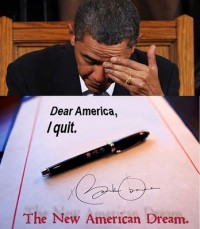
I always thought it was creepy the way Barack Hussein Obama has repeatedly referred to the likelihood of his being a one-term President. It is as if he knew, even as he campaigned in 2008, that all the loose ends and unanswered questions about his life would eventually disqualify him.
It is now widely acknowledged that the mainstream media ran interference for him, ignoring or disparaging those who questioned his eligibility.
After two and a half years in office, however, his arrogance and incompetence is so manifest that even they can no longer cover for him.
Obama has single handedly generated a mass political movement called the Tea Party and election results for governors and members of Congress have put opposition candidates into office.
On March 31, 1968, then-President Lyndon B. Johnson announced that he would not run for reelection, responding to the massive opposition to the war in Vietnam. On August 9, 1974, Richard M. Nixon announced his resignation in the wake of the Watergate scandal to avoid impeachment.
I predict that Barack Hussein Obama will resign before the end of his first term. He may well do so prior to the September 2012 Democratic Party convention.
Obama was never eligible to run for the office. In his book, “Where’s the Birth Certificate? The Case that Barack Obama is Not Eligible to be President”, Dr. Jerome R. Corsi, Phd, devotes 387 pages, complete with appendices and endnotes, to irrefutably make that case.
Anyone who reads Article 2, Section 1, of the Constitution, however, can make that case in less than a minute. Only a “natural born” individual whose both parents were American citizens can be President. Obama’s father was a citizen of Kenya. There is no dispute regarding what the Founders meant when they said “natural born.” Further clouding Obama’s eligibility is the time he spent in his youth in Indonesia as the adopted son of that nation’s nationality.
Corsi’s book explores all the other mysteries including a highly suspicious Social Security number, passports, and other documentation that any candidate for office would normally submit to public disclosure. A massive cover up that includes the national press corps, the Democratic Party, Congress and even the U.S. courts, permitted Obama to gain and hold the office.
Indeed, Corsi’s book is not the first to reveal the deceptions. At least three other books have meticulously examined the issue. They include “The Manchurian Candidate” by Aaron Klein with Brenda J. Elliot, “The Blueprint: Obama’s Plan to Subvert the Constitution and Build an Imperial Presidency” by Ken Blackwell and Ken Klukowski, and “The Post-American Presidency” by Pamela Geller with Robert Spencer.
Corsi, however, has the benefit of timing. As the nation enters the period following Obama’s announcement he is running for reelection and during the process of selecting a Republican opponent, the issue of his eligibility is gathering momentum.
The polling data is all against him. The failure of his policies, combined with the massive increase in the national debt, rising unemployment, the implosion of the housing market, and a growing perception of incompetence, are coalescing to give weight to the demand that he end his candidacy or resign.
“History has not been kind to U.S. Presidents that have attempted to hide behind a lie,” says Corsi.
When republics begin to ignore their founding documents, they are literally committing suicide and, in Obama’s case, it is an assisted suicide.
The recognized definition of a “natural born citizen”, a requirement to be President, does not require much more than common sense. In a May article published by Canada Free Press, Lawrence B. Solum, the John E. Cribbett Professor of Law at the University of Illinois College of Law, is quoted as having written in September 2008, “Anyone born on American soil whose parents are citizens of the United States is a natural born citizen.”
Ironically, in 2008, his political opponent, Sen. John McCain, whose both parents were Americans when he was born in Panama Canal Zone, was the subject of a Senate Resolution confirming his eligibility to run. The then-Democrat controlled Senate took up no such action regarding Obama. If they had, they would have had to hold a convention to pick a new candidate!
Lawrence Sellin, the author of the Canada Free Press article cited above, warned “Whether through cowardice or arrogance, both Republican and Democrats fail to appreciate the fact that ordinary Americans are reaching a tipping point. Imagine a Tea Party on steroids.”
“If the Constitutional crisis is not soon addressed, the present political polarization will inevitably lead to political fragmentation. Erosion of the Constitution will inevitably lead to the collapse of the rule of law.”
There is no documentation to support the myths about his life that Obama has carefully devised. Indeed, the President has reportedly spent millions to deny public access to his birth certificate and all other records.
If he resigns, he may be able to assert the legitimacy of every piece of legislation, every executive order, signed into law, but if he is found to have been ineligible, every one of them would become null and void.
The nation can be put right again as a Constitutional Republic. Obama has led an unlawful regime. America has been drunk on socialism since the 1930s. It’s time to sober up.
Breaking News - Congressman Issa Has Enough on Obama to Impeach
Breaking News - Congressman Issa Has Enough on Obama to Impeach

By Nicholas Contompasis
I've been waiting for this information for months. Most on the Right have suspected foul play by the President and his operatives. Now, Congressman Issa Republican from California finally has the goods on our President and his illegal activities with taxpayer dollars.
CONGRESSMAN DARRELL ISSA GETS RESULTS!!
Posted by Loretta A. Estrella, Moderator on June 16, 2011 at 8:11pm in Know Your Opposition
Congressman Darrell Issa has produced a shocking new report detailing the Obama administration’s extensive use of taxpayer-funded propaganda, which he says breaks federal law. The report created for the House Committee on Oversight and Government Reform details how the former Alinskyite community organizer has channeled the resources of the federal government — that is, your money — to create “a sophisticated propaganda and lobbying campaign” made up of “inappropriate and sometimes unlawful public relations and propaganda initiatives.” The highlights include:
Using federal arts grants to spread Obama’s legislative message. Last August 10, administration officials held a conference call with National Endowment of the Arts grant recipients. Buffy Wicks, a college radical who worked in Valerie Jarrett‘s Office of Public Engagement, told the invitees, “we’re going to come at you with some specific ‘asks’ here,” specifically supporting Obama’s initiatives on health care, the environment, or energy. She suggested, “We wanted folks to connect…with federal agencies, with labor unions, progressive groups, face groups [faith groups, perhaps?], women’s groups, you name it.” Within 48 hours, no fewer than 21 arts organizations released a statement endorsing ObamaCare.
The Dept. of Health and Human Services paid MIT economist Jonathan Gruber nearly $400,000 for various jobs. He did not disclose his employment by HHS while writing a string of op-eds, nor while testifying before the Senate in favor of, ObamaCare.
The Justice Dept. hired Tracy Russo, the former blogger for John Edwards, to comment on internet articles or bulletin board messages that criticized Barack Obama and his agenda. She did this anonymously or used a pen name.
A Dept. of Education officer used the White House email to send his colleagues eight bullet points to “communicate the merits of the President’s proposal with your members and their audiences.”
The federal government “highly recommended” constructing highway signs that tout big government and advertise politicians (Watch the committee’s video on the subject here http://www.impeachobamacampaign.com/video-of-the-day-you-pay-for-possibly-illegal-obama-propaganda/ )
Obama attempted to enlist “voluntary” Hollywood propaganda for his proposals through the iParticipate campaign. Here http://bighollywood.breitbart.com/jjmnolte/2009/10/15/leaked-memo-reveals-the-white-house-has-control-of-your-television-set/
Andy Griffith starred in a Medicare “update” that doubled as a commercial for Obama’s health care legislation. Not only is the PSAl propaganda, it is erroneous. A writer with the nonpartisan FactCheck.org remarked Griffith’s scripted “promise that ‘benefits will remain the same’ is just as fictional as the town of Mayberry.”
The White House routinely drove traffic to websites that lobby for Obama’s legislation.
You can read the full report here.
Issa cites three separate federal statutes violated by the Obama administration and has called for a Government Accountability Office (GAO) to launch an investigation. If violations of the law are found, impeachment could follow.
It’s not bad enough the president is a megalomaniac who skirts the law to foist his far-Left agenda on the American people — he also uses your money to do it.
Submitted by Git-R-Done 06/13/11, a great patriot. Breitbart & Western Journalism

By Nicholas Contompasis
I've been waiting for this information for months. Most on the Right have suspected foul play by the President and his operatives. Now, Congressman Issa Republican from California finally has the goods on our President and his illegal activities with taxpayer dollars.
CONGRESSMAN DARRELL ISSA GETS RESULTS!!
Posted by Loretta A. Estrella, Moderator on June 16, 2011 at 8:11pm in Know Your Opposition
Congressman Darrell Issa has produced a shocking new report detailing the Obama administration’s extensive use of taxpayer-funded propaganda, which he says breaks federal law. The report created for the House Committee on Oversight and Government Reform details how the former Alinskyite community organizer has channeled the resources of the federal government — that is, your money — to create “a sophisticated propaganda and lobbying campaign” made up of “inappropriate and sometimes unlawful public relations and propaganda initiatives.” The highlights include:
Using federal arts grants to spread Obama’s legislative message. Last August 10, administration officials held a conference call with National Endowment of the Arts grant recipients. Buffy Wicks, a college radical who worked in Valerie Jarrett‘s Office of Public Engagement, told the invitees, “we’re going to come at you with some specific ‘asks’ here,” specifically supporting Obama’s initiatives on health care, the environment, or energy. She suggested, “We wanted folks to connect…with federal agencies, with labor unions, progressive groups, face groups [faith groups, perhaps?], women’s groups, you name it.” Within 48 hours, no fewer than 21 arts organizations released a statement endorsing ObamaCare.
The Dept. of Health and Human Services paid MIT economist Jonathan Gruber nearly $400,000 for various jobs. He did not disclose his employment by HHS while writing a string of op-eds, nor while testifying before the Senate in favor of, ObamaCare.
The Justice Dept. hired Tracy Russo, the former blogger for John Edwards, to comment on internet articles or bulletin board messages that criticized Barack Obama and his agenda. She did this anonymously or used a pen name.
A Dept. of Education officer used the White House email to send his colleagues eight bullet points to “communicate the merits of the President’s proposal with your members and their audiences.”
The federal government “highly recommended” constructing highway signs that tout big government and advertise politicians (Watch the committee’s video on the subject here http://www.impeachobamacampaign.com/video-of-the-day-you-pay-for-possibly-illegal-obama-propaganda/ )
Obama attempted to enlist “voluntary” Hollywood propaganda for his proposals through the iParticipate campaign. Here http://bighollywood.breitbart.com/jjmnolte/2009/10/15/leaked-memo-reveals-the-white-house-has-control-of-your-television-set/
Andy Griffith starred in a Medicare “update” that doubled as a commercial for Obama’s health care legislation. Not only is the PSAl propaganda, it is erroneous. A writer with the nonpartisan FactCheck.org remarked Griffith’s scripted “promise that ‘benefits will remain the same’ is just as fictional as the town of Mayberry.”
The White House routinely drove traffic to websites that lobby for Obama’s legislation.
You can read the full report here.
Issa cites three separate federal statutes violated by the Obama administration and has called for a Government Accountability Office (GAO) to launch an investigation. If violations of the law are found, impeachment could follow.
It’s not bad enough the president is a megalomaniac who skirts the law to foist his far-Left agenda on the American people — he also uses your money to do it.
Submitted by Git-R-Done 06/13/11, a great patriot. Breitbart & Western Journalism
First Cairo Egypt And Now Washington DC: Tent City Occupation Begins Oct. 6, 2011
First Cairo Egypt And Now Washington DC: Tent City Occupation Begins Oct. 6, 2011
By Liam Fox
 Finally, a large, and rapidly growing, coalition of left wing and progressive activists, and organizations, is coming together with a clear and united platform. Hundreds of thousands are expected to descend on DC this coming October, 111 days from now, not just to march in a permitted parade and then return home, but to stay and occupy Freedom Plaza indefinitely, until their demands have been met.
The Bonus Army, made up of WWI veterans, did precisely this in 1932 so that they could be paid the money that the government owed them for their service, performed more than a decade earlier, and be able to feed their families during the horrible early years of the Great Depression. They were met with violence from the police and two of the veterans latter died from their wounds. The army was also called in and the protest was finally put down after almost six weeks.
 In 1968, Dr. Martin Luther King Junior was on his way to a permanent tent city being established on the Capitol grounds in Washington, called Resurrection City, as part of his ‘Poor Peoples’ campaign. He was murdered while in Memphis, on his way to the event. After his murder, the army was used to clear the demonstrators and their tent city.

 Both of these prior events share fundamental principles with the October 2011 action. Illegal foreign wars, high unemployment, cuts to services and wages while increasing costs and taxes, and corporate influence over political institutions and policies are just as current today as they were at either of those times.
Wage disparity is worse than ever. Jobs are being lost, benefits cut, and homes foreclosed on while the financial elite are boasting record profits. The politicians they’ve paid for are busy stripping away any rules, regulations, and responsible taxation, in return for campaign donations and lucrative post-public-office positions. Plainly speaking, it’s the politician’s jobs to hold us down while Big-Finance, Big-Business, and any other well-heeled special interest with an army of lobbyists rapes us, robs us, and rolls us.
There is a nonviolence pledge that all participants are asked to sign even though it can be expected that the DC police, and the Federal Security Forces, are unlikely to have any such pledge of their own. Information and tips regarding peaceful civil disobedience, your rights, and your responsibilities, will be shared as the event approaches both at the main site as well as in regular updates here at News Junkie Post.
The left has been slow in their response to the loud rantings of the extreme right. A unified and focused effort that brings all those with shared fundamental principles together has taken some time to organize, but that time is here. In One Hundred Eleven days, on October 6, America will show up on the lawns of the Capitol and will not move until they have been heard, and the appropriate responses are forthcoming.
 The October2011 site states;
“October 2011 is the 10th anniversary of the invasion of Afghanistan and the beginning of the 2012 federal austerity budget. It is time to light the spark that sets off a true democratic, nonviolent transition to a world in which people are freed to create just and sustainable solutions.”
The event beginning October 6 is endorsed by a growing list of participating organizations that include ANSWER, Backbone Campaign, FireDogLake, The Green Party USA, Progressive Democrats of America, Single Payer Action, Veterans for Peace, War is a Crime, Food Not Bombs, Ted Rall – author of The Anti-American Manifesto, Code Pink, World Can’t Wait, United National Antiwar Committee, National Campaign for Nonviolent Resistance, and many more. In addition to these organizations, there are currently more than twenty media outlets besides NewsJunkiePost.com that will be covering and carrying this event and all related and relevant information.
Also from the October2011 site;
“Previous demonstrations were one-day events which were simple for the Administration and Congress to ignore” Margaret Flowers, another organizer, told me. “The large demonstrations usually happened on weekends when there was little going on in Washington. “This is different because it is an occupation that begins on a Thursday, a day of business, and will continue.”
They will keep the heat on. “We intend to stay and to have waves of nonviolent civil resistance. The time for symbolic actions has ended. Too many people are suffering and dying here and around the world because of the policies of this nation. The planet is suffering because of the policies of this nation. This government has demonstrated that it is incapable of acting in the best interests of the people and planet. We say that this is unacceptable and we will stay and resist until this changes,” Flowers said.
The goal of the protest can be found in this excerpt from the pledge found on the October2011 site;
“I pledge that if any U.S. troops, contractors, or mercenaries remain in Afghanistan on Thursday, October 6, 2011, as that occupation goes into its 11th year, I will commit to being in Freedom Plaza in Washington, D.C.,…where we will NONVIOLENTLY resist the corporate machine until our resources are invested in human needs and environmental protection instead of war and exploitation…”
The question of ‘if’ it’s going to happen is already settled; comprehensive planning by a large and committed coalition has ensured that. The goal is to sustain the action for as long as it takes. Pack small, pack smart, and pack to make it last. The action will begin during the beautiful low 70′s weather of early October in DC, but the hints of winter will only be a few weeks off. As a group, problem solving can be done as things develop, but, preparation can save a lot of frustration and strengthen the groups morale and resolve.
 We have seen the response to such demonstrations in Egypt, Bahrain, Yemen, and Syria. One always hopes that their own government will be more civil, and more democratic, and, indeed, this is everyone’s hope. But, make your back-up plans, contact plans, bail contacts, emergency numbers, etc. Good planning and preparation are what will ensure success.
A volunteers list is already being organized through October2011.org to manage logistics and supplies. Transportation programs are also available at the October2011.org site. A method for receiving donations has already been established and, it too, can be accessed through the October2011 site. Bookmark their page and check back here for any further details as they are available.
Mark your calendars: October 6, 2011, 111 days from today. Arrange to have the time off; as much as possible but preferably for the duration. I’ll see everyone there.
‘Like’ October2011′s brand new Facebook Page and ‘Follow’ the Twitter Hashtag #October2011 !

By Liam Fox

The Bonus Army, made up of WWI veterans, did precisely this in 1932 so that they could be paid the money that the government owed them for their service, performed more than a decade earlier, and be able to feed their families during the horrible early years of the Great Depression. They were met with violence from the police and two of the veterans latter died from their wounds. The army was also called in and the protest was finally put down after almost six weeks.


Wage disparity is worse than ever. Jobs are being lost, benefits cut, and homes foreclosed on while the financial elite are boasting record profits. The politicians they’ve paid for are busy stripping away any rules, regulations, and responsible taxation, in return for campaign donations and lucrative post-public-office positions. Plainly speaking, it’s the politician’s jobs to hold us down while Big-Finance, Big-Business, and any other well-heeled special interest with an army of lobbyists rapes us, robs us, and rolls us.
There is a nonviolence pledge that all participants are asked to sign even though it can be expected that the DC police, and the Federal Security Forces, are unlikely to have any such pledge of their own. Information and tips regarding peaceful civil disobedience, your rights, and your responsibilities, will be shared as the event approaches both at the main site as well as in regular updates here at News Junkie Post.
The left has been slow in their response to the loud rantings of the extreme right. A unified and focused effort that brings all those with shared fundamental principles together has taken some time to organize, but that time is here. In One Hundred Eleven days, on October 6, America will show up on the lawns of the Capitol and will not move until they have been heard, and the appropriate responses are forthcoming.

“October 2011 is the 10th anniversary of the invasion of Afghanistan and the beginning of the 2012 federal austerity budget. It is time to light the spark that sets off a true democratic, nonviolent transition to a world in which people are freed to create just and sustainable solutions.”
The event beginning October 6 is endorsed by a growing list of participating organizations that include ANSWER, Backbone Campaign, FireDogLake, The Green Party USA, Progressive Democrats of America, Single Payer Action, Veterans for Peace, War is a Crime, Food Not Bombs, Ted Rall – author of The Anti-American Manifesto, Code Pink, World Can’t Wait, United National Antiwar Committee, National Campaign for Nonviolent Resistance, and many more. In addition to these organizations, there are currently more than twenty media outlets besides NewsJunkiePost.com that will be covering and carrying this event and all related and relevant information.
Also from the October2011 site;
“Previous demonstrations were one-day events which were simple for the Administration and Congress to ignore” Margaret Flowers, another organizer, told me. “The large demonstrations usually happened on weekends when there was little going on in Washington. “This is different because it is an occupation that begins on a Thursday, a day of business, and will continue.”
They will keep the heat on. “We intend to stay and to have waves of nonviolent civil resistance. The time for symbolic actions has ended. Too many people are suffering and dying here and around the world because of the policies of this nation. The planet is suffering because of the policies of this nation. This government has demonstrated that it is incapable of acting in the best interests of the people and planet. We say that this is unacceptable and we will stay and resist until this changes,” Flowers said.
The goal of the protest can be found in this excerpt from the pledge found on the October2011 site;
“I pledge that if any U.S. troops, contractors, or mercenaries remain in Afghanistan on Thursday, October 6, 2011, as that occupation goes into its 11th year, I will commit to being in Freedom Plaza in Washington, D.C.,…where we will NONVIOLENTLY resist the corporate machine until our resources are invested in human needs and environmental protection instead of war and exploitation…”
The question of ‘if’ it’s going to happen is already settled; comprehensive planning by a large and committed coalition has ensured that. The goal is to sustain the action for as long as it takes. Pack small, pack smart, and pack to make it last. The action will begin during the beautiful low 70′s weather of early October in DC, but the hints of winter will only be a few weeks off. As a group, problem solving can be done as things develop, but, preparation can save a lot of frustration and strengthen the groups morale and resolve.

A volunteers list is already being organized through October2011.org to manage logistics and supplies. Transportation programs are also available at the October2011.org site. A method for receiving donations has already been established and, it too, can be accessed through the October2011 site. Bookmark their page and check back here for any further details as they are available.
Mark your calendars: October 6, 2011, 111 days from today. Arrange to have the time off; as much as possible but preferably for the duration. I’ll see everyone there.
‘Like’ October2011′s brand new Facebook Page and ‘Follow’ the Twitter Hashtag #October2011 !

Subscribe to:
Posts (Atom)