Much of Sarah Palin's outreach since the 2008 election has been through social media -- Facebook and Twitter -- with considerable impact.
Now it looks as though the documentary about her, "The Undefeated," has sought success with a similar strategy.
Directed and written by Stephen K. Bannon, the film opened this weekend in AMC Theatres in 10 selected digital markets -- the closest to Los Angeles being the city of Orange in Orange County -- going up against the opening of perhaps the biggest film of the summer, the final installment in the "Harry Potter" series.
According to a release Sunday from distributor ARC Entertainment, which partnered with digital distributor Cinedigm, the film grossed approximately $5,000 per screen through Saturday night, with "large markets trending towards weekend per screen averages above $10,000."
That's quite modest by Hollywood standards, but the rollout was booked quickly over three weeks, with marketing carried out through word-of-mouth and low-cost social media.
The release quotes Jill Newhouse Calcaterra, the chief marketing officer for Cinedigm, saying, " 'The Undefeated' is the perfect example of how digital cinema can benefit both producers and audiences. Starting with theater location selection, we worked quickly -- with precision accuracy -- to generate a terrific box-office result with virtually no marketing dollars.
"This is a new model that is going to benefit the entire entertainment industry and audiences who want to see unique products."
Palin remains in Alaska, on call for jury duty through the end of July, and it's unclear if the response to "The Undefeated" will affect her decision on whether to seek the GOP 2012 presidential nomination.
Although it's unlikely that many who are opposed to a Palin candidacy will queue up for the movie (unless it's their political or media job to do so), the film has the potential of moving the needle one way or the other among GOP voters and independents, as reaction spreads through conservative blogs and mainstream media outlets.
Below is an email Q&A conducted Sunday morning with Bannon.
Top of the Ticket: How do the opening-weekend figures stack up against your expectations (or hopes)?
Bannon: This was a high-risk strategy -- one I don't remember ever being attempted -- to open a documentary nationwide in such disparate markets with only 4 weeks prep with no media spend. And it paid off. Why -- we had distribution partners at ARC and Cinedigm that knew what they were doing and a theater chain that knows how to handle specialty film.
I thought $5k/screen would have been amazing ... and $10k a home run. We will be above $10k in key markets ... and all markets performed well.
Ticket: A story appeared in which a reporter talked about being in a empty theater at a just-after-midnight showing Thursday night into Friday, in Orange County. Do you think that story has any impact, good or bad, on your weekend attendance?
Bannon: The story had zero impact on anything ... and I never focus on nonsense. ... OC numbers were huge ... incredible numbers considering the competition there.
Ticket: How were the selected markets chosen?
Bannon: ARC/Cinedigm did analysis about a wide range of targets they felt could help launch, and they picked right.
Ticket: Based on the opening-weekend figures, what is your future roll-out plan?
Bannon: ARC/Cinedigm will announce tomorrow, but the film will now get rolled out over the next few weeks.
Ticket: The DVD is currently available those who contribute $100 or more to SarahPAC. Are there any TV or other DVD distribution deals in the works?
Bannon: We are focused on theatrical, but the strong reaction to the film means we are going to make deals to get the film everywhere.
Ticket: Big Hollywood.com conservative contributor Ben Howe of RedState.com said seeing the movie strongly affected his opinion of Palin. Did you intend the movie to be a political game-changer?
Bannon: I intended the film to tell the story of one of America's great leaders. The audience reaction means I think we are helping to let folks see her real narrative.
Ticket: Critics listed at Rotten Tomatoes have generally referred to the movie as "hagiography" or "propaganda," and some reporters have criticized the omission of familiar incidents from the 2008 campaign, such as the much-discussed Katie Couric interview. How do you respond to that?
Bannon: The critics talk about the marginalia of what I left out while acknowledging her [Palin's] great accomplishments. I will take that trade all day long.
Ticket: Do you have another project in mind?
Bannon: All my projects I do in secret, but it involves the continual crisis of America's financial collapse.
Note: we checked with the AMC 30 at the Block in Orange on Friday night, and the manager said the 7 p.m. show was sold out through advance ticket sales, with "small amounts" sold in advance at that point for showings through the weekend.
Another check Sunday revealed no other sold-out shows, and when asked to characterize the ticket sales, the manager said the film was "lost" amid the "Harry Potter" excitement. The AMC 30 will know Tuesday whether "The Undefeated" will get a second weekend.
Monday, July 18, 2011


`Cash Cab' taxi hits, kills Vancouver pedestrian
VANCOUVER, British Columbia (AP) — A replica taxi used in the Canadian version of the TV game show "Cash Cab" struck and killed a pedestrian after finishing production for the day in Vancouver.
Vancouver Police said a 61-year-old man from Surrey, B.C., died in a hospital shortly after being struck by the mock yellow cab late Friday night in the city's Downtown Eastside district. Police did not immediately release the victim's identity.
The accident happened as a producer was driving the replica cab back to a storage facility after filming for the day had been completed, said Andrew Burnstein, president of Castlewood Productions Inc., which produces the show's Canadian version.
"Our thoughts and prayers are with the victim and his friends and his family." said Burnstein. "My heart also goes out to the driver of the vehicle, a member of our technical staff, who is shaken and devastated by this tragic accident, as is our entire team."
Vancouver Police Constable Lindsey Houghton said the circumstances leading to the accident were still being determined and no charges have been filed so far.
On "Cash Cab," broadcast in North America on the Discovery Channel, unassuming people who flag down a replica yellow taxi become instant contestants on a game show, answering trivia questions for cash prizes.
"Cash Cab" originated in Britain in 2005 and has since been licensed to television networks in more than two dozen countries. The Canadian version, hosted by comedian Adam Growe, a licensed taxi driver, has been broadcast by Discovery Channel Canada since 2008.
The U.S. version, now filmed in New York and Chicago, has been broadcast on the Discovery Channel since 2005.
Vancouver Police said a 61-year-old man from Surrey, B.C., died in a hospital shortly after being struck by the mock yellow cab late Friday night in the city's Downtown Eastside district. Police did not immediately release the victim's identity.
The accident happened as a producer was driving the replica cab back to a storage facility after filming for the day had been completed, said Andrew Burnstein, president of Castlewood Productions Inc., which produces the show's Canadian version.
"Our thoughts and prayers are with the victim and his friends and his family." said Burnstein. "My heart also goes out to the driver of the vehicle, a member of our technical staff, who is shaken and devastated by this tragic accident, as is our entire team."
Vancouver Police Constable Lindsey Houghton said the circumstances leading to the accident were still being determined and no charges have been filed so far.
On "Cash Cab," broadcast in North America on the Discovery Channel, unassuming people who flag down a replica yellow taxi become instant contestants on a game show, answering trivia questions for cash prizes.
"Cash Cab" originated in Britain in 2005 and has since been licensed to television networks in more than two dozen countries. The Canadian version, hosted by comedian Adam Growe, a licensed taxi driver, has been broadcast by Discovery Channel Canada since 2008.
The U.S. version, now filmed in New York and Chicago, has been broadcast on the Discovery Channel since 2005.
Obama picks ex-Ohio AG to lead consumer agency
WASHINGTON (AP) — Reigniting a partisan fight over banking regulations, President Barack Obama intends to nominate former Ohio Attorney General Richard Cordray to lead a consumer protection bureau that was a central feature of a law overhauling the rules that govern the financial sector.
Obama plans to announce the nomination formally on Monday, the White House said Sunday. Republicans immediately threatened to block Cordray's Senate confirmation.
In choosing Cordray, Obama bypassed Elizabeth Warren, a favorite of consumer groups, who has been assembling the agency as a special adviser to the White House and to Treasury Secretary Timothy Geithner.
The Consumer Financial Protection Bureau will officially begin its oversight and regulatory work on July 21. Its role is to be a government watchdog over mortgages, credit cards and other forms of lending.
"Richard Cordray has spent his career advocating for middle-class families, from his tenure as Ohio's attorney general, to his most recent role as heading up the enforcement division at the CFPB and looking out for ordinary people in our financial system," Obama said in a statement.
Sen. Tim Johnson, D-S.D., chairman of the Senate Committee on Banking, Housing and Urban Affairs, promised Sunday, "I will move Mr. Cordray's nomination forward in the Banking Committee as quickly as possible."
Warren, who is considered the architect of the consumer bureau, faced stiff Republican opposition in the Senate and would have had a difficult time wining confirmation.
The financial industry lined up against Warren. Bankers said a Warren-run agency would restrict new products just when companies are seeking to replace profits squeezed by the new financial rules.
Sen. Richard Shelby of Alabama, the top Republican on the Banking committee, said Republicans would block Cordray as well unless Obama seeks changes in the agency.
"Until President Obama addresses our concerns by supporting a few reasonable structural changes, we will not confirm anyone to lead it," Shelby said. "No accountability, no confirmation."
Cordray's elevation from enforcement chief to director raises a separate concern for the industry: Some fear the agency will launch early enforcement actions designed to raise its public profile. Treasury officials said that's unlikely, because the agency's enforcement division still is making key decisions about policy and procedure.
Cordray, 52, is considered a Warren ally and has been working with her as director of enforcement for the agency.
"He will make a stellar director," Warren said of Cordray.
Republicans fought fiercely against the creation of the bureau last year and have been trying to place restrictions on the agency. In May, all Senate Republicans joined in a letter to Obama threatening to withhold their support for any nominee to the position if the White House didn't seek significant changes to the agency.
Among the changes would be to replace a single director with a board and to make the bureau's finances subject to congressional approval.
Though Democrats control the Senate, Republicans could block Cordray's appointment through a filibuster.
"I remain hopeful that those who want to cripple this consumer bureau will think again and remember that the financial crisis — and the recession and job losses that it sparked — began one lousy mortgage at a time," Warren said in a statement Sunday.
Rep. Barney Frank, D-Mass., who shepherded the financial regulation bill through the House last year as the chairman of the House Financial Services Committee, said he regretted that Warren had "fallen victim to such wholly unjustified political attacks."
But Frank praised Cordray and said, "There is no excuse for Senate Republicans to refuse to confirm Richard Cordray given his clear qualifications for this job."
The Progressive Change Campaign Committee, which had backed Warren, issued a statement supporting Cordray.
"With her track record of standing up to Wall Street and fighting for consumers, Elizabeth Warren was the best qualified to lead this bureau that she conceived — and we imagine Richard Cordray would agree," said the committee's co-founder, Stephanie Taylor. "That said, Rich Cordray has been a strong ally of Elizabeth Warren's and we hope he will continue her legacy of holding Wall Street accountable."
But consumer advocate and one-time presidential candidate Ralph Nader called bypassing Warren "an act of political cowardliness by President Obama."
"Elizabeth Warren apparently is just too good, too smart, too able to arouse the just concerns of millions of American families over the need to put the law-and-order wood to the corporate criminals, defrauders and reckless speculators," Nader said.
Treasury Secretary Timothy Geithner credited Warren for recruiting staff for the consumer bureau and for her efforts to simplify mortgage disclosure, improve credit card transparency and protect military families from lending abuses.
Johnson added, "The CFPB is off to a strong start promoting an equitable and transparent consumer financial market place, and that is due in large part to the leadership of Elizabeth Warren."
Warren wants to remain a public advocate on consumer issues including abuses by mortgage servicing companies that have foreclosed illegally on military families and others, according to people familiar with her thinking.
She has felt constrained from speaking out as a White House appointee and looks forward to the freedom she will enjoy when she returns to being a Harvard Law School professor, said those familiar with her plans. They spoke on condition of anonymity to describe private conversations.
In pushing for changes in financial regulations last year, Obama focused on the popular appeal of a consumer bureau, which he had proposed as an independent agency. It was during that debate that Obama referred to bankers as "fat cats," a characterization he has since abandoned.
The regulatory overhaul was a response to the financial crisis of 2008 that helped plunge the country into a recession.
In a compromise, the consumer agency was placed within the Federal Reserve, but will act autonomously from the central bank.
In his statement, Obama thanked Warren "for her many years of impassioned leadership, and her fierce defense of a simple idea: ordinary people deserve to be treated fairly and honestly in their financial dealings."
Obama also said, "This agency was Elizabeth's idea, and through sheer force of will, intelligence, and a bottomless well of energy, she has made, and will continue to make, a profound and positive difference for our country."
Obama plans to announce the nomination formally on Monday, the White House said Sunday. Republicans immediately threatened to block Cordray's Senate confirmation.
In choosing Cordray, Obama bypassed Elizabeth Warren, a favorite of consumer groups, who has been assembling the agency as a special adviser to the White House and to Treasury Secretary Timothy Geithner.
The Consumer Financial Protection Bureau will officially begin its oversight and regulatory work on July 21. Its role is to be a government watchdog over mortgages, credit cards and other forms of lending.
"Richard Cordray has spent his career advocating for middle-class families, from his tenure as Ohio's attorney general, to his most recent role as heading up the enforcement division at the CFPB and looking out for ordinary people in our financial system," Obama said in a statement.
Sen. Tim Johnson, D-S.D., chairman of the Senate Committee on Banking, Housing and Urban Affairs, promised Sunday, "I will move Mr. Cordray's nomination forward in the Banking Committee as quickly as possible."
Warren, who is considered the architect of the consumer bureau, faced stiff Republican opposition in the Senate and would have had a difficult time wining confirmation.
The financial industry lined up against Warren. Bankers said a Warren-run agency would restrict new products just when companies are seeking to replace profits squeezed by the new financial rules.
Sen. Richard Shelby of Alabama, the top Republican on the Banking committee, said Republicans would block Cordray as well unless Obama seeks changes in the agency.
"Until President Obama addresses our concerns by supporting a few reasonable structural changes, we will not confirm anyone to lead it," Shelby said. "No accountability, no confirmation."
Cordray's elevation from enforcement chief to director raises a separate concern for the industry: Some fear the agency will launch early enforcement actions designed to raise its public profile. Treasury officials said that's unlikely, because the agency's enforcement division still is making key decisions about policy and procedure.
Cordray, 52, is considered a Warren ally and has been working with her as director of enforcement for the agency.
"He will make a stellar director," Warren said of Cordray.
Republicans fought fiercely against the creation of the bureau last year and have been trying to place restrictions on the agency. In May, all Senate Republicans joined in a letter to Obama threatening to withhold their support for any nominee to the position if the White House didn't seek significant changes to the agency.
Among the changes would be to replace a single director with a board and to make the bureau's finances subject to congressional approval.
Though Democrats control the Senate, Republicans could block Cordray's appointment through a filibuster.
"I remain hopeful that those who want to cripple this consumer bureau will think again and remember that the financial crisis — and the recession and job losses that it sparked — began one lousy mortgage at a time," Warren said in a statement Sunday.
Rep. Barney Frank, D-Mass., who shepherded the financial regulation bill through the House last year as the chairman of the House Financial Services Committee, said he regretted that Warren had "fallen victim to such wholly unjustified political attacks."
But Frank praised Cordray and said, "There is no excuse for Senate Republicans to refuse to confirm Richard Cordray given his clear qualifications for this job."
The Progressive Change Campaign Committee, which had backed Warren, issued a statement supporting Cordray.
"With her track record of standing up to Wall Street and fighting for consumers, Elizabeth Warren was the best qualified to lead this bureau that she conceived — and we imagine Richard Cordray would agree," said the committee's co-founder, Stephanie Taylor. "That said, Rich Cordray has been a strong ally of Elizabeth Warren's and we hope he will continue her legacy of holding Wall Street accountable."
But consumer advocate and one-time presidential candidate Ralph Nader called bypassing Warren "an act of political cowardliness by President Obama."
"Elizabeth Warren apparently is just too good, too smart, too able to arouse the just concerns of millions of American families over the need to put the law-and-order wood to the corporate criminals, defrauders and reckless speculators," Nader said.
Treasury Secretary Timothy Geithner credited Warren for recruiting staff for the consumer bureau and for her efforts to simplify mortgage disclosure, improve credit card transparency and protect military families from lending abuses.
Johnson added, "The CFPB is off to a strong start promoting an equitable and transparent consumer financial market place, and that is due in large part to the leadership of Elizabeth Warren."
Warren wants to remain a public advocate on consumer issues including abuses by mortgage servicing companies that have foreclosed illegally on military families and others, according to people familiar with her thinking.
She has felt constrained from speaking out as a White House appointee and looks forward to the freedom she will enjoy when she returns to being a Harvard Law School professor, said those familiar with her plans. They spoke on condition of anonymity to describe private conversations.
In pushing for changes in financial regulations last year, Obama focused on the popular appeal of a consumer bureau, which he had proposed as an independent agency. It was during that debate that Obama referred to bankers as "fat cats," a characterization he has since abandoned.
The regulatory overhaul was a response to the financial crisis of 2008 that helped plunge the country into a recession.
In a compromise, the consumer agency was placed within the Federal Reserve, but will act autonomously from the central bank.
In his statement, Obama thanked Warren "for her many years of impassioned leadership, and her fierce defense of a simple idea: ordinary people deserve to be treated fairly and honestly in their financial dealings."
Obama also said, "This agency was Elizabeth's idea, and through sheer force of will, intelligence, and a bottomless well of energy, she has made, and will continue to make, a profound and positive difference for our country."
An Alien Pod Person in a Room Full of Leftists

I hear Berkeley is bad, and Madison is the only place I’ve ever seen one-person protest marches, but here in New York things are intense. It is a given that the political right is a cartoon pig who will do anything for money and wants everyone who isn’t a cartoon pig to die. The End. Nobody has ever questioned this and every time I do, it creates a hole in the space-time continuum that swallows the entire universe, or at least ruins the party.
During a break while I was working on a travel show recently, Anthony Bourdain was sitting at the lunch table and mentioned he’d like to skin Glenn Beck alive. Everyone nodded as if he’d said he enjoys tiramisu. I kept my mouth shut. A few months earlier I was in a similar environment when a cameraman casually mentioned he’d like to “kick Sarah Palin in the cunt.” This got the same placid reaction and when I begged to differ, it started a two-hour argument that ruined everybody’s day. That’s the problem with grazing amid a leftist herd. You’re constantly on the edge of a huge argument.
But when you don’t say anything, you hate yourself. I was on vacation in Mexico with a group consisting mostly of comedy writers, and a conversation began about Al Gore’s wonderfulness. I kept my mouth shut because I didn’t want to bum everyone out (especially my wife), but I didn’t sleep well that night and it still bothers me.
During a dinner party in Maine, the hostess told us a bunch of Internet rednecks ruined the immigration-reform bill on which she’d been working. I confessed I was one of said rednecks, and a nice dinner turned into a nice big fight that ended the night early. As everyone angrily grabbed their coats, the host said to my wife, “Your husband is a big bore,” and we haven’t been invited back, but I have no regrets about that night.
How did we get to this point? The way I remember things, the left used to be the chin-scratching, idea-weighing side where dissent was encouraged. I don’t think my views have changed. I still hate the government and despite the laughter it brings, I’d still call myself a feminist. The problem is, when the president is black and the fanatics who are oppressing women are brown, it’s racist to complain about the government and religion. The left went from thinking outside the box to becoming myopically fixated on anything that sounds mean or benefits “white males” (AKA someone who reminds them of dad). What remains is a sea of knee-jerk liberals who aren’t just intolerant of other points of view, they literally can’t handle the truth.
I don’t get that from the other side. Maybe it’s because the so-called conservatives I know live in the eye of the storm, but if you say something to William McGowan or Peter Brimelow or John Carney or even Jared Taylor that totally contradicts their beliefs, they’re as polite as British butlers. They’ve usually heard the point before and after a nod will say, “Yeah, but…” followed by a calm and reasonable explanation of why they think I’m wrong. When they say something about our Lord Jesus Christ, I don’t have to wonder whether I’m dropping a neutron bomb on the evening by disagreeing. I just speak my mind. Isn’t that was conversations are all about? Isn’t that what makes us superior to animals? It’s not genes that got us here, it’s memes. While monkeys scream oooh-eeeh-aaah-aah to no avail, we say to our fellow cavemen, “Stay away from saber-toothed tigers. I just saw them eat some dude.”
Last Saturday, I was staying with an old friend in Hudson, NY, and he had a bunch of people over who were mostly fellow musicians and filmmakers. I was in a room full of artistes whom I didn’t know and was regaling them with stories of having sex after having kids because most of them were still single and thought it was funny. Things were going swimmingly until I made the mistake of bringing up The New York Times and how they are so anti-family they pretend homosexuals banging in a parking lot are just like the dads in the same parking lot taking their kids to soccer games. This led the conversation to the Times’ glowing review of Mark Ruffalo’s anti-normal-family movie The Kids Are All Right, and one of the women at the party mentioned her film company is presenting Ruffalo an award next week for his grassroots work in the fight against fracking. Uh-oh. Here we go again.
“Oh yeah, fracking,” I said. “That horrible thing that gives us 90% of our natural gas.” A filmmaker there named Tony laughed because he assumed I was kidding, but when I assured I him I was serious he said, “Wait, do you believe in global warming?” What happened next is what happens every time you depart from orthodoxy: group panic. We’ve all been there. You don’t want to wreck everyone’s good time and you wish everyone could keep cool, but allowing their hysteria to censor you is ridiculous, so you open your big mouth. “I’m dubious,” I said. He didn’t believe me. I assured him I wasn’t kidding. He remained skeptical. I finally convinced him I wasn’t playing devil’s advocate.
Bang! Tony is up on his feet and his finger is in my face. (They always do that.) “Do you realize that 60% of this country believes in creationism? That’s who you’re associating yourself with. Do you believe in creationism, too?” I stood up and tried to explain the logical fallacy of guilt by association, but now his wife and two other people were standing and finger-pointing, too. “Don’t you think it’s strange that the science against global warming is all funded by oil companies?” Then they did this thing liberals do where they make a sarcastic idiot face with their finger on their chin and say, “Hmm, I wonder why that could be? Gee, I guess they care about science. Yeah, that’s it.” I had to yell to be heard at this point and kept saying, “I don’t care who’s saying it or what anyone’s motive is to say anything. John Wayne Gacy can tell me murder is wrong, and it’s still wrong. All I care about is the facts.” I told them Hitler used toilet paper but that doesn’t mean we’re tied in with his shit just because we use it, too. I even yelled, “All cats are mammals. All dogs are mammals. All cats are not dogs.” But I couldn’t get a word in edgewise. This screaming match wasn’t meant to get to the truth. It was meant to wake me up from being an ignorant heretic who’d chosen the Dark Side. They allowed zero possibility I knew what I was talking about. I disagreed with them and therefore I was ignorant.
“The past ten years have shown the hottest days in history,” someone yelled, and I said that even if that was true it’s totally irrelevant when we’re talking about a planet that is billions of years old. I said the hottest day on record was a hundred years ago and they used to grow grapes in Scotland. It annoyed me that everyone was getting their facts from a movie. Why are they ready to take on the world after watching TV for an hour and a half? A woman yelled, “Well, I’d take Al Gore over Ann Coulter any day,” and everyone laughed enthusiastically in agreement.
“Why?” I asked. “Because he flies all over the country in his private jet using more fuel than any of us will in our entire lives?” Allegations were coming at me like villagers attacking Frankenstein. “It’s about the ideas, not the person,” someone barked. I couldn’t even see who was saying what. I noticed that a young black kid seemed to be the only one interested in hearing both sides. “Not one person in this room has read one sentence by Ann Coulter,” I chastised them. “Her books are clear and calm and crammed with footnotes.” This made everyone guffaw and I have no idea why. What’s so funny about footnotes?
“Fine!” I yelled during a break in the shouting. “Explain this to me, then: Why is it life expectancy—not just here but everywhere on Earth—has been on a steady climb since we began recording it?”
“Not anymore,” Tony hollered back. “America’s just started to go down.” The beauty of arguing in 2011 is that Google is never far away. “All right,” I said, “let’s just choose that one random statement to do a fact check.” I went over to the computer and began sifting through the piles of confusing results you get when looking up average human lifespan, but the pages were taking forever to load. This left me vulnerable because my back was to the mob and they pounced.
“You KNOW things are getting worse,” Tony’s wife yelled. “Everything is getting more polluted and we’re running out of fuel. We can’t sustain this culture!”
“We’ve always been screaming that,” I replied without screaming. “Nietzsche said we were doomed. Then it was nuclear war with the Russians. They said we were out of oil in the 1970s. This ‘sky is falling’ mentality is a huge part of what defines Western culture.”
Every time I made a good point like that, the argument completely changed course. This is not how a good discussion operates; it’s more like a strategic battle. “You have kids,” Tony yelled in my face. “You want them to go to war fighting for oil? You want them to die because we don’t have energy solutions here?” This is one of the few times I got genuinely angry and told him never to mention my fucking kids in an argument again. Liberals always have to make it personal.
Tony sat down and his wife took over to calm things down. “Look,” she said in her best maternal voice, “he’s not trying to manipulate you using your kids.” I told her that’s exactly what he’s trying to do and she said, “He’s just saying we need to find another solution.” I told the room we were trying to do that with natural gas, but that they shut it down because there was an accident: “We can’t have coal or oil and you won’t allow natural gas, so what does that leave?”
Tony stood back up and explained the merits of wind and solar power. Germany was doing well with wind, and his house was now completely solar. I commended both him and Germany but said these tiny solutions are decades from doing anything substantial and it would involve a massive infrastructure. “Who’s going to build it?” I asked.
“The government,” Tony responded. “We need to force the government to stop doing whatever the oil companies tell them to do and we need them to start creating green jobs.” I was flabbergasted. “The fact that you think the government can do ANYTHING right—let alone create an entire workforce out of thin air—baffles me,” I said. Things were finally dying down because we were getting to some inexorable differences. “What happened to you?” the host asked. “We used to be punks. We used to hate corporations.”
“I still do!” I said incredulously. “But I hate the government more. At least big business provides a service for the money they take from me and at least they don’t tell us how to live our lives.” Everyone in the room was exhausted and there was no going back to a casual party, so they all started to gather their stuff to leave. “If you don’t know that big business is the lesser of the two evils,” I told them all, “I don’t know what to tell you.”
As people headed for the door, the black kid who had remained quiet finally said, “So what was the result with the lifespan?” People rolled their eyes and waited by the front door as Tony joined me by the computer. The results were in. Apparently Americans’ lifespan is still on the same upward trajectory it’s always been; it’s just that “some” experts “predict” that it “could” decline. I announced that to the people by the front door and then added, “You people don’t just think it could decline. You want it to decline. You look forward to your own extinction. And that is the fundamental difference between you and me.” They shook their heads in disgust and the whole party walked out, including the enlightened black kid. As the host shut the door behind them, he looked at me, shook his head, and said, “Thanks a lot.”
I sort of apologized with a shrug and went up to my room, where I slept like a baby.
Israel-Iran War in September?

Zerohedge is reporting on some very interesting positioning of U.S. naval ships:
As the most recently updated naval map from Stratfor demonstrates, the CVN 77 G.H.W. Bush has just entered the Persian Gulf, the first time a US aircraft carrier has passed through the Straits of Hormuz in months. What is also notable is that the LHD 5 Bataan amphibious warfare ship has just weighed anchor right next to Libya: this is odd since the coast of Tripoli had been left unattended for many weeks by US attack ships. And topping it all off is that a third aircraft carrier, the CVN 73, is sailing west from the South China seas, potentially with a target next to CVN 76 Ronald Reagan which is the second carrier in the Straits of Hormuz area. Three carriers in proximity to Iran would be extremely troubling.
Zerohedge goes on to report:
CIA veteran Robert Baer, the man played by George Clooney in Syriana, who as Al Jazeera reports, appeared on KPFK Los Angeles, warning that Israeli PM Netanyahu is "likely to ignite a war with Iran in the very near future." It gets worse: "Masters asked Baer why the US military is not mobilising to stop this war from happening. Baer responded that the military is opposed, as is former Secretary of Defense Robert Gates, who used his influence to thwart an Israeli attack during the Bush and Obama administrations. But he's gone now and "there is a warning order inside the Pentagon" to prepare for war." The punchline: "There is almost "near certainty" that Netanyahu is "planning an attack [on Iran] ... and it will probably be in September before the vote on a Palestinian state. And he's also hoping to draw the United States into the conflict", Baer explained." For the betting public out there, an September CL call may not be the dumbest trade possible...
All this is real interesting, but here's the real kicker: Economist Nouriel Roubini has tweeted the link to the ZeroHedge story. As long-term EPJ readers know, I consider Roubini the most connected man in finance. He has a small house warming party and George Soros shows up. To ring in the New Year, he shows up at billionaire Russian oligarch Roman Abramovich's New Year's eve party. He gave Larry Summers stock in his company. Within hours of DSK being arrested, he tweeted that Christine Lagarde would take his place--as she has done. He is a consultant to most of the central banks in the world.
I have never seen Roubini tweeting on foreign affairs before, he is unlikely to be tweeting because he finds the story interesting. The story likely falls in line with what he is hearing from his very in the know network.
Israel-Iran war in September, mark your calendar.
Ohio Treasurer Mandel Practices Fiscal Responsibility from the Top Down
By Tara Dodrill | Yahoo! Contributor Network
COMMENTARY | Ohio Treasurer Josh Mandel has been attacked by liberals who claim he has paid more attention to campaigning than his daily office duties. A quick look at all the cost saving and fiscally responsible new policies enacted by Mandel already, easily disproves Democrat claims. Ohio's treasurer produced $400,000 in savings by the end of the fiscal year and is just getting started.
Making the office run more efficiently and economically for the benefit of the taxpayers is an ongoing goal for Mandel. In one fell swoop he saved approximately $100,000 per year when he updated the antiquated office deposit procedure. Prior to Mandel taking office a staffer make five trips per week to the Cleveland bank to deposit cash and checks. Even more shocking than the waste of valuable staff time and taxpayer dollars is the security risk created by the old-fashioned approach to doing business. The public is far better served by the new electronic deposit practice and the elimination of check processing fees.
No leaf will be left unturned during Mandel's quest for efficiency and frugality. Terminating a contract with a plant watering service saved the taxpayers approximately $2,000 annually. It is a reasonable assumption that the janitorial staff already on the payroll can squirt indoor and outdoor plants with water on a regular basis. A total of 13 jobs have been eliminated by streamlining tasks and saving Ohioans $850,000 in salary and benefit costs.
Simple measures which corrected a lazy approach to running an office while taking taxpayer dollars for granted garnered another $30,000 in savings by eliminating fax, land lines and mobile phones which were not in use Reducing the number of cellular minutes on necessary mobile lines saved an additional $10,000 of public money.
Consolidating local offices into regional service centers saved $47,000 without decreasing access for the public. Mandel is also protecting against identity theft by upgrading outdated financial software and encrypting records. Nearly 200 old computers and printers have been removed from the office and will be sold at a Department of Administrative Services surplus sale.
Ohio's treasurer also stopped spending taxpayer dollars on "free" promotional items like his Democratic predecessor. Ending the practice of giving away items such as tote bags, water bottles and pens saved $80,000 from the department budget. The large pot of money surely could have been spent better elsewhere last year and rightfully ended when Mandel took the reins.
Perhaps liberals are not really disenchanted with Mandel's attention to office duties but embarrassed by the total disregard for fiscally responsible practices which have now come to light. The same review format is being modeled by many conservative office holders in the Buckeye State. Those elected to govern in Washington should follow the same conscious approach and give taxpayers the respect which they not only deserve, but are now demanding across the United States '" thanks in large part to Tea Party activists keeping the focus on spending issues.
COMMENTARY | Ohio Treasurer Josh Mandel has been attacked by liberals who claim he has paid more attention to campaigning than his daily office duties. A quick look at all the cost saving and fiscally responsible new policies enacted by Mandel already, easily disproves Democrat claims. Ohio's treasurer produced $400,000 in savings by the end of the fiscal year and is just getting started.
Making the office run more efficiently and economically for the benefit of the taxpayers is an ongoing goal for Mandel. In one fell swoop he saved approximately $100,000 per year when he updated the antiquated office deposit procedure. Prior to Mandel taking office a staffer make five trips per week to the Cleveland bank to deposit cash and checks. Even more shocking than the waste of valuable staff time and taxpayer dollars is the security risk created by the old-fashioned approach to doing business. The public is far better served by the new electronic deposit practice and the elimination of check processing fees.
No leaf will be left unturned during Mandel's quest for efficiency and frugality. Terminating a contract with a plant watering service saved the taxpayers approximately $2,000 annually. It is a reasonable assumption that the janitorial staff already on the payroll can squirt indoor and outdoor plants with water on a regular basis. A total of 13 jobs have been eliminated by streamlining tasks and saving Ohioans $850,000 in salary and benefit costs.
Simple measures which corrected a lazy approach to running an office while taking taxpayer dollars for granted garnered another $30,000 in savings by eliminating fax, land lines and mobile phones which were not in use Reducing the number of cellular minutes on necessary mobile lines saved an additional $10,000 of public money.
Consolidating local offices into regional service centers saved $47,000 without decreasing access for the public. Mandel is also protecting against identity theft by upgrading outdated financial software and encrypting records. Nearly 200 old computers and printers have been removed from the office and will be sold at a Department of Administrative Services surplus sale.
Ohio's treasurer also stopped spending taxpayer dollars on "free" promotional items like his Democratic predecessor. Ending the practice of giving away items such as tote bags, water bottles and pens saved $80,000 from the department budget. The large pot of money surely could have been spent better elsewhere last year and rightfully ended when Mandel took the reins.
Perhaps liberals are not really disenchanted with Mandel's attention to office duties but embarrassed by the total disregard for fiscally responsible practices which have now come to light. The same review format is being modeled by many conservative office holders in the Buckeye State. Those elected to govern in Washington should follow the same conscious approach and give taxpayers the respect which they not only deserve, but are now demanding across the United States '" thanks in large part to Tea Party activists keeping the focus on spending issues.
.. and eat your doggoned peas too
Do you remember the stories about schools sending letters home to the parents of fat kids? Obviously humiliating children into pursuing svelte culturally acceptable physiques did not work. Now, there are people who believe that fat children should be taken from their homes and their parents and placed into foster care until such time as they become acceptably lean. I believe that our nation’s first lady should be the first foster mother. Her eating habits set such a fine example for our children. As the President reminded us, it is time to for us to eat our peas. Does a ShackBurger have peas on it? Just asking.
These save the children from obesity advocates insist that allowing one to become chubby is child abuse. I agree. We should force feed them raw vegetables. No, that may not work. Raw vegetables create an abundance of methane and we could accelerate global warming, unless of course Al Gore can invent an adolescent fart catcher. These advocates for children’s health are the same bunch who will scream to high heaven to preserve a woman’s “legal choice” to kill an unborn child, but damn her for allowing a live child to eat a cupcake.
Frankly, I think these actions are way past due. We must get control of these parents who continually abuse their children with their poor choices. A good place to start is taking children away from people who mark their poor defenseless tots for life by naming them things like Dweezil. We need to take those kids from their nutty parents and keep them in a foster home until they are old enough to legally file for a name change. We are sure to save them from a lifetime of agony and clinical depression. Remember what happened to Johnny Cash when his daddy named him Sue? “I tell ya, life ain’t easy for a boy named Sue.” If it was tough on Sue, can you imagine going through life being called a Dweezil? Yep, we must protect the children – it is off to foster care for Apple, Peaches Honeyblossom, Dixie Boo, Banjo…
But, let us not stop there. If parents smoke, legal smoking products that is, we should take away their children too. Children do imitate their parents and we must not let children learn how to smoke from watching their parents do it. Children should not be exposed to second hand smoke, unless it is of the medical variety particularly native to California. If they are in foster care, we can force them to look at pictures of people dying from respiratory illnesses and cancer. Oh, wait. Someone already had that idea.
Oh there is more. We should take defenseless children away from parents who give them Mohawk haircuts when they are three. Or who take pictures of them naked in the bathtub that can only ruin their lives posted on facebook when they are seventeen – or forty.
If your adolescent daughter hangs out at the mall, I mean literally hangs out, looking like a street hooker on the prowl; she should be in foster care. And her tattooed, eyebrow pierced brother with half his rear-end hanging out of his oversized jeans should be in there with her.
If a child comes to school and shares strange ideas with his schoolmates, like for instance Christianity or patriotism, straight to foster care. We cannot have parents radically indoctrinating their children with such crazy ideas. That is the job of the public school system, which also by the way has the opportunity to teach health and physical fitness. That is a nationwide failure that even the Atlanta school system cannot cover up.
Place aside the sarcasm for a moment. There once was a society that believed it could intercede where parents had failed. Its leader intended to build a perfect race starting with perfect children. Let us not start down that path, even as sincere as it might seem.
©2011
These save the children from obesity advocates insist that allowing one to become chubby is child abuse. I agree. We should force feed them raw vegetables. No, that may not work. Raw vegetables create an abundance of methane and we could accelerate global warming, unless of course Al Gore can invent an adolescent fart catcher. These advocates for children’s health are the same bunch who will scream to high heaven to preserve a woman’s “legal choice” to kill an unborn child, but damn her for allowing a live child to eat a cupcake.
Frankly, I think these actions are way past due. We must get control of these parents who continually abuse their children with their poor choices. A good place to start is taking children away from people who mark their poor defenseless tots for life by naming them things like Dweezil. We need to take those kids from their nutty parents and keep them in a foster home until they are old enough to legally file for a name change. We are sure to save them from a lifetime of agony and clinical depression. Remember what happened to Johnny Cash when his daddy named him Sue? “I tell ya, life ain’t easy for a boy named Sue.” If it was tough on Sue, can you imagine going through life being called a Dweezil? Yep, we must protect the children – it is off to foster care for Apple, Peaches Honeyblossom, Dixie Boo, Banjo…
But, let us not stop there. If parents smoke, legal smoking products that is, we should take away their children too. Children do imitate their parents and we must not let children learn how to smoke from watching their parents do it. Children should not be exposed to second hand smoke, unless it is of the medical variety particularly native to California. If they are in foster care, we can force them to look at pictures of people dying from respiratory illnesses and cancer. Oh, wait. Someone already had that idea.
Oh there is more. We should take defenseless children away from parents who give them Mohawk haircuts when they are three. Or who take pictures of them naked in the bathtub that can only ruin their lives posted on facebook when they are seventeen – or forty.
If your adolescent daughter hangs out at the mall, I mean literally hangs out, looking like a street hooker on the prowl; she should be in foster care. And her tattooed, eyebrow pierced brother with half his rear-end hanging out of his oversized jeans should be in there with her.
If a child comes to school and shares strange ideas with his schoolmates, like for instance Christianity or patriotism, straight to foster care. We cannot have parents radically indoctrinating their children with such crazy ideas. That is the job of the public school system, which also by the way has the opportunity to teach health and physical fitness. That is a nationwide failure that even the Atlanta school system cannot cover up.
Place aside the sarcasm for a moment. There once was a society that believed it could intercede where parents had failed. Its leader intended to build a perfect race starting with perfect children. Let us not start down that path, even as sincere as it might seem.
©2011
Since 9/11: A new world order
The traffic from London’s Heathrow Airport was as stagnant as the air in the slow-moving minicab. But the driver’s opinions flowed freely.
The slight, sad-faced man, a former Pakistani pilot, gripped the wheel grimly as he wrestled the car across the city.
The world was unfair, its inequalities shocking.
The United States was the new Roman Empire, the Muslim world a poodle, cringing at its feet.
And, as the cab heaved to my door, the final salvo.
“That will soon change,” he said. “Something very, very enormous is about to happen. You’ll be hearing about it everywhere. The whole world will know. Believe me, it will change everything.”
That was September 10, 2001: the last day of the world as we knew it.
A decade has passed and the cab driver’s curse has come true in ways few could have predicted.
A superpower’s pedestal has cracked and the tremors have shaken half the world. Petty tyrants were toppled and a new order of uncertainty arrived in countries where peace and prosperity once seemed guaranteed.
Today, the echoes of the 9/11 cataclysm have grown fainter. The buzz in the streets and offices is not of terrorist threats, but fear of a rebounding recession, one that has been stalking us since the global economic meltdown of 2008.
A decade after 9/11, the world has moved on. The global community is pulled by many strings and no one knows how strong or fragile they might be, or in what direction they will be jerked.
The New World Order is not what it was on that day before 9/11, when a sole superpower was the colossus on the global horizon.
Now, while the U.S. sags and Europe slides, China flexes its muscles. India follows on its heels with Brazil and Russia alongside. The nuclear club is expanding, and with it uncharted global influence. A multipolar world looms with more opportunity than certainty.
But the journey to 2011 can also be traced back to the blackened ruins of the twin towers on the day the geopolitical earth moved.
“There’s a contemporary feeling of things being out of control,” says sociologist Frank Furedi of University of Kent, author of The Politics of Fear.
“It’s an unravelling of security in a terrorist century, beginning with the World Trade Center, but going off into other things. Sept. 11 stands out as a marker, but its meaning has changed 10 years on. We’re left with a more divided, less confident public life.”
When Al Qaeda sent its deadly arrows into the heart of America, it was striking at a country that seemed invulnerable. The United States had seen off the mighty Soviet Union, coaxed reluctant allies into line, intimidated foes and dominated the economic, military and political landscape.
Suddenly it felt besieged, wounded and alone. It had been caught unawares, not by a hostile state but a ragtag band of cave-dwellers.
For the presidency of George W. Bush it was a galvanizing moment. His second term had begun with little interest in the Middle East and Central Asia. Now attention focused on the region like a laser beam.
“It was a dramatic shift,” says international affairs professor Stephen Walt of Harvard University. “Suddenly people in the administration were convinced it was a potentially grave threat to American interests and it was time to clean house.”
The housecleaning began with Afghanistan, where the Taliban was swept from power with head-spinning speed. And the hawks close to Bush were emboldened to carry out plans that had gained little traction until the Al Qaeda attacks.
“The neo-conservatives who were on record before the election urging an American effort to overthrow Saddam Hussein were handed an opportunity to put the plan into action,” said Walt.
The Iraq war distracted from Afghanistan, where UN officials called in vain for more troops to guard against a resurgent Taliban. Even as Washington toppled Saddam it was losing its way in both countries, which were fertile grounds for new insurgency and terrorist recruitment.
“The most important fact of Sept. 11 was to spur a very dramatic increase in the footprint of the American empire, contributing to a very serious case of ‘imperial overstretch,’” says Peter Beinart of the New America Foundation, author of The Icarus Syndrome.
To carry out both wars, American resources were stretched to the snapping point, setting the stage for long-term economic as well as military and political difficulties.
“In adding up the quantifiable costs of the war it is hard not to come up with a number in excess of $3 trillion,” said Nobel Prize-winning economist Joseph Stiglitz and Linda Bilmes, co-authors of The Three Trillion Dollar War.
“The huge deficits to finance the war will have their toll in the long run. They help crowd out private investments that would have stimulated the economy far more than the war expenditures,” they wrote in The Guardian. “With 40 per cent of the funds borrowed from abroad, Americans will be sending interest payments abroad — lowering living standards at home.”
Bogged down in two wars, America was also embattled on the home front. After the launch of the “war on terror” in 2001, some 1,271 government bodies and nearly 2,000 private contractors were dedicated to working on counterterrorism, according to a Washington Post survey. More than 850,000 people — the population of Edmonton — were given high-level security clearance.
As terrorist attacks on Britain, Spain and India horrified Americans, and fear of another Al Qaeda assault mounted, there was little opposition to the expansion of homeland security, or the erosion of civil liberties that accompanied it.
More serious was the blowback overseas.
As the number of Muslims detained, deported in “rendition” programs and imprisoned in Guantanamo Bay without internationally accepted rights increased, the initial sympathy for America turned to anger and anxiety in the Muslim world.
Images of prisoners shackled, abused and humiliated in Iraq’s Abu Ghraib prison turned many against the United States.
By 2006, the number of people in Arab countries who favoured the U.S. reached a low for that decade, says pollster James Zogby, who heads the Arab American Institute and does regular surveys of the Arab world.
“It was a combination of Iraq seeming out of control, Abu Ghraib, Guantanamo and the Palestinian issue, which was still unsolved. They sucked the life out of the relationship with the U.S.,” he said.
When Bush set out to “reconfigure” the Middle East by displacing Saddam, his advisers saw the Holy Grail of a peaceful, Israel-and-America-friendly region in sight. By defeating one of the major tyrants, they reckoned, smaller ones would fall into line — or just fall.
“The grand scheme didn’t pan out,” says Walt. “The neo-conservatives didn’t understand there is a difference between overthrowing and recreating a government. Instead of putting friendly people in power, and putting Iran on notice, we have a situation where Iran’s influence in Iraq and the region is greater than before.”
Shiite, Persian Iran had been isolated in a mainly Sunni Arab neighbourhood. But, says Vali Nasr of Tufts University in Foreign Affairs, “by liberating and empowering Iraq’s Shiite majority, the Bush administration helped to launch a broad Shiite revival that will upset the sectarian balance in Iraq and the Middle East for years to come.”
While the Iraq war strengthened Iran’s hand in Iraq, its influence also solidified in Lebanon through Israel’s enemies Hamas and Hezbollah, now leading the Lebanese government.
But a realignment of power was also taking shape in Afghanistan, where Iran expanded its influence through donations to the government, and rising economic star India played a growing role in reconstruction — unsettling historic foe Pakistan.
“The extent of Indian involvement is a real problem for Pakistan,” says Paul Rogers, a professor of peace studies at University of Bradford. “It’s always seen Afghanistan as its line of defence against its primary enemy. And the Indians see Pakistan as a potential haven for terrorism, while looking over their shoulder at China.”
China, meanwhile, was gaining ground as the U.S.’s Iraq invasion alienated both friends and enemies. The chequebook diplomacy of the rapidly rising power was winning new allies.
Now its foreign investment is vast and its growth spectacular, even while the West is mired in economic angst. It has overtaken Japan as the world’s second biggest economy, although experts disagree on whether it can match the U.S.’s world stature within this century.
For many that is the new narrative of the post-9/11 world, and one that will resonate for decades to come.
“The tragedy of 9/11 was that so many people came to believe the real struggle was against jihadist militants,” says Beinart. “That distracted us from the more profound struggle — not against the losers of the international system, the fanatical ideologues — but people who are succeeding in challenging the notions that America is the most successful political and economic model around.”
The slight, sad-faced man, a former Pakistani pilot, gripped the wheel grimly as he wrestled the car across the city.
The world was unfair, its inequalities shocking.
The United States was the new Roman Empire, the Muslim world a poodle, cringing at its feet.
And, as the cab heaved to my door, the final salvo.
“That will soon change,” he said. “Something very, very enormous is about to happen. You’ll be hearing about it everywhere. The whole world will know. Believe me, it will change everything.”
That was September 10, 2001: the last day of the world as we knew it.
A decade has passed and the cab driver’s curse has come true in ways few could have predicted.
A superpower’s pedestal has cracked and the tremors have shaken half the world. Petty tyrants were toppled and a new order of uncertainty arrived in countries where peace and prosperity once seemed guaranteed.
Today, the echoes of the 9/11 cataclysm have grown fainter. The buzz in the streets and offices is not of terrorist threats, but fear of a rebounding recession, one that has been stalking us since the global economic meltdown of 2008.
A decade after 9/11, the world has moved on. The global community is pulled by many strings and no one knows how strong or fragile they might be, or in what direction they will be jerked.
The New World Order is not what it was on that day before 9/11, when a sole superpower was the colossus on the global horizon.
Now, while the U.S. sags and Europe slides, China flexes its muscles. India follows on its heels with Brazil and Russia alongside. The nuclear club is expanding, and with it uncharted global influence. A multipolar world looms with more opportunity than certainty.
But the journey to 2011 can also be traced back to the blackened ruins of the twin towers on the day the geopolitical earth moved.
“There’s a contemporary feeling of things being out of control,” says sociologist Frank Furedi of University of Kent, author of The Politics of Fear.
“It’s an unravelling of security in a terrorist century, beginning with the World Trade Center, but going off into other things. Sept. 11 stands out as a marker, but its meaning has changed 10 years on. We’re left with a more divided, less confident public life.”
When Al Qaeda sent its deadly arrows into the heart of America, it was striking at a country that seemed invulnerable. The United States had seen off the mighty Soviet Union, coaxed reluctant allies into line, intimidated foes and dominated the economic, military and political landscape.
Suddenly it felt besieged, wounded and alone. It had been caught unawares, not by a hostile state but a ragtag band of cave-dwellers.
For the presidency of George W. Bush it was a galvanizing moment. His second term had begun with little interest in the Middle East and Central Asia. Now attention focused on the region like a laser beam.
“It was a dramatic shift,” says international affairs professor Stephen Walt of Harvard University. “Suddenly people in the administration were convinced it was a potentially grave threat to American interests and it was time to clean house.”
The housecleaning began with Afghanistan, where the Taliban was swept from power with head-spinning speed. And the hawks close to Bush were emboldened to carry out plans that had gained little traction until the Al Qaeda attacks.
“The neo-conservatives who were on record before the election urging an American effort to overthrow Saddam Hussein were handed an opportunity to put the plan into action,” said Walt.
The Iraq war distracted from Afghanistan, where UN officials called in vain for more troops to guard against a resurgent Taliban. Even as Washington toppled Saddam it was losing its way in both countries, which were fertile grounds for new insurgency and terrorist recruitment.
“The most important fact of Sept. 11 was to spur a very dramatic increase in the footprint of the American empire, contributing to a very serious case of ‘imperial overstretch,’” says Peter Beinart of the New America Foundation, author of The Icarus Syndrome.
To carry out both wars, American resources were stretched to the snapping point, setting the stage for long-term economic as well as military and political difficulties.
“In adding up the quantifiable costs of the war it is hard not to come up with a number in excess of $3 trillion,” said Nobel Prize-winning economist Joseph Stiglitz and Linda Bilmes, co-authors of The Three Trillion Dollar War.
“The huge deficits to finance the war will have their toll in the long run. They help crowd out private investments that would have stimulated the economy far more than the war expenditures,” they wrote in The Guardian. “With 40 per cent of the funds borrowed from abroad, Americans will be sending interest payments abroad — lowering living standards at home.”
Bogged down in two wars, America was also embattled on the home front. After the launch of the “war on terror” in 2001, some 1,271 government bodies and nearly 2,000 private contractors were dedicated to working on counterterrorism, according to a Washington Post survey. More than 850,000 people — the population of Edmonton — were given high-level security clearance.
As terrorist attacks on Britain, Spain and India horrified Americans, and fear of another Al Qaeda assault mounted, there was little opposition to the expansion of homeland security, or the erosion of civil liberties that accompanied it.
More serious was the blowback overseas.
As the number of Muslims detained, deported in “rendition” programs and imprisoned in Guantanamo Bay without internationally accepted rights increased, the initial sympathy for America turned to anger and anxiety in the Muslim world.
Images of prisoners shackled, abused and humiliated in Iraq’s Abu Ghraib prison turned many against the United States.
By 2006, the number of people in Arab countries who favoured the U.S. reached a low for that decade, says pollster James Zogby, who heads the Arab American Institute and does regular surveys of the Arab world.
“It was a combination of Iraq seeming out of control, Abu Ghraib, Guantanamo and the Palestinian issue, which was still unsolved. They sucked the life out of the relationship with the U.S.,” he said.
When Bush set out to “reconfigure” the Middle East by displacing Saddam, his advisers saw the Holy Grail of a peaceful, Israel-and-America-friendly region in sight. By defeating one of the major tyrants, they reckoned, smaller ones would fall into line — or just fall.
“The grand scheme didn’t pan out,” says Walt. “The neo-conservatives didn’t understand there is a difference between overthrowing and recreating a government. Instead of putting friendly people in power, and putting Iran on notice, we have a situation where Iran’s influence in Iraq and the region is greater than before.”
Shiite, Persian Iran had been isolated in a mainly Sunni Arab neighbourhood. But, says Vali Nasr of Tufts University in Foreign Affairs, “by liberating and empowering Iraq’s Shiite majority, the Bush administration helped to launch a broad Shiite revival that will upset the sectarian balance in Iraq and the Middle East for years to come.”
While the Iraq war strengthened Iran’s hand in Iraq, its influence also solidified in Lebanon through Israel’s enemies Hamas and Hezbollah, now leading the Lebanese government.
But a realignment of power was also taking shape in Afghanistan, where Iran expanded its influence through donations to the government, and rising economic star India played a growing role in reconstruction — unsettling historic foe Pakistan.
“The extent of Indian involvement is a real problem for Pakistan,” says Paul Rogers, a professor of peace studies at University of Bradford. “It’s always seen Afghanistan as its line of defence against its primary enemy. And the Indians see Pakistan as a potential haven for terrorism, while looking over their shoulder at China.”
China, meanwhile, was gaining ground as the U.S.’s Iraq invasion alienated both friends and enemies. The chequebook diplomacy of the rapidly rising power was winning new allies.
Now its foreign investment is vast and its growth spectacular, even while the West is mired in economic angst. It has overtaken Japan as the world’s second biggest economy, although experts disagree on whether it can match the U.S.’s world stature within this century.
For many that is the new narrative of the post-9/11 world, and one that will resonate for decades to come.
“The tragedy of 9/11 was that so many people came to believe the real struggle was against jihadist militants,” says Beinart. “That distracted us from the more profound struggle — not against the losers of the international system, the fanatical ideologues — but people who are succeeding in challenging the notions that America is the most successful political and economic model around.”
Sunday, July 17, 2011
Was John F. Kennedy the flat-out absolute worst U.S. president of the 20th century?
Was John F. Kennedy the flat-out absolute worst U.S. president of the 20th century?
Posted By Thomas E. Ricks
As I studied the Vietnam war over the last 14 months, I began to think that John F. Kennedy probably was the worst American president of the previous century.
In retrospect, he spent his 35 months in the White House stumbling from crisis to fiasco. He came into office and okayed the Bay of Pigs invasion. Then he went to a Vienna summit conference and got his clock cleaned by Khrushchev. That led to, among other things, the Cuban missile crisis and a whiff of nuclear apocalypse.
Looming over it all is the American descent into Vietnam. The assassination of Vietnam's President Diem on Kennedy's watch may have been one of the two biggest mistakes of the war there. (The other was the decision to wage a war of attrition on the unexamined assumption that Hanoi would buckle under the pain.) I don't buy the theory promulgated by Robert McNamara and others that Kennedy would have kept U.S. troops out. Sure, Kennedy wanted out of Vietnam -- just like Lyndon Johnson wanted out a few years later: We'll scale down our presence after victory is secure. And much more than Johnson, Kennedy was influenced by General Maxwell Taylor, who I suspect had been looking for a "small war" mission for the Army for several years. Indochina looked like a peachy place for that -- warmer than Korea, and farther from Russia.
(As a side note, there's another coup that JFK supported earlier in 1963: the Baathist one in Iraq that chucked out a pro-Soviet general. Events in subsequent decades obviously are not Kennedy's fault, but it still is interesting to look at the documents. Here's a State Department sitrep from, of all dates, Nov. 21, 1963: "Initial appraisal cabinet named November 20 is that it contains some moderate Baathis. Of twenty-one ministers, seven are holdovers from previous cabinet, thirteen are civilians, four are from moderate Shabib-Jawad faction of Baath (Defense -- Tikriti; Communications -- Abd al-Latif; Education -- Jawari; Health -- Mustafa) and a number of technician-type civil servants." Did you notice the name of that defense minister? I think this might have been Saddam Hussein's uncle.)
Anyway, I think his track record kind of makes even old Herbert Hoover look good.
Posted By Thomas E. Ricks
As I studied the Vietnam war over the last 14 months, I began to think that John F. Kennedy probably was the worst American president of the previous century.
In retrospect, he spent his 35 months in the White House stumbling from crisis to fiasco. He came into office and okayed the Bay of Pigs invasion. Then he went to a Vienna summit conference and got his clock cleaned by Khrushchev. That led to, among other things, the Cuban missile crisis and a whiff of nuclear apocalypse.
Looming over it all is the American descent into Vietnam. The assassination of Vietnam's President Diem on Kennedy's watch may have been one of the two biggest mistakes of the war there. (The other was the decision to wage a war of attrition on the unexamined assumption that Hanoi would buckle under the pain.) I don't buy the theory promulgated by Robert McNamara and others that Kennedy would have kept U.S. troops out. Sure, Kennedy wanted out of Vietnam -- just like Lyndon Johnson wanted out a few years later: We'll scale down our presence after victory is secure. And much more than Johnson, Kennedy was influenced by General Maxwell Taylor, who I suspect had been looking for a "small war" mission for the Army for several years. Indochina looked like a peachy place for that -- warmer than Korea, and farther from Russia.
(As a side note, there's another coup that JFK supported earlier in 1963: the Baathist one in Iraq that chucked out a pro-Soviet general. Events in subsequent decades obviously are not Kennedy's fault, but it still is interesting to look at the documents. Here's a State Department sitrep from, of all dates, Nov. 21, 1963: "Initial appraisal cabinet named November 20 is that it contains some moderate Baathis. Of twenty-one ministers, seven are holdovers from previous cabinet, thirteen are civilians, four are from moderate Shabib-Jawad faction of Baath (Defense -- Tikriti; Communications -- Abd al-Latif; Education -- Jawari; Health -- Mustafa) and a number of technician-type civil servants." Did you notice the name of that defense minister? I think this might have been Saddam Hussein's uncle.)
Anyway, I think his track record kind of makes even old Herbert Hoover look good.
Federal Court Rules That TSA ‘Naked Scans’ Are Constitutional
Last weekend, a Tennessee woman was arrested at the Nashville airport for disorderly conduct after she refused TSA security measures for her children. The woman didn’t want her two children to have to go through a whole-body-imaging scanner. When a Transportation Security Administration officer told her the machines were safe, she said, “I still don’t want someone to see our bodies naked.”
She won’t be pleased with a ruling then out of the D.C. Circuit today. This morning, the federal court ruled that the “naked scans” of air travelers do not violate Americans’ constitutional rights. Privacy rights group EPIC had sued the Department of Homeland Security, alleging violations of innocent passengers’ Fourth Amendment right to be free of unreasonable searches. The court says that argument doesn’t fly.
In the opinion [pdf] from the D.C. Circuit Court (the Volokh Conspiracy), Judge Douglas Ginsburg writes that the advance imaging technology is not unreasonable given the security concerns on airplanes, and that people have the option to opt out for a pleasurable patdown. The court notes that some “have complained that the resulting patdown was unnecessarily aggressive,” but the judges don’t seem overly concerned about that. Ginsburg writes:
On the other side of the balance, we must acknowledge the steps the TSA has already taken to protect passenger privacy, in particular distorting the image created using AIT and deleting it as soon as the passenger has been cleared. More telling, any passenger may opt-out of AIT screening in favor of a patdown, which allows him to decide which of the two options for detecting a concealed, nonmetallic weapon or explosive is least invasive.
Good news for body scanner manufacturers Rapiscan and L-3. Bad news for those who don’t like having to choose between digital nudity and frisking. Legal scholar Orin Kerr of the Volokh Conspiracy expresses mild surprise at how easily the court dismissed privacy concerns with the TSA screens, as he regards the court as a Fourth-Amendment-friendly one.
Photos: How To Protect Your Dignity From The TSA
There was a small rebuke in the opinion for the TSA. The judges ruled that the TSA had violated an administrative law requiring public comment before issuing a new rule making the body scanners their primary tool for airport security. It would be too disruptive to have the TSA stop using the scanners, writes Judge Ginsburg, but they do expect that the TSA will now take comments. In this case, “better late than never” doesn’t really mean much.
She won’t be pleased with a ruling then out of the D.C. Circuit today. This morning, the federal court ruled that the “naked scans” of air travelers do not violate Americans’ constitutional rights. Privacy rights group EPIC had sued the Department of Homeland Security, alleging violations of innocent passengers’ Fourth Amendment right to be free of unreasonable searches. The court says that argument doesn’t fly.
In the opinion [pdf] from the D.C. Circuit Court (the Volokh Conspiracy), Judge Douglas Ginsburg writes that the advance imaging technology is not unreasonable given the security concerns on airplanes, and that people have the option to opt out for a pleasurable patdown. The court notes that some “have complained that the resulting patdown was unnecessarily aggressive,” but the judges don’t seem overly concerned about that. Ginsburg writes:
On the other side of the balance, we must acknowledge the steps the TSA has already taken to protect passenger privacy, in particular distorting the image created using AIT and deleting it as soon as the passenger has been cleared. More telling, any passenger may opt-out of AIT screening in favor of a patdown, which allows him to decide which of the two options for detecting a concealed, nonmetallic weapon or explosive is least invasive.
Good news for body scanner manufacturers Rapiscan and L-3. Bad news for those who don’t like having to choose between digital nudity and frisking. Legal scholar Orin Kerr of the Volokh Conspiracy expresses mild surprise at how easily the court dismissed privacy concerns with the TSA screens, as he regards the court as a Fourth-Amendment-friendly one.
Photos: How To Protect Your Dignity From The TSA
There was a small rebuke in the opinion for the TSA. The judges ruled that the TSA had violated an administrative law requiring public comment before issuing a new rule making the body scanners their primary tool for airport security. It would be too disruptive to have the TSA stop using the scanners, writes Judge Ginsburg, but they do expect that the TSA will now take comments. In this case, “better late than never” doesn’t really mean much.
Social Security Scam Now Obvious
Socialist governments traditionally do make a financial mess. They always run out of other people’s money.
− Margaret Thatcher
If there is a silver lining to the dark clouds hanging over our economy − and that’s a big if − it is highlighting the sad fact that Social Security is an enormous fraud. This fraud goes beyond even the fact that it is a Ponzi scheme − that it depends on enough new workers joining the workforce to pay for older people retiring.
Yes, Social Security is as much a Ponzi scheme as were the machinations of Bernie Madoff, but this is old news to anyone who has been paying attention. What is new is the official admission by President Obama and Senate Majority Leader Harry Reid that if the debt limit is not raised by the August 2 deadline, Social Security payments to 53 million recipients may cease. This threat may be exaggerated, but it is still a threat.
It may be a bluff to intimidate Republicans, or a real threat. But in either case, it is an open admission by high officials that Social Security depends on continuous borrowing. This admission exposes for all to see that Social Security is based on two colossal lies:
Payments are “guaranteed.”
Over the years, officials − from former Speaker Pelosi to leaders of the AFL-CIO to official statements − declared that Social Security payments are “guaranteed.” The word occurs repeatedly in descriptions of Social Security as it now exists, especially when contrasting it with proposals to privatize it.
But what does “guaranteed” mean? Most retirees assume that it means what it says − that the United States government stands behind its promise to pay benefits. But in fact, “guaranteed” is used here in a very limited sense. Payments are “guaranteed,” but only so long as (1) enough new workers join the workforce; (2) enough money can be raised by taxes or borrowing to cover the payments; and (3) the president feels it is to his political advantage to make the payments, rather than to withhold them and blame Republicans.
If a bank or other business claimed its investments were “guaranteed” in this narrow, deceptive sense, it would be closed down, and its officials subject to prosecution for fraud. But the federal government polices itself − which is impossible. So no one will punish the officials who promised that Social Security payments are “guaranteed.” Few will even point out their false promises.
In part, this is due to the fact that the mainstream media are propaganda outlets for the Democratic Party. But it is also due to the fact that we have become so used to politicians making false promises that we hardly notice. How sad.
Remember how President Bush was called a “fear-monger” for proposing fixes for Social Security six years ago? Remember how Democrats claimed that the system was sound and payments were “guaranteed,” so we shouldn’t change a thing? But now President Obama threatens that payments may stop in two weeks if something isn’t done immediately. So who is the real fear-monger?
In fact, the Supreme Court decided in 1960 that recipients have no right to payments, no matter how many years they have paid into the system. The government can decide to decrease − or stop − the payments at its sole discretion. How’s that for “guaranteed”?
Money is in the “trust fund” or “lock box.”
Obviously, if there were money in the “trust fund” or “lock box,” it would be available to cover Social Security payments − surely for at least a month or two, while the current dispute is resolved. If that were the case, the president’s threat would be seen as empty, and his credibility would sink to even lower levels.
But whether the president’s threat is real or a bluff, what does the threat clearly demonstrate? If there is no money on hand to cover even one month’s payments, there cannot be a “trust fund” or “lock box” in any meaningful sense.
Yet we have been told for decades that there is a “trust fund.” What does it consist of? It consists of U.S. bonds, but of a special type. Most U.S. bonds are negotiable. They can be bought and sold. Otherwise, no one would want them − what good would they be?
But these bonds are non-negotiable. They can be redeemed only by the government, and only at the time they are due. So even if the Social Security Administration has a truckload of these bonds, it can’t sell some to cover even one month’s payments to retirees. It can’t do anything with them.
When I wrote about this subject in the past, some readers castigated me as a fool for not understanding that U.S. government bonds are among the safest investments on earth. But were these readers correct? Are the bonds held by the Social Security Administration really safe? Are they really bonds at all?
Suppose I want to borrow $500 from you. I’m a reliable fellow, so you go to your sock drawer, take out the money, and lend it to me. In return, I give you an IOU. You put it in your sock drawer. You trust me to repay the loan, so you can count my IOU as an asset. If you were to total up your net worth, you could add that $500.
But now suppose you want $500 for a fun weekend. You go to your sock drawer, take out the money, and leave your own IOU. But you see the difference. You can’t count your own IOU as an asset. It isn’t really an IOU. It is merely a memo that you took $500 and spent it. You may put $500 back in the sock drawer some day, or you may not. But in any case, the so-called IOU is just a memo to verify that the money is gone.
If I hold a government bond, it is an asset. I know the government will repay the money. Perhaps it will repay in inflated dollars that are worth much less than what I invested in the first place, but at least the debt will be honored to some degree. On the contrary, if the government holds a government bond − especially one that cannot be sold on the market − it is not really a bond. It is merely a memo to verify that the money is gone. The money went into the general fund, and was spent on whatever the government was spending on.
All this was already clear. But now it is so clear that it is impossible to ignore. There is no “guarantee.” There is no “trust fund” or “lock box.” Monthly Social Security payments depend on the government taking in enough money that month in taxes, or the government borrowing enough money that month, to cover the payments.
In short, the U.S. government is no better than Bernie Madoff. And now President Obama and Senator Reid have openly admitted as much. Madoff is in prison for the rest of his life. All we can do is make sure that lying, thieving bullies are voted out of office for the rest of their lives. All we can do is make sure that when our elected officials use the words “guaranteed” or “trust fund,” they are not fabricating pleasant fantasies to get reelected.
And we can work hard to be sure that noble words like “guarantee,” “trust,” and “security” mean something again. We can work hard to be sure that when our government makes promises − especially to the elderly, the disabled, and the truly needy − its word is good.
− Margaret Thatcher
If there is a silver lining to the dark clouds hanging over our economy − and that’s a big if − it is highlighting the sad fact that Social Security is an enormous fraud. This fraud goes beyond even the fact that it is a Ponzi scheme − that it depends on enough new workers joining the workforce to pay for older people retiring.
Yes, Social Security is as much a Ponzi scheme as were the machinations of Bernie Madoff, but this is old news to anyone who has been paying attention. What is new is the official admission by President Obama and Senate Majority Leader Harry Reid that if the debt limit is not raised by the August 2 deadline, Social Security payments to 53 million recipients may cease. This threat may be exaggerated, but it is still a threat.
It may be a bluff to intimidate Republicans, or a real threat. But in either case, it is an open admission by high officials that Social Security depends on continuous borrowing. This admission exposes for all to see that Social Security is based on two colossal lies:
Payments are “guaranteed.”
Over the years, officials − from former Speaker Pelosi to leaders of the AFL-CIO to official statements − declared that Social Security payments are “guaranteed.” The word occurs repeatedly in descriptions of Social Security as it now exists, especially when contrasting it with proposals to privatize it.
But what does “guaranteed” mean? Most retirees assume that it means what it says − that the United States government stands behind its promise to pay benefits. But in fact, “guaranteed” is used here in a very limited sense. Payments are “guaranteed,” but only so long as (1) enough new workers join the workforce; (2) enough money can be raised by taxes or borrowing to cover the payments; and (3) the president feels it is to his political advantage to make the payments, rather than to withhold them and blame Republicans.
If a bank or other business claimed its investments were “guaranteed” in this narrow, deceptive sense, it would be closed down, and its officials subject to prosecution for fraud. But the federal government polices itself − which is impossible. So no one will punish the officials who promised that Social Security payments are “guaranteed.” Few will even point out their false promises.
In part, this is due to the fact that the mainstream media are propaganda outlets for the Democratic Party. But it is also due to the fact that we have become so used to politicians making false promises that we hardly notice. How sad.
Remember how President Bush was called a “fear-monger” for proposing fixes for Social Security six years ago? Remember how Democrats claimed that the system was sound and payments were “guaranteed,” so we shouldn’t change a thing? But now President Obama threatens that payments may stop in two weeks if something isn’t done immediately. So who is the real fear-monger?
In fact, the Supreme Court decided in 1960 that recipients have no right to payments, no matter how many years they have paid into the system. The government can decide to decrease − or stop − the payments at its sole discretion. How’s that for “guaranteed”?
Money is in the “trust fund” or “lock box.”
Obviously, if there were money in the “trust fund” or “lock box,” it would be available to cover Social Security payments − surely for at least a month or two, while the current dispute is resolved. If that were the case, the president’s threat would be seen as empty, and his credibility would sink to even lower levels.
But whether the president’s threat is real or a bluff, what does the threat clearly demonstrate? If there is no money on hand to cover even one month’s payments, there cannot be a “trust fund” or “lock box” in any meaningful sense.
Yet we have been told for decades that there is a “trust fund.” What does it consist of? It consists of U.S. bonds, but of a special type. Most U.S. bonds are negotiable. They can be bought and sold. Otherwise, no one would want them − what good would they be?
But these bonds are non-negotiable. They can be redeemed only by the government, and only at the time they are due. So even if the Social Security Administration has a truckload of these bonds, it can’t sell some to cover even one month’s payments to retirees. It can’t do anything with them.
When I wrote about this subject in the past, some readers castigated me as a fool for not understanding that U.S. government bonds are among the safest investments on earth. But were these readers correct? Are the bonds held by the Social Security Administration really safe? Are they really bonds at all?
Suppose I want to borrow $500 from you. I’m a reliable fellow, so you go to your sock drawer, take out the money, and lend it to me. In return, I give you an IOU. You put it in your sock drawer. You trust me to repay the loan, so you can count my IOU as an asset. If you were to total up your net worth, you could add that $500.
But now suppose you want $500 for a fun weekend. You go to your sock drawer, take out the money, and leave your own IOU. But you see the difference. You can’t count your own IOU as an asset. It isn’t really an IOU. It is merely a memo that you took $500 and spent it. You may put $500 back in the sock drawer some day, or you may not. But in any case, the so-called IOU is just a memo to verify that the money is gone.
If I hold a government bond, it is an asset. I know the government will repay the money. Perhaps it will repay in inflated dollars that are worth much less than what I invested in the first place, but at least the debt will be honored to some degree. On the contrary, if the government holds a government bond − especially one that cannot be sold on the market − it is not really a bond. It is merely a memo to verify that the money is gone. The money went into the general fund, and was spent on whatever the government was spending on.
All this was already clear. But now it is so clear that it is impossible to ignore. There is no “guarantee.” There is no “trust fund” or “lock box.” Monthly Social Security payments depend on the government taking in enough money that month in taxes, or the government borrowing enough money that month, to cover the payments.
In short, the U.S. government is no better than Bernie Madoff. And now President Obama and Senator Reid have openly admitted as much. Madoff is in prison for the rest of his life. All we can do is make sure that lying, thieving bullies are voted out of office for the rest of their lives. All we can do is make sure that when our elected officials use the words “guaranteed” or “trust fund,” they are not fabricating pleasant fantasies to get reelected.
And we can work hard to be sure that noble words like “guarantee,” “trust,” and “security” mean something again. We can work hard to be sure that when our government makes promises − especially to the elderly, the disabled, and the truly needy − its word is good.
San Jose man faces life sentence for attacking man suspected of molesting his stepdaughter
A San Jose man is facing a maximum of life in prison for something many fathers would be tempted to do -- badly beating a Thanksgiving weekend houseguest who molested his 8-year-old stepdaughter.
Surely the suspected molester, who has confessed to the sexual attack and even apologized to the child, is in worse trouble than the stepfather?
Actually, the stepfather is facing the possibility of spending more time behind bars -- perhaps his entire life.
The stiff penalty the stepfather faces for his allegedly violent reaction to what many would consider extreme provocation has lawyers debating whether he deserves leniency.
Nationwide, penalties for other fathers in high-profile cases who have beaten up -- or even killed -- men they believed molested their children range from 12 years in prison to mere probation.
The controversial Santa Clara County case follows a similar incident on the verge of trial here -- the revenge beating of a priest by a man who says the cleric molested him when he was a child.
Without condoning vigilantism, defense attorneys and some legal scholars contend the girl's stepfather deserves to be treated far more leniently -- especially because if he had killed the houseguest in a rage, the most he could get under California's perplexing sentencing scheme would be 11 years. The attack came after the 8-year-old woke up her mother at about 2 a.m., saying the family's friend had duct-taped her mouth and sexually abused her.
"I have a 10-year-old daughter and I'm not at all sure I'd act differently or regret it if I did," said Scott Altman, a law-school professor at the University of Southern California and expert in jurisprudence.
But Santa Clara County District Attorney Jeff Rosen makes no apologies for throwing the book at stepfather Miguel Cerda and his brother Erik, who is also accused of participating in the Nov. 26 beating.
He has filed the maximum felony charges possible -- torture, mayhem, battery, assault and making criminal threats. According to the police report, Avelino Rodriguez had two black eyes, a broken jaw, missing teeth, several burn marks that could have been made by a cigarette on one of his hips, and bruising from what appeared to be a whipping. Rosen said his office also came down hard on the brothers because they didn't act immediately in the heat of the moment; they drove Rodriguez from San Jose to a Gilroy ranch where the beating took place.
"This is not the way we settle disputes in a civilized society," Rosen said. "Certainly we understand the mitigating circumstances, but we can't give somebody a pass for this."
The charges against the Cerdas carry a sentence of seven years to life in prison. It would be up to the parole board after they served seven years whether to ever let them out -- a risk that defense attorneys in the case say is out of line considering the circumstances.
"There's no guarantee about the parole board," said Ruben Munoz, Miguel Cerda's lawyer. "If we went to trial and lost, it would be a miscarriage of justice."
Rodriguez, on the other hand, pleaded no contest to two felony counts of oral copulation or sexual penetration with a child 14 years old or younger. Under the plea bargain, he will be sentenced to 22 years in prison and could be released after 19 years.
Rosen said prosecutors and defense attorneys could reach a plea deal in the Cerdas' case that would result in reduced charges and less prison time than Rodriguez will get. Sources said prosecutors have offered six to eight years in state prison. The trial is set for next month if the case isn't settled. Erik Cerda doesn't have a criminal record. Miguel Cerda has been convicted of misdemeanor battery for hitting a 10-year-old and slapping and punching his girlfriend. But Rosen said that "his background did not sway me either way."
The proposed plea deal is not good enough for Erik Cerda's lawyers, who are seeking either probation or a short jail sentence, or at most two years in prison.
"Each of us certainly understands that the first reaction of a caring family member to the report of the sexual molest of a loved one would be emotional and impulsive," said Supervising Deputy Public Defender Damon Silver, who oversees all felony cases. "We are optimistic that the District Attorney's Office will recognize these basic human responses as they review the case to determine whether sending someone to prison for six to eight years is consistent with the values of our community or excessive under these circumstances."
In Florida earlier this year, a Broward County father got probation after bashing a man with rocks and concrete blocks hours after his child reported being sexually abused. The molester, who was sentenced to two life terms in prison, was injured so badly he had to be put in a medically induced coma.
Some legal scholars contend that such lenient treatment gives people the sense they can take the law into their own hands -- and thus increases the chances of innocent people being badly hurt.
Indeed, in a 2006 Connecticut case, there are indications that patent lawyer Jonathon Edington, who fatally stabbed a neighbor he believed had molested his daughter, had been misinformed by his wife, who suffered from postpartum depression. Edington pleaded guilty to manslaughter and was sentenced to 12 years in state prison -- less than the potential life term the Cerdas are facing.
Surely the suspected molester, who has confessed to the sexual attack and even apologized to the child, is in worse trouble than the stepfather?
Actually, the stepfather is facing the possibility of spending more time behind bars -- perhaps his entire life.
The stiff penalty the stepfather faces for his allegedly violent reaction to what many would consider extreme provocation has lawyers debating whether he deserves leniency.
Nationwide, penalties for other fathers in high-profile cases who have beaten up -- or even killed -- men they believed molested their children range from 12 years in prison to mere probation.
The controversial Santa Clara County case follows a similar incident on the verge of trial here -- the revenge beating of a priest by a man who says the cleric molested him when he was a child.
Without condoning vigilantism, defense attorneys and some legal scholars contend the girl's stepfather deserves to be treated far more leniently -- especially because if he had killed the houseguest in a rage, the most he could get under California's perplexing sentencing scheme would be 11 years. The attack came after the 8-year-old woke up her mother at about 2 a.m., saying the family's friend had duct-taped her mouth and sexually abused her.
"I have a 10-year-old daughter and I'm not at all sure I'd act differently or regret it if I did," said Scott Altman, a law-school professor at the University of Southern California and expert in jurisprudence.
But Santa Clara County District Attorney Jeff Rosen makes no apologies for throwing the book at stepfather Miguel Cerda and his brother Erik, who is also accused of participating in the Nov. 26 beating.
He has filed the maximum felony charges possible -- torture, mayhem, battery, assault and making criminal threats. According to the police report, Avelino Rodriguez had two black eyes, a broken jaw, missing teeth, several burn marks that could have been made by a cigarette on one of his hips, and bruising from what appeared to be a whipping. Rosen said his office also came down hard on the brothers because they didn't act immediately in the heat of the moment; they drove Rodriguez from San Jose to a Gilroy ranch where the beating took place.
"This is not the way we settle disputes in a civilized society," Rosen said. "Certainly we understand the mitigating circumstances, but we can't give somebody a pass for this."
The charges against the Cerdas carry a sentence of seven years to life in prison. It would be up to the parole board after they served seven years whether to ever let them out -- a risk that defense attorneys in the case say is out of line considering the circumstances.
"There's no guarantee about the parole board," said Ruben Munoz, Miguel Cerda's lawyer. "If we went to trial and lost, it would be a miscarriage of justice."
Rodriguez, on the other hand, pleaded no contest to two felony counts of oral copulation or sexual penetration with a child 14 years old or younger. Under the plea bargain, he will be sentenced to 22 years in prison and could be released after 19 years.
Rosen said prosecutors and defense attorneys could reach a plea deal in the Cerdas' case that would result in reduced charges and less prison time than Rodriguez will get. Sources said prosecutors have offered six to eight years in state prison. The trial is set for next month if the case isn't settled. Erik Cerda doesn't have a criminal record. Miguel Cerda has been convicted of misdemeanor battery for hitting a 10-year-old and slapping and punching his girlfriend. But Rosen said that "his background did not sway me either way."
The proposed plea deal is not good enough for Erik Cerda's lawyers, who are seeking either probation or a short jail sentence, or at most two years in prison.
"Each of us certainly understands that the first reaction of a caring family member to the report of the sexual molest of a loved one would be emotional and impulsive," said Supervising Deputy Public Defender Damon Silver, who oversees all felony cases. "We are optimistic that the District Attorney's Office will recognize these basic human responses as they review the case to determine whether sending someone to prison for six to eight years is consistent with the values of our community or excessive under these circumstances."
In Florida earlier this year, a Broward County father got probation after bashing a man with rocks and concrete blocks hours after his child reported being sexually abused. The molester, who was sentenced to two life terms in prison, was injured so badly he had to be put in a medically induced coma.
Some legal scholars contend that such lenient treatment gives people the sense they can take the law into their own hands -- and thus increases the chances of innocent people being badly hurt.
Indeed, in a 2006 Connecticut case, there are indications that patent lawyer Jonathon Edington, who fatally stabbed a neighbor he believed had molested his daughter, had been misinformed by his wife, who suffered from postpartum depression. Edington pleaded guilty to manslaughter and was sentenced to 12 years in state prison -- less than the potential life term the Cerdas are facing.
Iranian children’s TV show infusing children with the usual hatreds from religious Muslims
Iranian children’s TV show infusing children with the usual hatreds from religious Muslims
This is a peculiar video. Clearly originally uploaded to liveleak, hence the awful quality, then re-uploaded to youtube on a channel called Iranian Press TV, which would seem to mean it was the official youtube channel of the Iranian regime propaganda arm, Press TV. It isn’t very flattering to Iran though I wouldn’t think.
Here is the description I got:
Below is the link to a video clip with English subtitles of the Iranian regime’s Kids TV channel where the teachers had asked the children to come to the studio dressed up as Palestinians.
With promoting hate, the teacher is trying to brainwash children’s minds against Israel (where they refer as enemy) and to make them ready to be martyrs for the children of Gaza.
This is a peculiar video. Clearly originally uploaded to liveleak, hence the awful quality, then re-uploaded to youtube on a channel called Iranian Press TV, which would seem to mean it was the official youtube channel of the Iranian regime propaganda arm, Press TV. It isn’t very flattering to Iran though I wouldn’t think.
Here is the description I got:
Below is the link to a video clip with English subtitles of the Iranian regime’s Kids TV channel where the teachers had asked the children to come to the studio dressed up as Palestinians.
With promoting hate, the teacher is trying to brainwash children’s minds against Israel (where they refer as enemy) and to make them ready to be martyrs for the children of Gaza.
Social Security: 78 Cents on the Dollar?
Imagine if your private investment company came out publicly with a change in their prospectus: “Dear grateful investors, due to economic conditions we are forced to reduce all accounts by 22% across the board, even our most conservative investments. Anyone investing with is now hereby entitled to only 78% of everything we contracted before.
They would be strung up for doing anything remotely close to this.
This is exactly prospectus given recently by the Social Security Administration.
The Social Security Administration (SSA) and all the liberals and socialists who praise the system would like us to believe that our “contributions” (that is, “taxes”) into that behemoth are collected and saved in a “Trust Fund.” More and more people today are beginning to realize how big a lie this really is.
Imagine if your private investment company came out publicly with a change in their prospectus: “Dear grateful investors, due to economic conditions we are forced to reduce all accounts by 22% across the board, even our most conservative investments. Anyone investing with is now hereby entitled to only 78% of everything we contracted before.
They would be strung up for doing anything remotely close to this.
This is exactly prospectus given recently by the Social Security Administration.
The Social Security Administration (SSA) and all the liberals and socialists who praise the system would like us to believe that our “contributions” (that is, “taxes”) into that behemoth are collected and saved in a “Trust Fund.” More and more people today are beginning to realize how big a lie this really is.
The SSA is quite aware of these two facts: 1) the Trust Fund is a tremendous accounting trick, and 2) that accounting trick is becoming widely acknowledged. So, in order to address the tension arising from these two facts, the SSA has resorted to that time-honored bureaucratic tradition: lie to your face and expect you to accept it.
This tactic is evident in the most recent round of personal Statements sent out by that Administration. Mine included a box entitled, “Will Social Security still be around when I retire?” My initial thought was “Not if I have anything to do about it.” I amuse myself.
But I was even amused when I read their answer: it was definitively “Yes.”
Well, it was “Yes,” anyway, and was considerably less definitive when I read further. It appeals to the “Trust Fund” into which our “taxes” (openly stated) are now paid, and it declares openly that these taxes are not saved, but “are used to pay current beneficiaries.” Back to this letter itself in a minute. . . .
Now liberals love to point out that the Trust Fund system has been running “surpluses” for decades. Thus says Christian-Socialist Jim Wallis’ organization Sojourners: “the program actually has been running surpluses for decades, to the tune of $2.6 trillion total.”
Is there really $2.6 Trillion in cash sitting in the SS Trust Fund, waiting to fund retirees indefinitely?
The email version (from Jan. 24, 2011) of Sojo’s $2.6T claim footnotes the 2010 Annual Report from the SSA’s own board of trustees—the Fund’s own trustees. (BTW, the ”trustees” include people like the Secretary of the Treasury, Timothy Geithner, and the radical leftist Secretary of Health and Human Services, Kathleen Sebelius.) This is a bit like taking the Enron Board of Directors at their word in regard to their corporate finances, and assuming the accounting procedures used are just peachy.
Indeed, what the Trustees really mean by that figure, and what liberals like Wallis and Sojourners take to be $2.6 trillion dollars, is actually a bookkeeping entry that says $2.6 trillion. But this entry only designates a claim against the Treasury—a promise from the Treasury—not an actual surplus of marketable assets or commodities.
What we have known explicitly, at least since George W. Bush in 2005, is that these surplus funds, once sent to the Treasury, are immediately spent into oblivion on other government programs. The cash is gone. Nothing remains except the promise to repay upon call.
But with a Treasury that is itself running deficits every year with no end in sight, how will the government be able to honor that promise?
Good question.
A somewhat less biased view of the situation was given in 2000 by the Office of Management and Budget:
These balances are available to finance future benefit payments and other trust fund expenditures—but only in a bookkeeping sense. These funds are not set up to be pension funds, like the funds of private pension plans. They do not consist of real economic assets that can be drawn down in the future to fund benefits. Instead, they are claims on the Treasury that, when redeemed, will have to be financed by raising taxes, borrowing from the public, or reducing benefits or other expenditures. The existence of large trust fund balances, therefore, does not, by itself, have any impact on the Government’s ability to pay benefits.[1]
According to the OMB, therefore, the only way this indebted, squandering, spendthrift government can repay on its promises is by raising taxes, borrowing more money, or reducing the payouts. That’s it: tax, borrow, or default. All of these changes from the initial promise, by the way, are merely different ways of accomplishing the same thing: defaulting on that promise.
Now liberals jump at this point to rebut: “but that promise if legally backed by the full faith and credit of the U.S. government.” But despite the escalation of language, is this anything more than a bare promise?
Of course not. It makes the promise no greater or more secure of a promise than childish word games: like when we were kids and someone “promised,” and we said, “But do you swear.” “Yeah.” “You swear on your mama’s grave?” “Yeah.” “Well, OK, but you better really mean it!”
It was still a bare promise, breakable by the next better self-indulgent benefit that floated by. Although, I admit, I can’t think of a much better image for our belief in the government’s promise to repay social security benefits than the verbal wagering on one’s parent’s grave. Social Security is, after all, a cradle-to-grave wealth-transfer scheme, paid for by an inter-generation scheme of wealth-redistribution. By that system, the government, ultimately, swears on our mothers’ graves.
And yet it is still a bare and elusive promise. Back to the personal “Statement” the SSA sent me: their answer to the default question was, as I said, “Yes.” But what followed was a terrific example of double-speak: “Yes,” but, “The Social Security Board of Trustees now estimates that based on current law, in 2041, the Trust Funds will be depleted.” So, “yes,” but “not really.”
The details of the “not really” are even better:
However, this does not mean that Social Security benefit payments would disappear. Even if modifications to the program are not made, there would still be enough funds in 2041 from taxes paid by workers to pay about $780 for every $1,000 in benefits scheduled.
What an assurance! By the time I am able to retire (I don’t believe in retirement, but for the sake of argument, I will be exactly 67 years old in 2041), I will have the great privilege of receiving 78 cents on every dollar I am promised! And you, too! That’s only a 22% negative return!
Paying 78% of what is promised. How’s that for full faith and credit? Not so full.
The law should, therefore, say that the promises are backed by “the partial faith and credit” of the U.S. government.
Notice the SSA states that this will be the case only “if modifications to the program are not made.” And we know what types of modifications can be made: tax, borrow, or default. So far they are promising a 22% default, so any changes to deflect that will necessitate borrowing or taxing more.
And of course, this all assumes that the Trust Fund actually exists, which we’ve already seen, it does not. So the full extent of the problem is infinitely worse. What really needs to happen is the raising of taxes or borrowing in order to meet the full extent of the entitlement payouts (beyond the taxes already collected of course), every year—not just after 2041, but every year up until that time.
The truth is, millions of Americans are facing a Retirement Armageddon.
So the question really is, Does the government have the means and the will to extract that whole $2.6 Trillion by force of taxation in the future in order to repay on its promises? And will the future generation—whose likelihood of repayment is even bleaker and even less “full”—stand idly by and continue being robbed by such a decrepit, corrupt, and immoral system?
Or perhaps the real question should be, especially for Christians, whether it is moral and biblical to extract and spread wealth by force period, and whether stolen wealth can morally be transferred to the previous generation without inviting God’s judgment on society. Further, should Christians even accept such “benefits” in light of the fact that they are wealth gained by coercion of other people’s children and grandchildren?
I say the whole system—in its conception, design, and practice—is corrupt and sinful. Christians should now be busy providing for their own futures, and creating private systems in their churches for those few who cannot really provide for themselves. The fact that they have not done so is testimony to their true faith: not faith in God, but the full faith and credit of the force of the U.S. government.
But that false god is failing them. Their soon-to-be 78-cents-on-the-dollar return is proof of that failure, and is only the beginning of the total failure to come.
Christians need to lead the way providing private solutions, and lead the way in demanding total freedom from the current tyrannical government system.
For thoughts on how to accomplish this, see my “Freedom in Welfare: how to get it back.”
They would be strung up for doing anything remotely close to this.
This is exactly prospectus given recently by the Social Security Administration.
The Social Security Administration (SSA) and all the liberals and socialists who praise the system would like us to believe that our “contributions” (that is, “taxes”) into that behemoth are collected and saved in a “Trust Fund.” More and more people today are beginning to realize how big a lie this really is.
Imagine if your private investment company came out publicly with a change in their prospectus: “Dear grateful investors, due to economic conditions we are forced to reduce all accounts by 22% across the board, even our most conservative investments. Anyone investing with is now hereby entitled to only 78% of everything we contracted before.
They would be strung up for doing anything remotely close to this.
This is exactly prospectus given recently by the Social Security Administration.
The Social Security Administration (SSA) and all the liberals and socialists who praise the system would like us to believe that our “contributions” (that is, “taxes”) into that behemoth are collected and saved in a “Trust Fund.” More and more people today are beginning to realize how big a lie this really is.
The SSA is quite aware of these two facts: 1) the Trust Fund is a tremendous accounting trick, and 2) that accounting trick is becoming widely acknowledged. So, in order to address the tension arising from these two facts, the SSA has resorted to that time-honored bureaucratic tradition: lie to your face and expect you to accept it.
This tactic is evident in the most recent round of personal Statements sent out by that Administration. Mine included a box entitled, “Will Social Security still be around when I retire?” My initial thought was “Not if I have anything to do about it.” I amuse myself.
But I was even amused when I read their answer: it was definitively “Yes.”
Well, it was “Yes,” anyway, and was considerably less definitive when I read further. It appeals to the “Trust Fund” into which our “taxes” (openly stated) are now paid, and it declares openly that these taxes are not saved, but “are used to pay current beneficiaries.” Back to this letter itself in a minute. . . .
Now liberals love to point out that the Trust Fund system has been running “surpluses” for decades. Thus says Christian-Socialist Jim Wallis’ organization Sojourners: “the program actually has been running surpluses for decades, to the tune of $2.6 trillion total.”
Is there really $2.6 Trillion in cash sitting in the SS Trust Fund, waiting to fund retirees indefinitely?
The email version (from Jan. 24, 2011) of Sojo’s $2.6T claim footnotes the 2010 Annual Report from the SSA’s own board of trustees—the Fund’s own trustees. (BTW, the ”trustees” include people like the Secretary of the Treasury, Timothy Geithner, and the radical leftist Secretary of Health and Human Services, Kathleen Sebelius.) This is a bit like taking the Enron Board of Directors at their word in regard to their corporate finances, and assuming the accounting procedures used are just peachy.
Indeed, what the Trustees really mean by that figure, and what liberals like Wallis and Sojourners take to be $2.6 trillion dollars, is actually a bookkeeping entry that says $2.6 trillion. But this entry only designates a claim against the Treasury—a promise from the Treasury—not an actual surplus of marketable assets or commodities.
What we have known explicitly, at least since George W. Bush in 2005, is that these surplus funds, once sent to the Treasury, are immediately spent into oblivion on other government programs. The cash is gone. Nothing remains except the promise to repay upon call.
But with a Treasury that is itself running deficits every year with no end in sight, how will the government be able to honor that promise?
Good question.
A somewhat less biased view of the situation was given in 2000 by the Office of Management and Budget:
These balances are available to finance future benefit payments and other trust fund expenditures—but only in a bookkeeping sense. These funds are not set up to be pension funds, like the funds of private pension plans. They do not consist of real economic assets that can be drawn down in the future to fund benefits. Instead, they are claims on the Treasury that, when redeemed, will have to be financed by raising taxes, borrowing from the public, or reducing benefits or other expenditures. The existence of large trust fund balances, therefore, does not, by itself, have any impact on the Government’s ability to pay benefits.[1]
According to the OMB, therefore, the only way this indebted, squandering, spendthrift government can repay on its promises is by raising taxes, borrowing more money, or reducing the payouts. That’s it: tax, borrow, or default. All of these changes from the initial promise, by the way, are merely different ways of accomplishing the same thing: defaulting on that promise.
Now liberals jump at this point to rebut: “but that promise if legally backed by the full faith and credit of the U.S. government.” But despite the escalation of language, is this anything more than a bare promise?
Of course not. It makes the promise no greater or more secure of a promise than childish word games: like when we were kids and someone “promised,” and we said, “But do you swear.” “Yeah.” “You swear on your mama’s grave?” “Yeah.” “Well, OK, but you better really mean it!”
It was still a bare promise, breakable by the next better self-indulgent benefit that floated by. Although, I admit, I can’t think of a much better image for our belief in the government’s promise to repay social security benefits than the verbal wagering on one’s parent’s grave. Social Security is, after all, a cradle-to-grave wealth-transfer scheme, paid for by an inter-generation scheme of wealth-redistribution. By that system, the government, ultimately, swears on our mothers’ graves.
And yet it is still a bare and elusive promise. Back to the personal “Statement” the SSA sent me: their answer to the default question was, as I said, “Yes.” But what followed was a terrific example of double-speak: “Yes,” but, “The Social Security Board of Trustees now estimates that based on current law, in 2041, the Trust Funds will be depleted.” So, “yes,” but “not really.”
The details of the “not really” are even better:
However, this does not mean that Social Security benefit payments would disappear. Even if modifications to the program are not made, there would still be enough funds in 2041 from taxes paid by workers to pay about $780 for every $1,000 in benefits scheduled.
What an assurance! By the time I am able to retire (I don’t believe in retirement, but for the sake of argument, I will be exactly 67 years old in 2041), I will have the great privilege of receiving 78 cents on every dollar I am promised! And you, too! That’s only a 22% negative return!
Paying 78% of what is promised. How’s that for full faith and credit? Not so full.
The law should, therefore, say that the promises are backed by “the partial faith and credit” of the U.S. government.
Notice the SSA states that this will be the case only “if modifications to the program are not made.” And we know what types of modifications can be made: tax, borrow, or default. So far they are promising a 22% default, so any changes to deflect that will necessitate borrowing or taxing more.
And of course, this all assumes that the Trust Fund actually exists, which we’ve already seen, it does not. So the full extent of the problem is infinitely worse. What really needs to happen is the raising of taxes or borrowing in order to meet the full extent of the entitlement payouts (beyond the taxes already collected of course), every year—not just after 2041, but every year up until that time.
The truth is, millions of Americans are facing a Retirement Armageddon.
So the question really is, Does the government have the means and the will to extract that whole $2.6 Trillion by force of taxation in the future in order to repay on its promises? And will the future generation—whose likelihood of repayment is even bleaker and even less “full”—stand idly by and continue being robbed by such a decrepit, corrupt, and immoral system?
Or perhaps the real question should be, especially for Christians, whether it is moral and biblical to extract and spread wealth by force period, and whether stolen wealth can morally be transferred to the previous generation without inviting God’s judgment on society. Further, should Christians even accept such “benefits” in light of the fact that they are wealth gained by coercion of other people’s children and grandchildren?
I say the whole system—in its conception, design, and practice—is corrupt and sinful. Christians should now be busy providing for their own futures, and creating private systems in their churches for those few who cannot really provide for themselves. The fact that they have not done so is testimony to their true faith: not faith in God, but the full faith and credit of the force of the U.S. government.
But that false god is failing them. Their soon-to-be 78-cents-on-the-dollar return is proof of that failure, and is only the beginning of the total failure to come.
Christians need to lead the way providing private solutions, and lead the way in demanding total freedom from the current tyrannical government system.
For thoughts on how to accomplish this, see my “Freedom in Welfare: how to get it back.”
The EU demands more tax money
They just can't get enough of our money: Fresh EU cash grab 'will force Treasury to raise VAT'
Brussels wants to raise take from VAT income, which could force a 1 per cent rise
Treasury already pays twice as much as France to the EU budget
British consumers face a fresh VAT hike as EU chiefs are planning a tax grab to fund their pet projects.
At the moment 0.3 per cent of VAT in every pound spent goes directly towards EU funding.
But Brussels politicians are planning to raise the levy to 1.3 per cent - and the cost will almost certainly be passed on to consumers if the plans are approved.
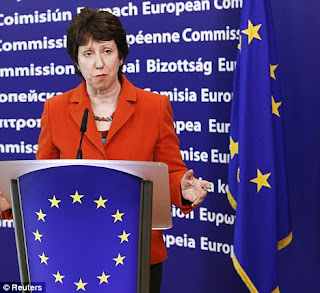 Baroness Ashton scrapped a proposal for taxpayers to be informed exactly how much of the contributions went to the EU
The increased tax could be absorbed by the Treasury, although with the Government imposing fierce cuts in spending they would likely be forced to ramp up VAT from 20 to 21 per cent.
The European Commission's seven-year budget proposals from 2014 include controversial moves to step up Brussels' direct revenue-raising powers, through a new EU levy on European banks - a 'Financial Transactions Tax' - and by increasing the EU 'take' from national VAT income.
As the EU budget proposals were being finalised at Commission headquarters last month, Eurocrats suggested that the extra 1 per cent VAT 'take' for Brussels should be itemised separately, to make the public aware of their direct contribution to running the EU.
According to insiders, Britain's EU Commissioner, Baroness Catherine Ashton, raised objections and the idea was dropped.
The proposals are already estimated by the Treasury to amount to a 'completely unrealistic' extra 11 per cent - or £1.4billion a year - on the British net contribution.
The first two years of increased contributions would have to come from the belt-tightening national spending review programme under which Chancellor George Osborne has already allocated drastically-reduced funds.
In Brussels there is still much to be battled over in what is being seen as an inflation-busting spending round at a time of major national cutbacks to fight the economic downturn.
Prime Minister David Cameron warned Commission President Jose Manuel Barroso at talks in Downing Street days before the proposals were unveiled that the public would not understand anything above an EU spending increase in line with inflation - a real-terms freeze.
And after publication, a Downing Street spokesman condemned the plans in a statement reminding Brussels of a letter published last December by Britain, France and Germany, urging that the EU creed 'should not be to spend more, but to spend better'.
The other battleground in the coming months of budget bartering between the Commission, the European Parliament and EU government ministers is the British rebate, which has knocked billions of pounds off the UK's EU bills for more than 25 years.
It currently saves the country more than £3billion a year and, as negotiated by Mrs Thatcher in 1984, is a permanent part of the EU budget system.
The Commission says the rebate is no longer necessary, but UK officials say the justification remains - UK payments to the EU kitty are disproportionately high, with the Treasury paying twice as much to the EU budget as France, and one and a half times as much as Germany.
Now the Commission wants to offer the UK a lump sum to end the current agreement and make any future rebate re-negotiable at each budget review.
The UK would temporarily get even more back than it does now - but face an uphill struggle to get anything back at all in future EU spending review rounds.
As the UK and other member states brace for months of budget wrangling with the Commission and MEPs before final figures are agreed, the Commission vigorously denied that it is planning a massive increase, arguing that the calculations of many national Treasuries use different criteria as the basis for comparing current and future spending.
Commission officials say the projected annual EU budget of £126.5billion amounts to about 1 per cent of the combined GDP of the 27 member states- the same GDP share as the current EU budget.
But national number-crunchers say that means a significant rise, as GDP has been growing in the member states.
They insist that, in cash terms - depending on the base year and whether some EU policies count as "off balance-sheet" as the Commission insists - the budget proposal represents an increase of about 11 per cent, way above inflation.
Brussels wants to raise take from VAT income, which could force a 1 per cent rise
Treasury already pays twice as much as France to the EU budget
British consumers face a fresh VAT hike as EU chiefs are planning a tax grab to fund their pet projects.
At the moment 0.3 per cent of VAT in every pound spent goes directly towards EU funding.
But Brussels politicians are planning to raise the levy to 1.3 per cent - and the cost will almost certainly be passed on to consumers if the plans are approved.

The increased tax could be absorbed by the Treasury, although with the Government imposing fierce cuts in spending they would likely be forced to ramp up VAT from 20 to 21 per cent.
The European Commission's seven-year budget proposals from 2014 include controversial moves to step up Brussels' direct revenue-raising powers, through a new EU levy on European banks - a 'Financial Transactions Tax' - and by increasing the EU 'take' from national VAT income.
As the EU budget proposals were being finalised at Commission headquarters last month, Eurocrats suggested that the extra 1 per cent VAT 'take' for Brussels should be itemised separately, to make the public aware of their direct contribution to running the EU.
According to insiders, Britain's EU Commissioner, Baroness Catherine Ashton, raised objections and the idea was dropped.
The proposals are already estimated by the Treasury to amount to a 'completely unrealistic' extra 11 per cent - or £1.4billion a year - on the British net contribution.
The first two years of increased contributions would have to come from the belt-tightening national spending review programme under which Chancellor George Osborne has already allocated drastically-reduced funds.
In Brussels there is still much to be battled over in what is being seen as an inflation-busting spending round at a time of major national cutbacks to fight the economic downturn.
Prime Minister David Cameron warned Commission President Jose Manuel Barroso at talks in Downing Street days before the proposals were unveiled that the public would not understand anything above an EU spending increase in line with inflation - a real-terms freeze.
And after publication, a Downing Street spokesman condemned the plans in a statement reminding Brussels of a letter published last December by Britain, France and Germany, urging that the EU creed 'should not be to spend more, but to spend better'.
The other battleground in the coming months of budget bartering between the Commission, the European Parliament and EU government ministers is the British rebate, which has knocked billions of pounds off the UK's EU bills for more than 25 years.
It currently saves the country more than £3billion a year and, as negotiated by Mrs Thatcher in 1984, is a permanent part of the EU budget system.
The Commission says the rebate is no longer necessary, but UK officials say the justification remains - UK payments to the EU kitty are disproportionately high, with the Treasury paying twice as much to the EU budget as France, and one and a half times as much as Germany.
Now the Commission wants to offer the UK a lump sum to end the current agreement and make any future rebate re-negotiable at each budget review.
The UK would temporarily get even more back than it does now - but face an uphill struggle to get anything back at all in future EU spending review rounds.
As the UK and other member states brace for months of budget wrangling with the Commission and MEPs before final figures are agreed, the Commission vigorously denied that it is planning a massive increase, arguing that the calculations of many national Treasuries use different criteria as the basis for comparing current and future spending.
Commission officials say the projected annual EU budget of £126.5billion amounts to about 1 per cent of the combined GDP of the 27 member states- the same GDP share as the current EU budget.
But national number-crunchers say that means a significant rise, as GDP has been growing in the member states.
They insist that, in cash terms - depending on the base year and whether some EU policies count as "off balance-sheet" as the Commission insists - the budget proposal represents an increase of about 11 per cent, way above inflation.
No charges against Christine O'Donnell
DOVER, Del. (AP) — An attorney for former Delaware Senate candidate Christine O'Donnell wants federal prosecutors to investigate the head of a group that filed a complaint last year alleging O'Donnell had illegally spent campaign money.
O'Donnell's lawyer alleged in a letter to the U.S. Attorney's office that Melanie Sloan, executive director of Citizens for Ethics and Responsibility in Washington, knowingly made false statements in the complaint against O'Donnell. O'Donnell's lawyer says the complaint was based on an affidavit from a former campaign worker that contained false information and was not properly vetted.
Sloan, a former prosecutor, said O'Donnell and her lawyers were unfamiliar with the law and that CREW was unconcerned.
Federal prosecutors informed O'Donnell's campaign lawyer Friday that they were closing their review and did not intend to pursue criminal charges.
O'Donnell's lawyer alleged in a letter to the U.S. Attorney's office that Melanie Sloan, executive director of Citizens for Ethics and Responsibility in Washington, knowingly made false statements in the complaint against O'Donnell. O'Donnell's lawyer says the complaint was based on an affidavit from a former campaign worker that contained false information and was not properly vetted.
Sloan, a former prosecutor, said O'Donnell and her lawyers were unfamiliar with the law and that CREW was unconcerned.
Federal prosecutors informed O'Donnell's campaign lawyer Friday that they were closing their review and did not intend to pursue criminal charges.
NJ township forcing diner owner to remove American flags
The owner of the Four Seasons Diner in the Rio Grande section of Middle Township, NJ has been told by the township to remove his American flags which are hung by a string.
The township has an ordinance prohibiting any stringed banners. However, they also say the American flag may be flown or displayed without limitation. The owner, originally from Greece, said he would go to jail for the American flag.
The township is threatening to fine the owner $1000. Despite these threats, the owner said he will not remove the flag.
It’s like this keeps happening over and over. But I really like this guy’s spirit and I hope his business begins to boom because of this.
Visit MRCTV for more on this plus the video!
The township has an ordinance prohibiting any stringed banners. However, they also say the American flag may be flown or displayed without limitation. The owner, originally from Greece, said he would go to jail for the American flag.
The township is threatening to fine the owner $1000. Despite these threats, the owner said he will not remove the flag.
It’s like this keeps happening over and over. But I really like this guy’s spirit and I hope his business begins to boom because of this.
Visit MRCTV for more on this plus the video!
DOJ: We can force you to decrypt that laptop
The Colorado prosecution of a woman accused of a mortgage scam will test whether the government can punish you for refusing to disclose your encryption passphrase.
The Obama administration has asked a federal judge to order the defendant, Ramona Fricosu, to decrypt an encrypted laptop that police found in her bedroom during a raid of her home.
Because Fricosu has opposed the proposal, this could turn into a precedent-setting case. No U.S. appeals court appears to have ruled on whether such an order would be legal or not under the U.S. Constitution's Fifth Amendment, which broadly protects Americans' right to remain silent.
In a brief filed last Friday, Fricosu's Colorado Springs-based attorney, Philip Dubois, said defendants can't be constitutionally obligated to help the government interpret their files. "If agents execute a search warrant and find, say, a diary handwritten in code, could the target be compelled to decode, i.e., decrypt, the diary?"
To the U.S. Justice Department, though, the requested court order represents a simple extension of prosecutors' long-standing ability to assemble information that could become evidence during a trial. The department claims:
Public interests will be harmed absent requiring defendants to make available unencrypted contents in circumstances like these. Failing to compel Ms. Fricosu amounts to a concession to her and potential criminals (be it in child exploitation, national security, terrorism, financial crimes or drug trafficking cases) that encrypting all inculpatory digital evidence will serve to defeat the efforts of law enforcement officers to obtain such evidence through judicially authorized search warrants, and thus make their prosecution impossible.
Prosecutors stressed that they don't actually require the passphrase itself, meaning Fricosu would be permitted to type it in and unlock the files without anyone looking over her shoulder. They say they want only the decrypted data and are not demanding "the password to the drive, either orally or in written form."
The question of whether a criminal defendant can be legally compelled to cough up his encryption passphrase remains an unsettled one, with law review articles for at least the last 15 years arguing the merits of either approach. (A U.S. Justice Department attorney wrote an article in 1996, for instance, titled "Compelled Production of Plaintext and Keys.")
Much of the discussion has been about what analogy comes closest. Prosecutors tend to view PGP passphrases as akin to someone possessing a key to a safe filled with incriminating documents. That person can, in general, be legally compelled to hand over the key. Other examples include the U.S. Supreme Court saying that defendants can be forced to provide fingerprints, blood samples, or voice recordings.
On the other hand are civil libertarians citing other Supreme Court cases that conclude Americans can't be forced to give "compelled testimonial communications" and extending the legal shield of the Fifth Amendment to encryption passphrases. Courts already have ruled that that such protection extends to the contents of a defendant's mind, so why shouldn't a passphrase be shielded as well?
In an amicus brief (PDF) filed on Friday, the San Francisco-based Electronic Frontier Foundation argues that the Justice Department's request be rejected because of Fricosu's Fifth Amendment rights. The Fifth Amendment says that "no person...shall be compelled in any criminal case to be a witness against himself."
"Decrypting the data on the laptop can be, in and of itself, a testimonial act--revealing control over a computer and the files on it," said EFF Senior staff attorney Marcia Hofmann. "Ordering the defendant to enter an encryption password puts her in the situation the Fifth Amendment was designed to prevent: having to choose between incriminating herself, lying under oath, or risking contempt of court."
The EFF says it's interested in this case because it wants to ensure that, as computers become more portable and encrypting data becomes more commonplace, passphrases and encrypted files receive full protection under the Fifth Amendment.
Because this involves a Fifth Amendment claim, Colorado prosecutors took the unusual step of seeking approval from headquarters in Washington, D.C.: On May 5, Assistant Attorney General Lanny Breuer sent a letter to John Walsh, the U.S. Attorney for Colorado, saying "I hereby approve your request."
While the U.S. Supreme Court has not confronted the topic, a handful of lower courts have.
In March 2010, a federal judge in Michigan ruled that Thomas Kirschner, facing charges of receiving child pornography, would not have to give up his password. That's "protecting his invocation of his Fifth Amendment privilege against compelled self-incrimination," the court ruled (PDF).
A year earlier, a Vermont federal judge concluded that Sebastien Boucher, who a border guard claims had child porn on his Alienware laptop, did not have a Fifth Amendment right to keep the files encrypted. Boucher eventually complied and was convicted.
One argument published in the University of Chicago Legal Forum in 1996--constitutional arguments among legal academics have long preceded actual prosecutions--says:
The courts likely will find that compelling someone to reveal the steps necessary to decrypt a PGP-encrypted document violates the Fifth Amendment privilege against compulsory self-incrimination. Because most users protect their private keys by memorizing passwords to them and not writing them down, access to encrypted documents would almost definitely require an individual to disclose the contents of his mind. This bars the state from compelling its production. This would force law enforcement officials to grant some form of immunity to the owners of these documents to gain access to them.
Translation: One way around the Fifth Amendment is for prosecutors to offer a defendant, in this case Fricosu, immunity for what they say. But it appears as though they've stopped far short of granting her full immunity for whatever appears on the hard drive (which may not, of course, even be hers).
Fricosu was born in 1974 and living in Peyton, Colo., as of last fall. She was charged with bank fraud, wire fraud, and money laundering as part of an alleged attempt to use falsified court documents to illegally gain title to homes near Colorado Springs that were facing "imminent foreclosure" or whose owners were relocating outside the state. Some of the charges include up to 30 years in prison; she pleaded not guilty. Her husband, Scott Whatcott, was also charged.
A ruling is expected from either Magistrate Judge Michael Hegarty or District Judge Robert Blackburn.
Jennifer Guevin contributed to this report.
The Obama administration has asked a federal judge to order the defendant, Ramona Fricosu, to decrypt an encrypted laptop that police found in her bedroom during a raid of her home.
Because Fricosu has opposed the proposal, this could turn into a precedent-setting case. No U.S. appeals court appears to have ruled on whether such an order would be legal or not under the U.S. Constitution's Fifth Amendment, which broadly protects Americans' right to remain silent.
In a brief filed last Friday, Fricosu's Colorado Springs-based attorney, Philip Dubois, said defendants can't be constitutionally obligated to help the government interpret their files. "If agents execute a search warrant and find, say, a diary handwritten in code, could the target be compelled to decode, i.e., decrypt, the diary?"
To the U.S. Justice Department, though, the requested court order represents a simple extension of prosecutors' long-standing ability to assemble information that could become evidence during a trial. The department claims:
Public interests will be harmed absent requiring defendants to make available unencrypted contents in circumstances like these. Failing to compel Ms. Fricosu amounts to a concession to her and potential criminals (be it in child exploitation, national security, terrorism, financial crimes or drug trafficking cases) that encrypting all inculpatory digital evidence will serve to defeat the efforts of law enforcement officers to obtain such evidence through judicially authorized search warrants, and thus make their prosecution impossible.
Prosecutors stressed that they don't actually require the passphrase itself, meaning Fricosu would be permitted to type it in and unlock the files without anyone looking over her shoulder. They say they want only the decrypted data and are not demanding "the password to the drive, either orally or in written form."
The question of whether a criminal defendant can be legally compelled to cough up his encryption passphrase remains an unsettled one, with law review articles for at least the last 15 years arguing the merits of either approach. (A U.S. Justice Department attorney wrote an article in 1996, for instance, titled "Compelled Production of Plaintext and Keys.")
Much of the discussion has been about what analogy comes closest. Prosecutors tend to view PGP passphrases as akin to someone possessing a key to a safe filled with incriminating documents. That person can, in general, be legally compelled to hand over the key. Other examples include the U.S. Supreme Court saying that defendants can be forced to provide fingerprints, blood samples, or voice recordings.
On the other hand are civil libertarians citing other Supreme Court cases that conclude Americans can't be forced to give "compelled testimonial communications" and extending the legal shield of the Fifth Amendment to encryption passphrases. Courts already have ruled that that such protection extends to the contents of a defendant's mind, so why shouldn't a passphrase be shielded as well?
In an amicus brief (PDF) filed on Friday, the San Francisco-based Electronic Frontier Foundation argues that the Justice Department's request be rejected because of Fricosu's Fifth Amendment rights. The Fifth Amendment says that "no person...shall be compelled in any criminal case to be a witness against himself."
"Decrypting the data on the laptop can be, in and of itself, a testimonial act--revealing control over a computer and the files on it," said EFF Senior staff attorney Marcia Hofmann. "Ordering the defendant to enter an encryption password puts her in the situation the Fifth Amendment was designed to prevent: having to choose between incriminating herself, lying under oath, or risking contempt of court."
The EFF says it's interested in this case because it wants to ensure that, as computers become more portable and encrypting data becomes more commonplace, passphrases and encrypted files receive full protection under the Fifth Amendment.
Because this involves a Fifth Amendment claim, Colorado prosecutors took the unusual step of seeking approval from headquarters in Washington, D.C.: On May 5, Assistant Attorney General Lanny Breuer sent a letter to John Walsh, the U.S. Attorney for Colorado, saying "I hereby approve your request."
While the U.S. Supreme Court has not confronted the topic, a handful of lower courts have.
In March 2010, a federal judge in Michigan ruled that Thomas Kirschner, facing charges of receiving child pornography, would not have to give up his password. That's "protecting his invocation of his Fifth Amendment privilege against compelled self-incrimination," the court ruled (PDF).
A year earlier, a Vermont federal judge concluded that Sebastien Boucher, who a border guard claims had child porn on his Alienware laptop, did not have a Fifth Amendment right to keep the files encrypted. Boucher eventually complied and was convicted.
One argument published in the University of Chicago Legal Forum in 1996--constitutional arguments among legal academics have long preceded actual prosecutions--says:
The courts likely will find that compelling someone to reveal the steps necessary to decrypt a PGP-encrypted document violates the Fifth Amendment privilege against compulsory self-incrimination. Because most users protect their private keys by memorizing passwords to them and not writing them down, access to encrypted documents would almost definitely require an individual to disclose the contents of his mind. This bars the state from compelling its production. This would force law enforcement officials to grant some form of immunity to the owners of these documents to gain access to them.
Translation: One way around the Fifth Amendment is for prosecutors to offer a defendant, in this case Fricosu, immunity for what they say. But it appears as though they've stopped far short of granting her full immunity for whatever appears on the hard drive (which may not, of course, even be hers).
Fricosu was born in 1974 and living in Peyton, Colo., as of last fall. She was charged with bank fraud, wire fraud, and money laundering as part of an alleged attempt to use falsified court documents to illegally gain title to homes near Colorado Springs that were facing "imminent foreclosure" or whose owners were relocating outside the state. Some of the charges include up to 30 years in prison; she pleaded not guilty. Her husband, Scott Whatcott, was also charged.
A ruling is expected from either Magistrate Judge Michael Hegarty or District Judge Robert Blackburn.
Jennifer Guevin contributed to this report.
Nashville residents take on Google Wi-Spy, join privacy lawsuit
Internet company pulled data from wireless networks
 A Google mapping and camera car charts the streets of Washington. From 2007 to 2010, Google cars also logged data from open Wi-Fi signals. / Paul J. Richards / AFP / Getty Images
A group of Nashville residents and attorneys are part of a class-action lawsuit against Internet giant Google that could go down as the largest invasion-of-privacy case in history.
The company is accused of breaking federal and state wiretap laws from 2007 to 2010. That’s when vehicles that were deployed nationwide to collect images for Google Maps’ street view feature also were outfitted with software that lifted scraps of personal information off residents’ and businesses’ open wireless networks.
If you can see a picture of your home or business on Google Maps’ street view and had a wireless Internet network that didn’t require a password to access between 2007 and 2010, Google may have downloaded information such as user names and passwords if you were on the Internet when the street view car drove by.
Google says it tapped into wireless networks in an effort — unrelated to the street view feature — to improve its location-based services, such as those that allow smartphone users to map their location.
Google has admitted it made a major mistake and claims it never intended to collect or use personal information, but insists it didn’t break the law by downloading information from wireless networks that were open to the public.
Nashville marketing and design coordinator Wes Hartline was outraged when he first heard about the so-called Wi-Spy controversy last year. He was working for health-care companies at the time and routinely dealt with confidential records while using his wireless network. He says he’s worried that he could be held personally liable if private information was collected and ever got loose.
“There’s nothing wrong with an expectation of privacy, and Google violated it,” Hartline, 28, said of the lawsuit. “I feel like if someone broke into your home and took these sorts of things, you’d be really upset. I don’t think this is any different.”
Hartline is one of several people across the country who have sued Google in federal court. The other Nashville plaintiffs are Lilla Marigza, a former television news reporter and stay-at-home mother, and David Binkley, a real estate agent.
They were referred to lawyers at Lieff Cabraser Heimann and Bernstein by Nashville attorney Brian Manookian, who works at Gideon Cooper & Essary and knew his firm wasn’t built to go toe to toe with the likes of Google. San Francisco-based Lieff Cabraser, however, is one of the most prominent plaintiffs firms in the nation, having achieved verdicts and settlements valued at more than $100 million in 45 cases, including 15 cases that won awards of $1 billion.
One of the firm’s three offices happens to be in Nashville. The Nashville case was ultimately consolidated with others across the country in a California federal court, and the firm was appointed to a leadership position to coordinate with the court and represent all the plaintiffs in the case. Nashville-based attorneys including Kathryn Barnett and Kenneth Byrd are working on the case.
State investigating
Google also is under investigation by government agencies in the United States and abroad. On Wednesday, the Tennessee attorney general’s office confirmed that it is investigating Google’s actions as part of a multistate effort.
U.S. District Judge James Ware breathed life into the class-action case late last month, when he rejected Google’s bid to have it dismissed. Ware’s decision turned on whether, as Google argued, unrestricted wireless Internet networks should be classified as the type of “radio communication” that is not protected by the federal Wiretap Act. Ware rejected Google’s argument as “absurd.”
Manookian, who has continued to participate to a degree in the lawsuit, praised Ware’s ruling.
“If Google was able to impede on that privacy right … just because you were using an open network, there would be no more hot spots at Starbucks or free wireless at McDonald’s,” he said.
Google, however, wants a second opinion. Last week it filed a motion asking for permission to appeal Ware’s decision to a federal appeals court and to have the lawsuit stopped in the meantime.
“We believe the claims are without merit and that the Court should have dismissed the Wiretap claim just as it dismissed the plaintiffs’ other claims,” a Google spokesperson said in an emailed statement.
Ware dismissed the plaintiffs’ state law claims because they are pre-empted by the alleged violations of the federal Wiretap Act.
Barnett said she opposes Google’s effort to pause the case and hopes to continue investigating what Google took specifically and what, if anything, they have done with it.
“We’re asking the court not to stop the proceedings,” Barnett said, “so we can find out what happened.”
Law not keeping up
The fact that there is even a question whether what Google did is illegal speaks to a deficiency in the nation’s laws, Hartline said.
“Our legislative bodies are not keeping up with the unexpected rapid advances of technologies, mobile or otherwise,” Hartline said.
“Whether wireless Internet, mobile phones, geo-tagging or other functionalities, we are far behind in effectively managing these from a legal privacy perspective.”
Written by
Brandon Gee | The Tennessean

A group of Nashville residents and attorneys are part of a class-action lawsuit against Internet giant Google that could go down as the largest invasion-of-privacy case in history.
The company is accused of breaking federal and state wiretap laws from 2007 to 2010. That’s when vehicles that were deployed nationwide to collect images for Google Maps’ street view feature also were outfitted with software that lifted scraps of personal information off residents’ and businesses’ open wireless networks.
If you can see a picture of your home or business on Google Maps’ street view and had a wireless Internet network that didn’t require a password to access between 2007 and 2010, Google may have downloaded information such as user names and passwords if you were on the Internet when the street view car drove by.
Google says it tapped into wireless networks in an effort — unrelated to the street view feature — to improve its location-based services, such as those that allow smartphone users to map their location.
Google has admitted it made a major mistake and claims it never intended to collect or use personal information, but insists it didn’t break the law by downloading information from wireless networks that were open to the public.
Nashville marketing and design coordinator Wes Hartline was outraged when he first heard about the so-called Wi-Spy controversy last year. He was working for health-care companies at the time and routinely dealt with confidential records while using his wireless network. He says he’s worried that he could be held personally liable if private information was collected and ever got loose.
“There’s nothing wrong with an expectation of privacy, and Google violated it,” Hartline, 28, said of the lawsuit. “I feel like if someone broke into your home and took these sorts of things, you’d be really upset. I don’t think this is any different.”
Hartline is one of several people across the country who have sued Google in federal court. The other Nashville plaintiffs are Lilla Marigza, a former television news reporter and stay-at-home mother, and David Binkley, a real estate agent.
They were referred to lawyers at Lieff Cabraser Heimann and Bernstein by Nashville attorney Brian Manookian, who works at Gideon Cooper & Essary and knew his firm wasn’t built to go toe to toe with the likes of Google. San Francisco-based Lieff Cabraser, however, is one of the most prominent plaintiffs firms in the nation, having achieved verdicts and settlements valued at more than $100 million in 45 cases, including 15 cases that won awards of $1 billion.
One of the firm’s three offices happens to be in Nashville. The Nashville case was ultimately consolidated with others across the country in a California federal court, and the firm was appointed to a leadership position to coordinate with the court and represent all the plaintiffs in the case. Nashville-based attorneys including Kathryn Barnett and Kenneth Byrd are working on the case.
State investigating
Google also is under investigation by government agencies in the United States and abroad. On Wednesday, the Tennessee attorney general’s office confirmed that it is investigating Google’s actions as part of a multistate effort.
U.S. District Judge James Ware breathed life into the class-action case late last month, when he rejected Google’s bid to have it dismissed. Ware’s decision turned on whether, as Google argued, unrestricted wireless Internet networks should be classified as the type of “radio communication” that is not protected by the federal Wiretap Act. Ware rejected Google’s argument as “absurd.”
Manookian, who has continued to participate to a degree in the lawsuit, praised Ware’s ruling.
“If Google was able to impede on that privacy right … just because you were using an open network, there would be no more hot spots at Starbucks or free wireless at McDonald’s,” he said.
Google, however, wants a second opinion. Last week it filed a motion asking for permission to appeal Ware’s decision to a federal appeals court and to have the lawsuit stopped in the meantime.
“We believe the claims are without merit and that the Court should have dismissed the Wiretap claim just as it dismissed the plaintiffs’ other claims,” a Google spokesperson said in an emailed statement.
Ware dismissed the plaintiffs’ state law claims because they are pre-empted by the alleged violations of the federal Wiretap Act.
Barnett said she opposes Google’s effort to pause the case and hopes to continue investigating what Google took specifically and what, if anything, they have done with it.
“We’re asking the court not to stop the proceedings,” Barnett said, “so we can find out what happened.”
Law not keeping up
The fact that there is even a question whether what Google did is illegal speaks to a deficiency in the nation’s laws, Hartline said.
“Our legislative bodies are not keeping up with the unexpected rapid advances of technologies, mobile or otherwise,” Hartline said.
“Whether wireless Internet, mobile phones, geo-tagging or other functionalities, we are far behind in effectively managing these from a legal privacy perspective.”
Written by
Brandon Gee | The Tennessean
Every Democrat Senator Voted Against Raising Debt Ceiling – 2006: Because G.W. Bush Was White?
Every Democrat Senator Voted Against Raising Debt Ceiling – 2006: Because G.W. Bush Was White?
The Greatest Democrat Embarrassment, Rep. Sheila Jackson Lee (D-TX), believes Republicans are against raising the debt ceiling because Barack Obama is Black. So what does that say about every single Democrat voting against raising the debt ceiling in 2006 when G. W. Bush occupied the Oval? See the video below.
Only this president…only this one…only this one…read between the lines…what is different about this one that should put him in a position that he should not receive the same kind of respectful treatment…yada…yada…when it is necessary to pay our bills…I do not understand what I think is the maligning and maliciousness of this president. Why is he different, and in my community that is the question that we raise…in the minority community that is the question being raised…why has the debt limit been raised 60 times…
H.J. Res. 47 [10th]: Debt Limit – Grouped By Vote PositionYEAs —52
Alexander (R-TN)
Allard (R-CO)
Allen (R-VA)
Bennett (R-UT)
Bond (R-MO)
Brownback (R-KS)
Bunning (R-KY)
Burr (R-NC)
Chafee (R-RI)
Chambliss (R-GA)
Cochran (R-MS)
Coleman (R-MN)
Collins (R-ME)
Cornyn (R-TX)
Craig (R-ID)
Crapo (R-ID)
DeMint (R-SC)
DeWine (R-OH) Dole (R-NC)
Domenici (R-NM)
Enzi (R-WY)
Frist (R-TN)
Graham (R-SC)
Grassley (R-IA)
Gregg (R-NH)
Hagel (R-NE)
Hatch (R-UT)
Hutchison (R-TX)
Inhofe (R-OK)
Isakson (R-GA)
Kyl (R-AZ)
Lott (R-MS)
Lugar (R-IN)
Martinez (R-FL)
McCain (R-AZ)
McConnell (R-KY) Murkowski (R-AK)
Roberts (R-KS)
Santorum (R-PA)
Sessions (R-AL)
Shelby (R-AL)
Smith (R-OR)
Snowe (R-ME)
Specter (R-PA)
Stevens (R-AK)
Sununu (R-NH)
Talent (R-MO)
Thomas (R-WY)
Thune (R-SD)
Vitter (R-LA)
Voinovich (R-OH)
Warner (R-VA)
NAYs —48
Akaka (D-HI)
Baucus (D-MT)
Bayh (D-IN)
Biden (D-DE)
Bingaman (D-NM)
Boxer (D-CA)
Burns (R-MT)
Byrd (D-WV)
Cantwell (D-WA)
Carper (D-DE)
Clinton (D-NY)
Coburn (R-OK)
Conrad (D-ND)
Dayton (D-MN)
Dodd (D-CT)
Dorgan (D-ND) Durbin (D-IL)
Ensign (R-NV)
Feingold (D-WI)
Feinstein (D-CA)
Harkin (D-IA)
Inouye (D-HI)
Jeffords (I-VT)
Johnson (D-SD)
Kennedy (D-MA)
Kerry (D-MA)
Kohl (D-WI)
Landrieu (D-LA)
Lautenberg (D-NJ)
Leahy (D-VT)
Levin (D-MI)
Lieberman (D-CT) Lincoln (D-AR)
Menendez (D-NJ)
Mikulski (D-MD)
Murray (D-WA)
Nelson (D-FL)
Nelson (D-NE)
Obama (D-IL)
Pryor (D-AR)
Reed (D-RI)
Reid (D-NV)
Rockefeller (D-WV)
Salazar (D-CO)
Sarbanes (D-MD)
Schumer (D-NY)
Stabenow (D-MI)
Wyden (D-OR)
Christian Hartsock at Big Government has more on the colorful Sheila Jackson Lee.
Sheila Jackson Lee doing what she does – playing the race card (video)
The Greatest Democrat Embarrassment, Rep. Sheila Jackson Lee (D-TX), believes Republicans are against raising the debt ceiling because Barack Obama is Black. So what does that say about every single Democrat voting against raising the debt ceiling in 2006 when G. W. Bush occupied the Oval? See the video below.
Only this president…only this one…only this one…read between the lines…what is different about this one that should put him in a position that he should not receive the same kind of respectful treatment…yada…yada…when it is necessary to pay our bills…I do not understand what I think is the maligning and maliciousness of this president. Why is he different, and in my community that is the question that we raise…in the minority community that is the question being raised…why has the debt limit been raised 60 times…
H.J. Res. 47 [10th]: Debt Limit – Grouped By Vote PositionYEAs —52
Alexander (R-TN)
Allard (R-CO)
Allen (R-VA)
Bennett (R-UT)
Bond (R-MO)
Brownback (R-KS)
Bunning (R-KY)
Burr (R-NC)
Chafee (R-RI)
Chambliss (R-GA)
Cochran (R-MS)
Coleman (R-MN)
Collins (R-ME)
Cornyn (R-TX)
Craig (R-ID)
Crapo (R-ID)
DeMint (R-SC)
DeWine (R-OH) Dole (R-NC)
Domenici (R-NM)
Enzi (R-WY)
Frist (R-TN)
Graham (R-SC)
Grassley (R-IA)
Gregg (R-NH)
Hagel (R-NE)
Hatch (R-UT)
Hutchison (R-TX)
Inhofe (R-OK)
Isakson (R-GA)
Kyl (R-AZ)
Lott (R-MS)
Lugar (R-IN)
Martinez (R-FL)
McCain (R-AZ)
McConnell (R-KY) Murkowski (R-AK)
Roberts (R-KS)
Santorum (R-PA)
Sessions (R-AL)
Shelby (R-AL)
Smith (R-OR)
Snowe (R-ME)
Specter (R-PA)
Stevens (R-AK)
Sununu (R-NH)
Talent (R-MO)
Thomas (R-WY)
Thune (R-SD)
Vitter (R-LA)
Voinovich (R-OH)
Warner (R-VA)
NAYs —48
Akaka (D-HI)
Baucus (D-MT)
Bayh (D-IN)
Biden (D-DE)
Bingaman (D-NM)
Boxer (D-CA)
Burns (R-MT)
Byrd (D-WV)
Cantwell (D-WA)
Carper (D-DE)
Clinton (D-NY)
Coburn (R-OK)
Conrad (D-ND)
Dayton (D-MN)
Dodd (D-CT)
Dorgan (D-ND) Durbin (D-IL)
Ensign (R-NV)
Feingold (D-WI)
Feinstein (D-CA)
Harkin (D-IA)
Inouye (D-HI)
Jeffords (I-VT)
Johnson (D-SD)
Kennedy (D-MA)
Kerry (D-MA)
Kohl (D-WI)
Landrieu (D-LA)
Lautenberg (D-NJ)
Leahy (D-VT)
Levin (D-MI)
Lieberman (D-CT) Lincoln (D-AR)
Menendez (D-NJ)
Mikulski (D-MD)
Murray (D-WA)
Nelson (D-FL)
Nelson (D-NE)
Obama (D-IL)
Pryor (D-AR)
Reed (D-RI)
Reid (D-NV)
Rockefeller (D-WV)
Salazar (D-CO)
Sarbanes (D-MD)
Schumer (D-NY)
Stabenow (D-MI)
Wyden (D-OR)
Christian Hartsock at Big Government has more on the colorful Sheila Jackson Lee.
Sheila Jackson Lee doing what she does – playing the race card (video)
Obama: Public Is Sold on Tax Increases or Something
You know, it's almost as if he believes his own lies.
President Obama on Friday kept up the pressure on Republicans to agree to revenue increases in a deal to raise the debt ceiling, claiming 80 percent of the public supports Democrats' demand for tax increases.
"The American people are sold," he said. "The problem is members of Congress are dug in ideologically."
Obama said 80 percent of Americans are on his side in the debate over what to include in the debt package. Voters are paying attention to "who seems to be trying to get something done," the president said. "It's going to be in the interests of everybody who wants to serve in this town to make sure they are on the right side of that impression."
The man is insane.
A poll releases Thursday said 34% of the public supports a tax increase while 55% oppose. So where does this lunatic come up with 80%?
President Obama on Friday kept up the pressure on Republicans to agree to revenue increases in a deal to raise the debt ceiling, claiming 80 percent of the public supports Democrats' demand for tax increases.
"The American people are sold," he said. "The problem is members of Congress are dug in ideologically."
Obama said 80 percent of Americans are on his side in the debate over what to include in the debt package. Voters are paying attention to "who seems to be trying to get something done," the president said. "It's going to be in the interests of everybody who wants to serve in this town to make sure they are on the right side of that impression."
The man is insane.
A poll releases Thursday said 34% of the public supports a tax increase while 55% oppose. So where does this lunatic come up with 80%?
Subscribe to:
Posts (Atom)