Monday, August 4, 2014

Obama administration's decision to leave gaping holes at our southern border has created a gateway for middle eastern terrorists to enter the U.S.

8/4/2014

Perry, Rogers: Record Number of Aliens From Terror-Linked Countries Being Nabbed at SW Border
Border Fence Down

A repair crew's ladder leans against a section of the border fence under repair near Nogales, Ariz., Sunday, July 27, 2014, after suspected smugglers made a garage-sized hole in the steel barrier that divides the U.S. and Mexico. (AP Photo/Nogales International, Curt Prendergast)


The number of illegal aliens being apprehended coming across the southwest border who hail from countries with “substantial terrorist ties” is at a record high, Texas Gov. Rick Perry said Sunday in comments backed up by House Intelligence Committee Chairman Mike Rogers.
Appearing on CNN’s State of the Union, Perry rejected the notion that his decision to deploy 1,000 National Guard troops to the Texas-Mexico border was related to a prospective 2016 presidential bid.
“It hasn’t got anything to do with anything other than those numbers of individuals who are coming across the border,” he said. “And when you think about the idea that some of them are from countries that have substantial terrorist ties – whether it’s Pakistan or Afghanistan or Syria, we are at historic record highs with individuals being apprehended from those countries.”
“We say it’s time to secure the border,” he added.
Perry also said the American people would “like to see a president who leads this country and says, ‘You know what? We do have a problem on our southern border. We’re going to deal with it.’ And the president refuses to lead on this, from my perspective.”
Appearing on the same show, Rogers (R-Mich.) concurred that there was reason for concern about people from countries with terrorist links trying to infiltrate the country across the southwest border.
He recalled an alleged Iranian plot, foiled in 2011, to carry out terrorist attacks on U.S. soil, beginning with the murder of the Saudi ambassador to the U.S. by bombing a Washington restaurant which he was known to frequent.
“We noticed the very dangerous trend a few years ago,” Rogers said, “when the Iranian Qods force – their external terrorist group, if you will, supported by the country of Iran – was planning an operation to use the southern border to infiltrate people into the United States to kill the Saudi ambassador.”
“So, clearly our enemies and our adversaries understand that it is a weakness,” he continued. “We have seen a trend of countries that we are very concerned about, a rise in individuals being apprehended at the border. The scary part about that is those are just the ones that get apprehended.”
Rogers said the fact the border is “porous” was now known to those wanting to carry out illegal activities in the U.S.
“Everything from criminal activity, gangs – we’ve seen that surely – human trafficking, and now you see these groups who, we believe, are connected in some way with terrorist organizations at least having the understanding, and now you see the apprehensions behind it.”
“Doesn’t take a rocket scientist to figure out that they figured out it is a weakness in our national security,” he said.
When the FBI announced the exposure of the 2011 Iranian plot cited by Rogers it said that alleged Iranian agents had hired a purported Mexican drug cartel associate (who was in fact an undercover DEA agent) to carry out the attacks, which were discussed at meetings in Mexico.
An Iranian-American from Texas, Manssor Arbabsiar, was sentenced in May 2013 to 25 years’ imprisonment after pleading guilty of conspiracy and murder for hire.
A second man who was indicted but remains at large in Iran is Gholam Shakuri, believed to be a member of the Islamic Revolutionary Guard Corps’ Qods Force. Iran at the time dismissed the allegations as “prefabricated.”

NYT'S ROSS DOUTHAT: OBAMA'S IMMIGRATION 'CAESARISM' CROSSING THE RUBICON TO IMPEACHMENT

8/4/2014

Note From Senior Management: In an opinion piece in today’s New York Times, columnist Ross Douthat articulates the case that Breitbart News has reported on in regards to the attack on American sovereignty and the president's increasing lawlessness that is leading the country to a Constitutional crisis later this summer.

Something rather dangerous is happening in American politics right now, all the more so for being taken for granted by many of the people watching it unfold.
I do not mean the confusion of House Republicans, or the general gridlock in Congress, which are impeding legislative action on the child migrant crisis (among other matters). Incompetence and gridlock are significant problems, indeed severe ones, but they’re happening within the context of a constitutional system that allows for — and can survive — congressional inaction.
What is different — more cynical and more destructive — is the course President Obama is pursuing in response.
Over the last month, the Obama political apparatus — a close aide to the president, the Democratic Congressional Campaign Committee, and the “independent” voices atMSNBC — has been talking nonstop about an alleged Republican plan to impeach the president. John Boehner’s symbolic lawsuit against the White House has been dubbed “impeachment lite,” Sarah Palin’s pleas for attention have been creatively reinterpreted as G.O.P. marching orders, and an entire apocalyptic fund-raising campaign has been built around the specter of a House impeachment vote.
Anyone paying attention knows that no such impeachment plan is currently afoot. So taken on its own, the impeachment chatter would simply be an unseemly, un-presidential attempt to raise money and get out the 2014 vote.
But it isn’t happening in a vacuum, because even as his team plays the impeachment card with gusto, the president is contemplating — indeed, all but promising — an extraordinary abuse of office: the granting of temporary legal status, by executive fiat, to up to half the country’s population of illegal immigrants.
Such an action would come equipped with legal justifications, of course. Past presidents have suspended immigration enforcement for select groups, and Obama himself did the same for certain younger immigrants in 2012. A creative White House lawyer — a John Yoo of the left — could rely on those precedents to build a case for the legality of a more sweeping move.
But the precedents would not actually justify the policy, because the scope would be radically different. Beyond a certain point, as the president himself has conceded in the past, selective enforcement of our laws amounts to a de facto repeal of their provisions. And in this case the de facto repeal would aim to effectively settle — not shift, but settle — a major domestic policy controversy on the terms favored by the White House.
This simply does not happen in our politics. Presidents are granted broad powers over foreign policy, and they tend to push the envelope substantially in wartime. But domestic power grabs are usually modest in scope, and executive orders usually work around the margins of hotly contested issues.
In defense of going much, much further, the White House would doubtless cite the need to address the current migrant surge, the House Republicans’ resistance to comprehensive immigration reform and public opinion’s inclination in its favor.
Read the rest of the article here
Photo Credit: Flickr/On Being


source

Sex Trafficking: Queens Mom Finds Missing Daughter Selling Sex on Internet

8/4/2014


TWC NewsSex Trafficking: Queens Mom Finds Missing Daughter Selling Sex on Internet
Play now
NY1's five-part series on sex trafficking has evoked a lot of reaction around the city – but perhaps one mom from Queens has been impacted the most. NY1's Dean Meminger filed the final report of the series.
They were images a mother shouldn't see.
We were there when a Queens mom noticed her daughter was selling sex on Craigslist.com.
We've blurred the pictures and protected their identities.
"Oh, I can't even look at this," one mother said as she looked through photos of her daughter.
Her 16-year-old daughter went missing two weeks ago, a victim of sex trafficking. After seeing NY1's series on prostitution, the desperate mother called us for help.
"I figure my last resort is to reach out to you guys and get the word out. Not just for my daughter, but just for other people out there—other people's daughters out there," the mother said.
There are thousands of teens and young women posting on various websites and social media—a major concern for advocates and the NYPD. It's not hard to find underage girls, like this woman's 16-year-old daughter, who actually claimed she was 21.

Advocates say most of the girls are being tricked and beaten by pimps and traffickers. This mom says her daughter went missing before and was with a guy she met who ended up being a pimp.
"She said that he hit her because he wanted her to go out there and do it, and she said she wasn't going to do it. And that's when he beat her up," the mother said. "It was nothing but a house full of girls, different ages. Thirty, 16, 15—out there prostituting."
There is a bit of good news here. After NY1 got involved, the NYPD's vice squad was contacted and in an uncover operation the teen was rescued. Advocates say there has to be more awareness, though.
At a recent meeting The Brooklyn District Attorney's clergy liaison, Rev. Cheryl Anthony, said she got disturbing information from a junior high schooler.
"I'm talking about a 12-year-old, and she said some of the girls—they leave in the morning and go off with these guys and they come back before school is over and they get dismissed with their class. So I want to say it is happening right under our noses," said Anthony.
Hopefully now, more people are aware.

FOR HELP AND INFORMATION ON SEX TRAFFICKING AND PROSTITUTION


Sanctuary for Families: 212-349-6009
Safe Horizon 24-hour Hotline: 800-621-4673
Girls Educational & Mentoring Services (GEMS): 212-926- 8089 / info@gems-girls.org

Insane Leftist Posse's Latest Brain Storm: Should we all get €12,000 a year?

8/4/2014


Should we all get €12,000 a year?
Martin Bohmeyer has not worked for money in six months. Photo: DPA
The 29-year-old lives in a rented apartment in Berlin with his wife and their daughter and eats lunch in a welfare kitchen. Having time is more important than having money, he says.
He has come to that conclusion after living on a self-imposed basic income for half a year. As a web developer who helped start two companies, he now gets paid without having to work, so he stopped.
"Since then I've had the most spectacular, thrilling and exciting time of my life," he says.
His health improved, he spends more time reading and he is now involved in several non-profit projects, among them an independent radio station.
'Money doesn't come out of the wall'
Projects like that are why Germany needs an unconditional basic income, its supporters argue. Instead of the current jungle of social services and benefits, everybody would receive one pay cheque a month from the government of €1,000, regardless of whether they were working or not.
Most backers of the idea say €1,000 would be a fair amount. That sum is endorsed by Götz Werner, the most prominent backer of the basic income idea (Grundeinkommen) in Germany.
Werner is the founder of dm, Europe's biggest drug store chain, and promotes the basic income in articles and speeches around the country.
Those who want a higher living standard, says Werner, will continue to work. Everybody else will contribute to society by pursuing their true passions.
Even basic income critics concede that it could make life more fulfilling.
But people like Hilmar Schneider, the former director of labour policy at the Bonn-Based Institute for the Study of Labour, warn that the concept is economically unfeasible.
"A basic income of €1,000 for everyone… would raise government expenditures into astronomical spheres," Schneider told the Frankfurter Allgemeine in 2010. "Those making such demands apparently think money is like electricity and comes out of the wall."
One economist estimated implementation in Germany would cost more than €100 billion.
The idea certainly has yet to break into the political mainstream, despite some pockets of support it has in parts of the media and left-leaning parties. One of the Left Party's two leaders, Katja Kipping, promotes the basic income but so far has failed to convince her party to officially adopt it.
And the ideologically diverse Pirate Party made the basic income part of its pitch before the last general election but did not get enough votes to enter parliament.
Frustrated with the lack of political momentum, Bohmeyer started his own initiative. "Mein Grundeinkommen" wants to show the concept works in a real-life experiment.
"The unconditional basic income offers one of the biggest potentials to move our society one step forward," he says.
'I would read Karl Marx'
With eight weeks to go before the crowdfunding drive ends, Bohmeyer took the first hurdle on Thursday when his campaign reached the €12,000 it asked for. The money came from more than 430 supporters, some of whom gave €1,000 each.
And while Bohmeyer will host an online community for supporters to discuss what they would do with the money, there are no criteria for a winner, who will be chosen at random.
Some supporters are already sharing ideas for what they would do.
"I would pay back my debts faster, would continue to work, would buy healthier food and do all the things that came second for financial reasons," one said.
Another wrote, "I would work less and spend more time with my children."
"I would read Karl Marx, help refugees and do yoga every day," said a third.
Even without an enforcement mechanism, Bohmeyer is convinced the winner will not put up their feet for a year.
One doesn't make a study
"I believe that every one of you contains great potential, regardless of whether you have specific ideas, projects or applications," Bohmeyer told supporters in a video.
"Maybe you're like me and need the rest from always having to think about money to have entirely new thoughts and ideas," he added.
That is not as unlikely as it may sound, some economists say. One of them is Schneider's successor at the Institute of Labour Studies, Alexander Spermann.
The labour policy expert has studied the basic income for years and points to pilot projects where participants did not become lethargic. "To the contrary: They suddenly tackle things that one would not have thought them capable of," says Spermann.
But Bohmeyer's crowdfunded project will not tell researchers much, Spermann cautions. One person does not make a representative sample and a scientific study would require observing a larger group of people over a longer period of time, he says.
Bohmeyer is undeterred. After the first €12,000 was raised, he said on his website that the first winner of the first basic income will be chosen soon.
"Now we are fundraising for a second one," he added.

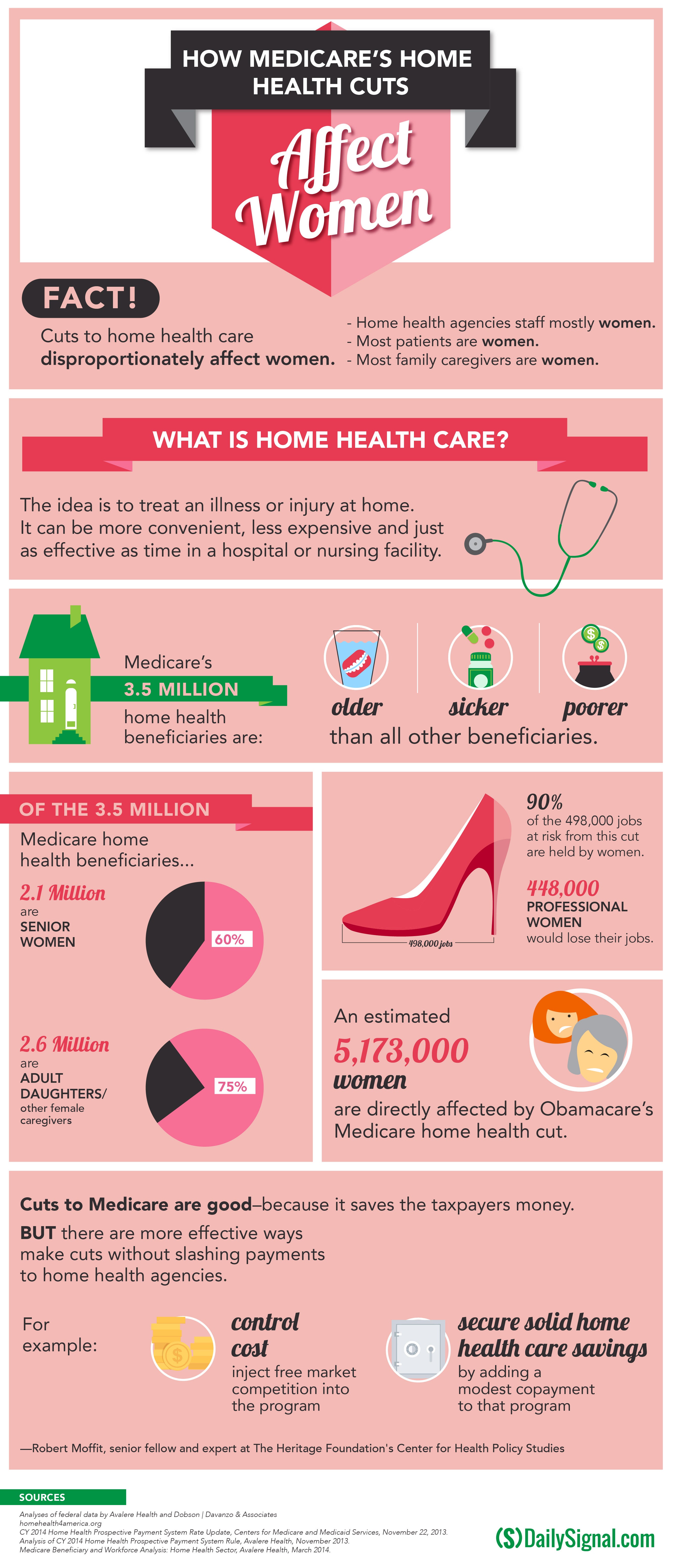
WAR ON WOMEN: How Medicare’s Home Health Cuts Disproportionately Affect Women

8/4/2014


The Affordable Care Act, popularly known as Obamacare, authorized the Department of Health and Human Services to cut or increase categories of Medicare spending. Last year, former HHS Secretary Kathleen Sebelius announced home health care funding would be slashed by 3.5 percent annually until 2017. According to industry analysts, these cuts disproportionately affect women—the majority of whom serve as home health care beneficiaries, caregivers and professionals in the home health care sector.
140723_WarOnWomenInfo


Obama Administration to Regulate Bake Sales

8/4/2014


New Requirements May Squeeze Out Gooey Fundraising Fare; Fat Standard

At Chapman School in Nebraska, resourceful students hawk pizza and cookie dough to raise money for school supplies, field trips and an eighth-grade excursion to Washington. They peddle chocolate bars to help fund the yearbook.
But the sales won't be so sweet starting this fall. Campus bake sales—a mainstay of school fundraisers—are going on a diet. A federal law that aims to curb childhood obesity means that, in dozens of states, bake sales must adhere to nutrition requirements that could replace cupcakes and brownies with fruit cups and granola bars.
Jeff Ellsworth, principal of the kindergarten through eighth-grade school in Chapman, Neb., isn't quite sure how to break the news to the kids. "The chocolate bars are a big seller," said Mr. Ellsworth.
The restrictions that took effect in July stem from the 2010 Healthy, Hunger-Free Kids Act championed by first ladyMichelle Obama and her "Let's Move!" campaign. The law overhauled nutrition standards affecting more than 30 million children. Among the changes: fatty french fries were out, while baked sweet potato fries were deemed to be fine.
The law also required the U.S. Department of Agriculture to set standards for all food and beverages sold during the school day, which includes vending machines, snack carts and daytime fundraisers. It allowed for "infrequent" fundraisers, and states were allowed to decide how many bake sales they would have that didn't meet nutrition standards.
Without state-approved exemptions, any treats sold would have to meet calorie, sodium, fat and other requirements. The law permits states to fine schools that don't comply.
Forget about buttery, salty popcorn, for instance. Kernels sold on site during the day must contain no more than 230 milligrams of sodium per serving until 2016, when it drops even lower. No more than 35% of calories in an item can come from total fat.
A graphic put out by the USDA shows where some snacks stand.
Six chocolate sandwich cookies at 286 calories would be out, but a 4-ounce fruit cup with 100% juice at 68 calories would make the cut. Also out: a large doughnut at 242 calories and a 1.6 oz. chocolate bar with 235 calories.
Homemade fare is more challenging to measure, schools say.
Each state can mandate the number of daytime fundraisers held each year that buck the nutrition requirements. But so far, 32 states have opted to stay strictly in the healthy zone, according to a draft report from the School Nutrition Association, which said the final number could change before the school year begins.
That means students in those states, which range from Alabama to California to Texas, can't sell fatty or sugary fare that doesn't meet the federal requirements.
"For some districts, this will be a huge change," said Julia Bauscher, president of the School Nutrition Association and director of school and community nutrition services at Jefferson County Public School in Louisville, Ky. "There's a lot of fear among school food directors that we will have to be the food police."
The Obama administration said it has provided states flexibility with the rules, which cover schools that participate in the federal school meals programs. "We defer to the states to make decisions that made sense to them," said Sam Kass, executive director of Let's Move!
Tennessee will allow schools to sell food items that tip the federal scales for 30 days each year.
"Schools have relied on these types of sales as revenue streams for sports, cheering clubs, marching bands," said David Sevier, deputy executive director of the Tennessee Board of Education. "We get the obesity issue, but we don't want to jerk this out from under the kids."
In advance of the law, some schools had already banned students from a near-sacred activity: setting up tables to sell boxes of Girl Scout cookies during the day. There are also those that have replaced food-centric fundraisers with calorie-free events such as wrapping-paper sales, pie-throwing events and bowl-a-thons. Others have prohibited homemade fare in favor of processed items where the nutritional information is calculated and displayed.
At least 12 states have also already adopted limits on bake-sale foods on their own—providing a taste of what's to come for hundreds of schools nationwide.
"We used to have a carnival with a cake walk, now we do a book walk," said Adam Drummond, principal of Lincoln Elementary School in Huntington, Ind. "The students get to pick a book."
Child obesity has more than quadrupled in adolescents in the past 30 years, according to the Centers for Disease Control and Prevention. Of children 6-11, in 2012, 18% were obese. That is up from 7% in 1980, according to the CDC.
Texas has had nutrition requirements since at least 2010 that cover fundraisers, but had allowed campuses to have three events a year during the school day where students could sell candy or other restricted items. This year, it didn't adopt such exemptions.
"Some don't follow the spirit and set up bake sales right after the bell rings," said Christine Jovanovic, of Austin, who is a member of the parent-teacher association at Canyon Vista Middle School and Westwood High School.
The result of the new requirements may be more processed-food products.
"We use prepackaged food because it has to have nutritional requirements posted," said Keli Gill, president-elect of the Arkansas PTA, where the state has had nutrition standards for bake sales for a few years. "Items like apples are perishable and don't last as long, so we don't want to waste money and have it go bad on us."
Schools are also grappling with how to monitor food sales so as not to end up in the penalty box.
Davis High School in Kaysville, Utah, was fined more than $15,000 during the 2012-2013 school year for selling certain snacks and carbonated beverages near the lunch area while meals were served, which isn't allowed under federal requirements. The Utah Department of Education conducted on-site visits and found the infractions. The fine was reduced to $1,297, according to Christopher Williams, a district spokesman.
Said Tennessee's Mr. Sevier: "It's not like we're going to have a brigade of black helicopters coming in to check."