Sunday, December 14, 2014

DOJ Debunks WH’s Stats on College Rape, Will Media Report?

12/14/2014


Are 1 in 5 undergrad college-age women raped in the USA, as feminists, the media and even the White House says? Not so much. 
A new report, ironically from the White House’s own Department of Justice, reveals that number is significantly lower than the media and the administration had reported previously. 
Instead of a whopping 20 percent of female college freshmen and sophomores, the new, more expansive stats put that number at just 0.61 percent – or 6.1 per 1,000 students. 
Even more ironic, the study found that college females are less likely to be sexually assaulted than their unenrolled female peers. These findings are a serious blow to the feminist left’s assertion that an “epidemic” of rape grips college campuses. This, combined with the fast-unraveling Rolling Stone story about the University of Virginia and Lena Dunham’s questionable (to put it kindly) allegation against “Barry One” at Oberlin College, makes it a very bad month for the rape panic industry. 
And 2014 had started so promising, too. President Obama launched the “White House Task Force to Protect Students From Sexual Assault,” which he and Vice President Biden subsequently promoted several times throughout the year, always citing the misleading 1 in 5 stat. Celebrities even appeared in a PSA campaign called “It’s On Us” in September which also cited the statistic. NBC, ABC, CBS, CNN and PBS all have run the misleading stats in recent broadcasts and it’s been adopted by women’s rights activists all across the country. But where did this number come from? 
The oft-cited number comes from just a singular source – a 2007 small-scale study called “The Campus Sexual Assault Study” done by the National Institute of Justice, a division of the Justice Department. The study polled just two universities, over the course of just under three years. Data was gathered through an online survey that took just 15 minutes to complete. The questions asked about things like if they’d been subjected to “forced kissing.” If the answer was, "Yes," the researchers – not the women themselves – qualified that as a sexual assault. The 5,446 undergraduate women who participated were provided a $10 Amazon gift card, as reported by The Washington Examiner
Despite the obvious flaws in the study, the numbers proved too dramatic for the left and the media to pass up. 
Amazingly, even the authors of this study admitted that the media and activists have misused their findings to broadly apply its meaning.  They told Slate
‘We don’t think one in five is a nationally representative statistic.’” It couldn’t be, he said, because his team sampled only two schools. “‘In no way does that make our results nationally representative,’” Krebs said. And yet President Obama used this number to make the case for his sweeping changes in national policy. 
Unlike the 2007 study, the newly released report by the Department of Justice called the “National Crime and Victimization Survey” (NCVS)  gathered data over a much longer time period,1995-2013. Encouragingly, this study finds there has been a downward trend of rape on college campuses since 1997, as The Federalist points out. The NCVS study stated, “For the period 2007-13, the NCVS victimization rate was 4.7 per 1,000 for females ages 18 to 24 who were enrolled in post-secondary schools.”
The study also found that ironically, female college students fare better when it comes to the chance of being sexually assaulted, than their unenrolled peers do. “The rate of rape and sexual assault was 1.2 times higher for nonstudents than for students,” according to the study
So what will the media do with this new information? If it defeats the left’s favorite statistics and undercuts a fear-mongering agenda it most likely will be ignored.


source

SOCIALISM UPDATE: Blacks And Whites Are BOTH Poorer Under First Black U.S. President

12/14/2014


Report: Americans Are Poorer Since The Recession Ended, Wealth Inequality Continues To Increase


The wealth gap between races continues to widen despite recession recovery.
While it could be debated to no end whether or not the Great Recession is over, a new report points out that consumers are still worth less money than they were before the bottom fell out of the economy.
A new analysis from Pew Research Center found that even as the economy has recovered, many households still face financial disparity and wealth inequality continues to widen along racial and ethnic lines.
According to the report, the net worth of American families – the difference between values of their assets and liabilities – fell 39.4% from the start of the recession to the purported end. Back in 2007, families had a net worth of $135,700, while they currently have a net worth of $81,400.
There has been significant decreases in consumer wealth since the recession ended.
In addition to the different in wealth from year to year, Pew’s analysis of Federal Reserve data found a stark divide between the experience of different races during economy recovery.
From 2010 to 2013, the median wealth of non-Hispanic white households increased from $138,600 to $141,900, or by 2.4%, while median wealth of non-Hispanic black households fell 33.7%, from $16,600 in 2010 to $11,000 in 2013.
Among Hispanics, median wealth decreased by 14.3%, from $16,000 to $13,700.
Pew points out that difference in wealth can, in part, be attributed to difference in median income between races and the use of financial assets such as stocks.
Still, since the recovery started all families have faced the same issues, including the reduction of ownership of key assets, such as homes, stocks and business equity.


source

"Hand tying" panel to consider tracking of civilians killed by police

12/14/2014

Mandel Magn

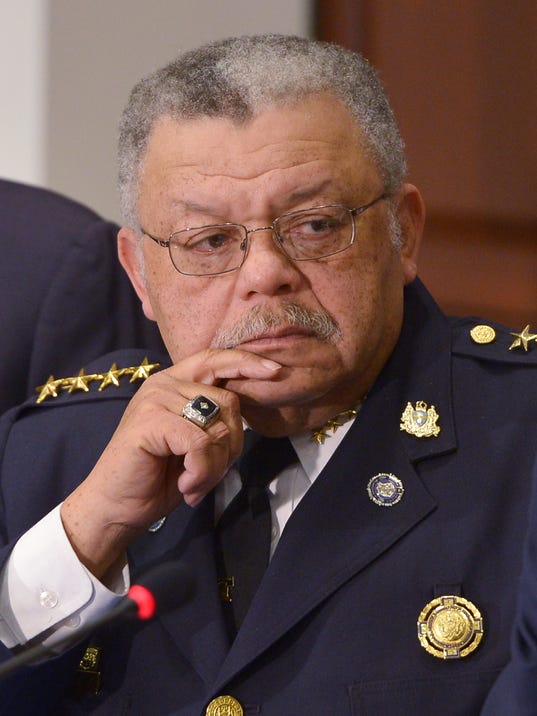
WASHINGTON — The newly created White House panel on policing will consider establishing a national repository that tracks all manner of civilian deaths at the hands of law enforcement officers. It's part of an effort to re-establish trust between police and the communities they serve, the co-chairman of the committee said.
Philadelphia Police Commissioner Charles Ramsey, tapped by the Obama administration to help bolster law enforcement's standing in the wake of national unrest stirred by a series of killings of young black men by white officers, told USA TODAY that the long-standing gap in police reporting "needs to be addressed.''
"It will be on the table, no question,'' Ramsey said.
The proposal comes just as the Senate passed legislation Wednesday that would require states to report the deaths of all people in law enforcement custody or during arrest to the federal government.
The most prominent record of civilian fatalities — the FBI's annual report of justifiable homicides by police — was described by Ramsey as "hit or miss'' because of its reliance on voluntary reporting by police agencies, a practice that results in a partial accounting.
Ramsey said civilian deaths at the hands of police, which have sparked demonstrations in cities across the nation, need to be tracked as meticulously as institutions now track the circumstances and numbers of police who are killed in the line of duty.
One of the most comprehensive records of police deaths is maintained by the National Law Enforcement Officers Memorial Fund (NLEOMF). The group is supported by a vast pool of retired police officers and others who review death reports in every state, said NLEOMF chairman and CEO Craig Floyd. That information is then provided to a database that is updated daily on the group's website.
"Personally, I think (both police and civilian death counts) ought to be pretty much the same. If you don't have the data, people think you are hiding something,' Ramsey said. "This is something that comes under the header of establishing trust.''
The inequities in the tracking systems for years have rankled criminal justice analysts who say the universe of civilian deaths remains largely unknown.
University of Nebraska criminologist Samuel Walker, who has described the lack of such a repository as a "major failure'' of the criminal justice system, said a national reporting program could finally bring "some solid facts'' to a public discussion that has largely relied on anecdotal reporting.
"This is a critical public health issue,'' Walker said.
DIFFERENT STANDARDS RULE DEATH COUNTS
Every spring, thousands of the nation's police officers flock to Washington, D.C., to pay their respects to colleagues whose lives have been lost in the line of duty.
The candlelight vigil at the National Law Enforcement Officers Memorial is affixed to the public schedules of the U.S. attorney general and FBI director. They join the solemn ceremony where the names of the newly fallen have been freshly engraved into the memorial's marbleized limestone.
The engravings are the result of the systematic tracking of police deaths that the memorial has researched back to the late 1700s. There is no disputing the merit of the tribute and the necessity of such data — some of it has been used through the years to enhance officer safety.
Yet the sacred memorial and the decades of research stand in stark contrast to the incomplete accounting of people killed by police.
Based on the voluntary data supplied to the FBI, last year's number of justified homicides by police — 461 — was the highest number recorded in nearly two decades. (Those cases and the ones reported in the years before are not audited after they are submitted to the bureau, and the data has conflicted with other independent measures of fatalities at the hands of police.)
During the same time period, according to the memorial fund group, there were 100 police officers who died in the line of duty due to all measurable causes — from electrocution to shootings.
The FBI's 2014 tally of justifiable homicides will not be available until next year, but the running count of officer deaths on the memorial fund website, as of Thursday, already has surpassed last year, at 114. And the number of fatal shootings of officers — 46 — is up 70% from last year. The overall number of fatalities, however, remains far less than the troubling spike in 2007 when there were 191 police deaths. That year was marked by unusually brutal attacks against police, including several incidents in which multiple officers were fatally shot.
Ramsey said that compelling police agencies to report such data may be difficult. "I don't know whether we'll get to a point where we'll be able to paint a portrait of the situation that is 100%,'' he said.
That worry could be eased by the new congressional action, as lawmakers are requiring that state report or risk losing millions of dollars in federal grants. The legislation is awaiting President Obama's signature.
"At a time when our nation is having an important conversation about police encounters that result in the loss of life, we know that hundreds of police-related deaths are unaccounted for in federal statistics,'' said Senate Judiciary Chairman Patrick Leahy, D-Vt. "Too many communities across our country are losing faith in our justice system. This bill provides a step towards accountability, and it is my hope that it may ultimately lead to restoring some measure of trust in these communities."
As recently as 2012, the nation's largest association of police chiefs and the Justice Department recommended the development of a data collection system that could produce annual national analyses of the use of force by police.
"I strongly support the idea of a national database on incidents involving deadly force by police,'' said Bernard Melekian, a former director of the Justice Department's Community Oriented Policing Services office. "I support it in large measure because I think the facts will show that police seldom use any force to make an arrest and only a fraction of those cases are a level of force likely to produce death or great bodily injury.''


source

30 Piece Orchestra.

12/14/2014


source

Che Guevara’s Son Offering Motorcycle Tours of Cuba

12/14/2014

HAVANA – The youngest son of Argentine-born Cuban revolutionary Ernesto “Che” Guevara is behind a tourism initiative that offers expeditions to different parts of the Communist-ruled island on board Harley-Davidson motorcycles.

The leader and coordinator of the project, 49-year-old Ernesto Guevara, is an attorney who “inherited from his father a passion for motorcycles, which have allowed him to traverse the country and know it like few others” and who has devoted more than 20 years of his life to restoring Harley-Davidsons.

The tours – and the name of the Argentine-based travel agency, “La Poderosa Tours” – are directly inspired by the expedition that Che (1928-1967) and his friend, Alberto Granado, two medical students, made in 1952 on a run-down motorbike they gave the ironic name “La Poderosa” (The Mighty One).

That journey also inspired Brazilian director Walter Salles’ 2004 biopic “The Motorcycle Diaries.”

The owner of La Poderosa Tours, Mimi Kohen, told Efe that the idea of offering motorcycle tours is an established global trend, adding that Cuba was chosen because “it’s a wonderful country and even more so when the weather cooperates.”

The Harley-Davidson brand was chosen for the tours because of its longstanding tradition in Cuba and its post-revolution staying power, Kohen said by e-mail, noting that the island even has a Harley club.

Camilo Sanchez, a childhood friend of Che’s youngest son, and Sergio Morales, a mechanic with more than 40 years of experience and Cuba’s most famous Harley aficionado, also are behind this initiative.

The agency offers tours that start at $3,000 per couple and $4,200 for individual expeditions. They begin in Havana and cover routes that include the cities of Santa Clara, Cienfuegos, Trinidad and Cayo Santa Maria island.

The tours include lodging, food, a guide and transportation via a “brand-new motorcycle,” but not the price of gasoline.

“Our tours combine the delights of this island’s varied landscapes with intimate contact with a part of the history of a unique revolution that generated a mystique that still endures and broadly transcends Cuba’s geographical limits,” La Poderosa Tours’ Web site says.


source

Breakdown of Negotiations Puts Climate Change Convention in Peril

12/14/2014

LIMA – The absolute breakdown of the Climate Change Summit (COP20) in Lima, just 24 hours after the period expired that had been set by participating countries to reach an accord, puts in jeopardy the UN Framework Convention on Climate Change itself.

That was observed at noon Saturday by the Obama administration’s special climate change envoy, Todd Stern, who, after listening to more than 20 countries refuse to accept the final “consensual” text before dawn Saturday, it was his turn to address the plenary session.

The U.S. negotiator, among the last to address the session, told delegates that the UN Climate Change Convention was in danger. “We have no time for lengthy new negotiations, and I think we all know that,” Stern said. “The hour glass is running down.”

But as the summit went into overtime, many ministers had to pick up and leave, such as the Spain’s minister of agriculture, food and the environment, Isabel Garcia Terjina, who had to be at the European Council of Ministers on Monday.

And there were developing countries like Bolivia, Venezuela and Nicaragua who continue in the opposition, something that sources in the negotiation told Efe will be a difficult obstacle to overcome, because the Peruvian presidency of the COP20 “does not look like it wants to fight with its neighbors.”

And naturally Saudi Arabia and its allies do not wish to reach any kind of accord.

“If it goes on like this and people don’t want to progress very quickly, we’ll have to look for other forums so that those who want to make progress can do so elsewhere,” Teresa Ribera, director of IDDRI, one of the most influential climate change lobbies in Europe, said.

Efforts to hammer out the text at the COP20, as the 20th yearly session of the Conference of the Parties to the UN Framework Convention on Climate Change is known, have been bogged down over a couple of contentious issues: differentiation between developed and developing countries and financing for adaptation.

The United States has demanded that all countries do their part to reduce greenhouse gas emissions, saying the world is presently on a disastrous course.

Developing countries such as China and Brazil, however, demand that the new agreement adhere to the principle of “common but differentiated responsibilities,” which recognizes developed countries’ greater historical contribution to environmental problems and their greater economic and technical capacity to tackle them.

The issue of financing for adaptation is also a tricky one, with the United Nations Environment Program saying in a report released in Lima on Dec. 5 that the amount of money developing countries will need to adapt to climate change could be double or triple the current estimate of $70 billion to $100 billion a year.

COP20 began on Dec. 1 and has drawn 10,300 delegates from 195 countries to make progress toward a new treaty that is take effect in 2020 and replace the Kyoto Protocol, which was adopted in 1997 and entered into force in 2005.


source

HARRY REID'S FINAL ACT AS MAJORITY LEADER: CAVING TO FIGHT AGAINST OBAMA'S EXECUTIVE AMNESTY

12/14/2014


Outgoing Senate Majority Leader Harry Reid’s final act as the most powerful person in the U.S. Senate chamber is one where he has relented to the Tea Party.

Reid’s Senate Democrats lost nine seats in the midterm elections—more than even the most generous prognosticators were expected—giving the GOP control over the U.S. Senate come January. And on Saturday evening, as his chamber readies the so-called "CRomnibus" spending bill for package, Reid has agreed to allow a vote on a measure from Sen. Ted Cruz (R-TX) on questioning the constitutionality of President Barack Obama’s executive amnesty. 
“Forcing a vote on the constitutionality of Obama's amnesty is important for two reasons,” Cruz said in a statement his office provided to Breitbart News. “First, since President Obama enacted his unilateral amnesty after the elections, Democrats have never been made to answer for it. Tonight, they will and they will show America whether they stand with a lawless President, who is defying the will of the voters or the millions of Americans who want a safe and legal immigration system.”
Cruz went on to detail more reasons why this fight was important.
“Second, it allows Republicans to also show they are committed to ending Obama's amnesty once and for all in the next Congress,” Cruz said. "If we agree it is indeed unconstitutional, we have no business funding it when the GOP controls Congress last year. The Constitution matters, and we must defend it. That is why we have fought so hard to ensure this vote.”
Reid allowing this vote comes after he threw a fit on Friday when Cruz attempted to get a vote on the point of order measure and Sen. Mike Lee (R-TX) attempted to get an amendment into the cromnibus that would have blocked funding for Obama’s executive amnesty.
What happened on Friday night is a series of procedural tactics that Cruz and Lee engaged in with Reid. Cruz tried to force a constitutional point of order—which requires a 51-vote threshold—to challenge the constitutionality of Obama’s executive amnesty. Meanwhile, Lee was pushing an amendment to the cromnibus spending bill that just passed the House that would have blocked funding for Obama’s executive amnesty implementation. 
Using parliamentary tricks, Reid blocked both Cruz’s and Lee’s measures, then sought unanimous consent to adjourn the Senate until Monday—at which time Senators would have been brought back in for passage for the cromnibus. But in consultation with Cruz, Lee objected to unanimous consent to adjourn the Senate until Monday unless Reid would allow a vote on the effort to block funding for Obama’s executive amnesty. Because Reid wouldn’t agree to allow the vote, he decided to keep Senators in Washington for the weekend.
Because Reid needed to, per Senate rules, fill the timeframe until senators can actually vote on cloture on the cromnibus bill—which they will do soon—Reid has been forcing through several nominees from the Obama administration. Some establishment Republicans like Sen. Jeff Flake (R-AZ), in an attempt to attack Cruz and Lee, claimed wrongly that Reid was never going to bring these nominees through the Senate during the lame duck session, but high-ranking Senate sources say Reid was always planning to confirm these nominees before Christmas.
So after a full day of partisan bickering back and forth—and establishment Republicans joining with Democrats to blame Cruz and Lee for being kept in Washington for the weekend—Reid has relented and in his final major act as Senate Majority Leader has agreed to grant Cruz his vote on his point of order.
The measure is expected to fail on the vote, as everyone has always expected it to. That’s because the Democrats—all 55 of them—are expected to vote against Cruz’s measure, while all of—or at least most of—the 45 Republicans in the Senate are voting for the Cruz measure. But Cruz wanted them all on the record now. 
**Update 
The measure failed when it came up for a vote in the Senate. But since some Republicans, like Sen. Pat Toomey (R-PA), were whipping votes, according to a congressional GOP aide, in favor of Obama's executive amnesty against Cruz's measure, a surprisingly high number of Republicans voted to reaffirm Obama's executive amnesty. The measure failed with 22 senators voting for it and 74 voting against it. Toomey's office hasn't responded to a request for comment as to why he was whipping votes against Cruz's measure, and in favor of Obama's amnesty.


source

Al Sharpton Leads March in DC as NYC Protesters Chant: 'What Do We Want? Dead Cops!'

12/14/2014


Joining the families of blacks killed by police, thousands marched toward the capitol and down New York streets on Saturday to protest what they called an epidemic of abuse at the hands of police. 

But even though it was his event, many attendees didn't want to hear from organizer Al Sharpton.
The march, organized by Sharpton's National Action Network, once again chanted the oft-heard slogan, "No Justice, No Peace" with marchers demanding that federal laws be enacted to curb local and state police agencies use of force rules.
In an op-ed published on December 8, Sharpton noted that the "march against police violence" was needed to force Congress to "immediately start hearings to deal with laws that will change the jurisdiction threshold for federal cases and policing."
Once the thousands of marchers reached the grounds outside the Capitol, Sharpton warned Congress that he and his supporters would not be ignored.
“You thought you'd sweep it under the rug. You thought there'd be no limelight," Sharpton said. "We are going to keep the light on Michael Brown, on Eric Garner, on Tamir Rice, on all of these victims because the only way -- I'm sorry, I come out of the 'hood -- the only way you make roaches run, you got to cut the light on."
Sharpton was joined at the podium by felony armed robbery suspect Lesley McSpadden and alleged riot-inciter Louis Head, the parents of Michael Brown,a strong-arm robbery suspect killed by a police officer in Ferguson, Missouri in August.
"What a sea of people," McSpadden said. "Thank you for having my back."
Gwen Carr, mother of Eric Garner, the man who died during an attempted arrest in New York, also spoke at the rally, saying, "This is a history-making moment. We need to stand like this at all times."
But even as Sharpton geared up for his address, dozens of protesters drifted away from the rally, saying they didn't want to hear from Sharpton.
David Saunders, 62, was one rally-goer who left as Sharpton began his comments. "I believe in the march. But I don’t want to hear him," he said.
Another person leaving as Sharpton began speaking told The Washington Post, "We wanted to be here. This was wonderful. But we’re good."
This isn't the first example of resistance Sharpton has been confronted with after his repeated attempts to capitalize on the pain of recent victims of police actions.
In one case, the family of a man accidentally shot by a rookie New York policeman in November publicly warned Sharpton to stay away from their loved one's funeral.
Similar protests wracked New York, where protesters allegedly assaulted two NYPD officers and blocked traffic on the Brooklyn Bridge. 
Protesters chanted violent slogans: "What do we want? Dead cops!" 
Back in November, black suspects allegedly beat unarmed white man Zemir Begic to death with hammers in St. Louis earlier in December after screaming, "Kill all white people." The killing took place after Officer Darren Wilson was not indicted in the shooting death of Michael Brown. Similar hammer attackstook place after Sanford resident George Zimmerman was acquitted in the shooting death of Trayvon Martin. 
New York City mayor Bill de Blasio issued a warning to would-be violent protesters. 


source

Global Warming Update: Quietest 3 years for twisters on record

12/14/2014

Tame tornadoes: Quietest 3 years for twisters on record


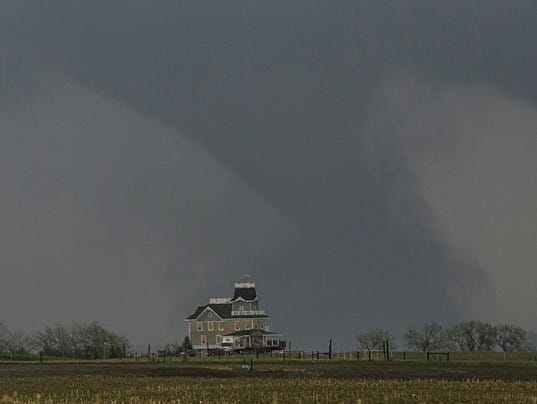
A tornado forms over a house near Pilger, Neb., on June 16, 2014.(Photo: Mark 'Storm' Farnik, AP)

The U.S. experienced fewer tornadoes in the past three years than any similar span since accurate records began in the 1950s. Yet meteorologists aren't sure exactly why.
As this year comes to a close, about 150 fewer damaging tornadoes than average have hit the U.S., according to data from the Storm Prediction Center (SPC). Explanations for the decrease in twisters the past three years range from unusual cold to unusual heat, or just coincidence.
Despite the calmer than average years, deaths due to twisters remain near the average of 60 each year, with 68 killed in 2012, 55 in 2013 and 42 so far this year, according to the SPC. That pales in comparison with the 553 Americans killed by tornadoes in 2011.
So far this year, just 348 EF-1 or stronger tornadoes have touched down across the country, marking the third-lowest number on record. An average year sees about 500 EF-1 or greater tornadoes. A total of 364 EF-1 or stronger tornadoes touched down in 2012 and 404 in 2013.
EF refers to the Enhanced Fujita Scale of tornado intensity, which runs from EF-0 to EF-5. Most twisters that cause damage and deaths are EF-1 or higher, with wind speeds of at least 86 mph.
Harold Brooks, a meteorologist with the National Severe Storms Laboratory in Norman, Okla., said there's no consistent reason for the three-year lull — the calmest stretch since a similar quiet period in the late 1980s — because weather patterns have varied significantly from year to year.
While 2012 tornado activity was likely suppressed by the warm, dry conditions in the spring, 2013 was on the cool side for much of the prime storm season before cranking up briefly in late May, especially in Oklahoma, SPC meteorologist Greg Carbin said. Then, activity quickly quieted for the summer of 2013.
"(This year) the area of the country usually most productive for tornadoes again experienced below-normal temperatures but not as extreme as 2013," Carbin said. "The last two years, it seems, have more in common with one another than the extreme heat of 2012."
In addition to cooler weather, which limits instability, the past two years also lacked the stronger, large-scale weather systems that bring together the ingredients necessary for widespread severe thunderstorm and tornado outbreaks, Carbin said.
So what can we expect next year? No one can predict that.
"There is no such thing as a long-range severe storm or tornado forecast," the SPC said. "There are simply too many small-scale variables involved which we cannot reliably measure or model weeks or months ahead of time."


source

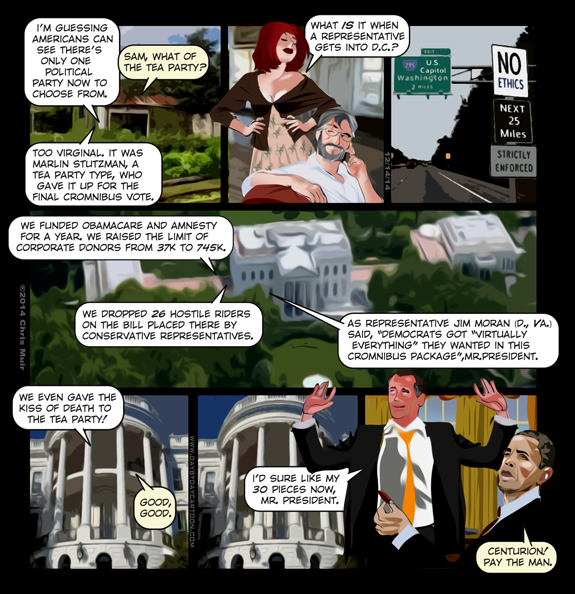
America's Demise Continues: Senate Passes The $1.1 Trillion Boehner-Obama Deal

12/14/2014


$1.1 trillion budget sent to President Barack Obama as spending bill clears senate avoiding repetition of chaotic 18-day shutdown of October 2013


source