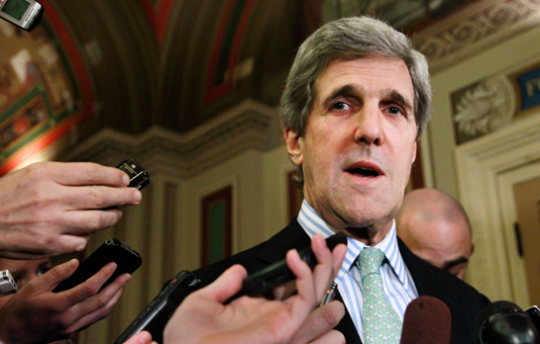
Five-terms in the Senate have made failed presidential candidate, Obama surrogate, and potential secretary of State John Kerry an amazingly prescient investor
BY: Andrew Stiles - May 3, 2012 12:00 pm
Failed Democratic presidential nominee Sen. John Kerry’s (D., Mass.) long history of ethically dubious investments could invite controversy as he takes on a new role as a “top surrogate” for President Obama’s reelection campaign.
Kerry’s net worth as listed on his 2011 financial disclosure form is at least $193 million and likely much higher, making him the wealthiest member of the Senate. He is also a prolific investor, maintaining an array of stocks and other holdings through a mix of family trusts, marital trusts, and commingled fund accounts with his wife, Big Ketchup baroness Teresa Heinz.
The five-term Senator has a well-documented history of investing in companies that would benefit from policies he supports, as well as making conveniently timed and highly profitable trades coinciding with the passage of major legislation and, in some cases, the dissemination of privileged information.
For years, Kerry has invested millions in a number of green energy companies that have benefitted from the president’s efforts to aggressively subsidize the industry with taxpayer dollars.
These companies include Exelon, which received a $646 million taxpayer-guaranteed loan in 2011 to build a solar facility in California and created only 20 permanent jobs, as well as Fisker Automotive, the fledgling electric car company that offshored its manufacturing operation to Finland after receiving a $529 million federal loan guarantee in 2010.
The loan guarantees, approved by the Department of Energy, were made possible by funding allocated in the 2009 stimulus bill, which Kerry supported. According to Kerry’s own office, the Senator “played a key role” in crafting the portions of the legislation designed to offer federal support for green energy projects.
Additionally, Kerry co-authored the controversial cap-and-trade legislation that would have effectively imposed a tax on carbon-dioxide emissions. Though the bill ultimately failed, the New York Times noted that Exelon and companies like it “would emerge as financial winners” if the legislation was enacted.
Kerry has hundreds of thousands of dollars invested in Kleiner Perkins Caufield & Byers (KPCB), a venture capital firm run by John Doerr, a prominent Obama donor who served on the president’s Economy Recovery Advisory Board.
The firm, where former vice president Al Gore is a partner, invests heavily in alternative energy companies such as Fisker Automotive and Amonix Inc., a Nevada-based solar panel manufacturer that laid off two-thirds of its workforce earlier this year despite receiving nearly $6 million in federal tax credits.
Amonix was one of 16 companies (out of 27 overall) listed in Doerr’s “green-tech” portfolio to receive some form of federal support under Obama.
Kerry purchased—through family trusts—between $30,000 and $100,000 worth of shares in a number of KPCB investment funds, including its “Green Growth Fund,” and continued to purchase shares throughout 2010, according to the Senator’s financial disclosure forms.
Kerry is one of several lawmakers prominently featured in Throw Them All Out, Peter Schweizer’s landmark book on how elected politicians exploit their privileged positions to enhance their personal wealth.
The Massachusetts Senator’s most dubious trading activity coincided with two major political events—the financial crisis of late 2008 and the passage of President Obama’s controversial healthcare overhaul in March 2010.
Kerry was one of at least 10 Senators to trade financial stocks just days after a Sept. 16, 2008 meeting between Treasury Sec. Henry Paulson, Federal Reserve chairman Ben Bernanke, and leading members of Congress to discuss the increasingly dire state of the financial markets.
In mid-October 2008, as the Treasury was discussing which banks would be bailed out in the Trouble Asset Relief Program (TARP), Kerry bought up to $550,000 worth of Citigroup stock and up to $350,000 worth of Bank of America shares. Days later, the American public learned that Citigroup would receive $50 billion from the TARP fund and up to $277 billion in additional loan guarantees. Bank of America also received $50 billion from TARP.
During the contentious healthcare debate in 2009, Schweizer noted, Kerry loaded up on pharmaceutical stocks, purchasing close to $750,000 worth of shares in one company—Teva Pharmaceuticals—in the month of November alone.
Drug companies were viewed to be among the major beneficiaries of the Democratic healthcare legislation. Pharmaceuticals “kicked in $80 billion to help make the bill work, but stand to make 10 times that amount in revenues from added government and government-subsidized business,” liberal columnist Howard Fineman wrote in Newsweek.
Teva stock was trading at about $50 a share when Kerry started buying, but jumped to $62 a share after the healthcare bill was passed, an increase of nearly 25 percent. After Obama signed the bill into law, Kerry sold his Teva shares, realizing tens of thousands in capital gains.
Kerry also bought shares of ResMed, a company that makes medical devices, which surged more than 70 percent after the healthcare bill’s passage. Throughout the healthcare negotiations, Kerry consistently opposed efforts to increase taxes on companies like ResMed.
He also purchased stock in Thermo Fisher Scientific, a firm providing products and services to hospitals, at $35 a share. After passage, they were trading at $50 a share, an increase of more than 40 percent.
As Kerry was buying shares of companies certain to benefit from healthcare reform, he was selling stock in healthcare insurance providers, which were deemed big losers under the new law.
That is hardly the extent of Kerry’s questionable dealings, however. He has millions of dollars invested in funds operated by some of his largest campaign donors, including Bain Capital, Beacon Capital Partners, and the Blackstone Group, investment firms that have collectively given more than $170,000 to Kerry’s campaigns since 2007.
The Washington Free Beacon reported in February that Kerry helped secure a $3.5 billion windfall for hospitals in Massachusetts that would net tens of millions in new federal support for Partners HealthCare, another prominent campaign donor.
Kerry’s controversial financial activity could complicate his recently announced role as a top surrogate for Obama’s reelection campaign. The president has repeatedly sought to blame wealthy investors such as Kerry for precipitating the financial crisis of 2008 and has expressed sympathy for the controversial “Occupy Wall Street” movement, which has become notorious for advocating and in many cases carrying out vandalism against large banks and investment firms.
Employing Kerry as a prominent campaign spokesman could also unwittingly highlight a popular criticism of the president—that his major policy initiatives have had little impact on the struggling economy but have succeeded in enriching a small number of wealthy supporters.
Showing posts with label Obama. Show all posts
Saturday, May 5, 2012
Obama abolishes the press conference
by Keith Koffler
May 4, 2012, 11:07 am
White House Dossier:
President Obama has held just one full length, multi-topic, solo press conference in the last six months, effectively abolishing the most accessible venue for American citizens to observe the thinking and learn the views of their leader.
It’s May, and the president has stood for only a single such news conference this year, a March 6 event in the briefing room. He’s had only three since last June, counting a November press conference in Hawaii that was supposed to be devoted to the just-held Asia-Pacific Economic Cooperation summit but which veered off into other issues.
Nor does Obama generally allow questioning during brief appearances at the White House, such as when he makes statements with foreign leaders. Previous presidents, including George W. Bush, routinely took a couple of questions on the topic of the day at such gatherings.
Obama doing what he loves best at a press conference.
Bush also held fewer press conferences than he should have. But this doesn’t excuse Obama, who would seem especially obligated to appear before the press given his pledges to maintain an “openness” administration.
Instead, the White House does its best to control access to Obama, presenting him to local and sometimes national reporters in “one-on-one” settings.
While these sessions occasionally do make news, they are poor substitute for formal press conferences. The local reporters are often not as well versed in the subtleties of national and international news as White House reporters and are more likely to be intimidated when suddenly finding themselves sitting in the White House interviewing the president.
And whether local or national reporters, those granted one-on-one interviews often aren’t given much time to probe – particularly with Obama’s longish answers – and so are incentivized to stick to their few prepared questions and “get them in” before time runs out. And a special invitation to interview the president is such a coveted coup for any news organization that there is enormous incentive to tread lightly for fear of never being invited back again while watching your competitors be welcomed instead.
And of course, the audience for each of these sessions is limited.
Press conferences are extraordinarily important for several reasons. A number of questions are asked on different topics. The pressure of being on national TV forces the president to explain his thinking. The public gets to actually see the president think and understand how he comes to his conclusions, an invaluable public service.
What’s more, the prospect of a press conference forces the White House to think through its own views. Everybody in the West Wing, including the president, has to stop and consider just what they are doing and why. Often the agencies are mined for answers about current policies so that White House aides can prepare the president, giving the West Wing valuable feedback about what’s going on.
Of course, Obama has switched almost fully from governing to campaigning. So maybe the need for a West Wing gut check has declined, since policy is mostly being made not in Washington but in Chicago. The home, of course, of the Obama 2012 campaign.
May 4, 2012, 11:07 am
White House Dossier:
President Obama has held just one full length, multi-topic, solo press conference in the last six months, effectively abolishing the most accessible venue for American citizens to observe the thinking and learn the views of their leader.
It’s May, and the president has stood for only a single such news conference this year, a March 6 event in the briefing room. He’s had only three since last June, counting a November press conference in Hawaii that was supposed to be devoted to the just-held Asia-Pacific Economic Cooperation summit but which veered off into other issues.
Nor does Obama generally allow questioning during brief appearances at the White House, such as when he makes statements with foreign leaders. Previous presidents, including George W. Bush, routinely took a couple of questions on the topic of the day at such gatherings.
Obama doing what he loves best at a press conference.
Bush also held fewer press conferences than he should have. But this doesn’t excuse Obama, who would seem especially obligated to appear before the press given his pledges to maintain an “openness” administration.
Instead, the White House does its best to control access to Obama, presenting him to local and sometimes national reporters in “one-on-one” settings.
While these sessions occasionally do make news, they are poor substitute for formal press conferences. The local reporters are often not as well versed in the subtleties of national and international news as White House reporters and are more likely to be intimidated when suddenly finding themselves sitting in the White House interviewing the president.
And whether local or national reporters, those granted one-on-one interviews often aren’t given much time to probe – particularly with Obama’s longish answers – and so are incentivized to stick to their few prepared questions and “get them in” before time runs out. And a special invitation to interview the president is such a coveted coup for any news organization that there is enormous incentive to tread lightly for fear of never being invited back again while watching your competitors be welcomed instead.
And of course, the audience for each of these sessions is limited.
Press conferences are extraordinarily important for several reasons. A number of questions are asked on different topics. The pressure of being on national TV forces the president to explain his thinking. The public gets to actually see the president think and understand how he comes to his conclusions, an invaluable public service.
What’s more, the prospect of a press conference forces the White House to think through its own views. Everybody in the West Wing, including the president, has to stop and consider just what they are doing and why. Often the agencies are mined for answers about current policies so that White House aides can prepare the president, giving the West Wing valuable feedback about what’s going on.
Of course, Obama has switched almost fully from governing to campaigning. So maybe the need for a West Wing gut check has declined, since policy is mostly being made not in Washington but in Chicago. The home, of course, of the Obama 2012 campaign.
Friday, May 4, 2012
Where’s the Combat Footage?
By R. Mitchell
May 04, 2012
CDN:
During Operations Desert Shield/Desert Storm and Operation Iraqi Freedom the press was embedded with American troops showing regular footage to American T.V. watchers causing an anti-incumbent sentiment as it was designed. Americans saw guided bomb hits, infantry assaults, tank maneuvers.. One question remains – where are the combat reporters in Afghanistan during Obama’s leadership?
No Time magazine covers of injured soldiers? New Y0rk Times interviews with Afghanistan civilians? No huge stories on torture, Gitmo or any of the other activities that have not stopped during the Presidency of Barack Obama despite his promises?
The impeachment of the American media is incomplete. While many have asked about the rush to judgement in the Treyvon Martin shooting, the lack of honesty from Nancy Pelosi and Harry Reid, there is more that is oddly missing and unjust.
Remember this video from CNN when we had a real President?
When was the last 60 minutes story on the fighting in the Middle East?
While CBS news is covering Pizza Hut creations in the region there is no riveting TV coverage of the fighting in the tribal regions of Afghanistan.
Is it the quiet cover for the sitting President that no one objects to? Sure, there are printed stories and 10 second quick-cover stories, but where are the every day battering of the American population with war footage that happened during a Republican presidency?
There is the current Administration’s disdain of Bush’s “unilateral” action in the region despite the press coverage of British successes and the more than 25 nations involved in the conflict. The media and re-historians even paint President George H.W. Bush as a fascist.
The previous White House also sought the approval of Congress for military actions as outlined by U.S. law – a process the Obama Administration has waved off, ignored and spoken against. Why Congress is not more inflamed that their part in our government has been lessened is unfathomable, questionable and possibly impeachable.
Congress has forgotten our fighting men and women. The press could care less about them. When it is not politically advantageous to do so, the most brave are forgotten – where is the combat footage?
The main stream media cover for the Democrat administration is not as obvious as many point out – in many cases, it is as simple as forgetting to report what’s actually going on because it suits an end.. by any means.
As we near Memorial Day, it is a behavior that Americans must deplore, outrage against and decide whether those networks deserve their time and money.
May 04, 2012
CDN:
During Operations Desert Shield/Desert Storm and Operation Iraqi Freedom the press was embedded with American troops showing regular footage to American T.V. watchers causing an anti-incumbent sentiment as it was designed. Americans saw guided bomb hits, infantry assaults, tank maneuvers.. One question remains – where are the combat reporters in Afghanistan during Obama’s leadership?
No Time magazine covers of injured soldiers? New Y0rk Times interviews with Afghanistan civilians? No huge stories on torture, Gitmo or any of the other activities that have not stopped during the Presidency of Barack Obama despite his promises?
The impeachment of the American media is incomplete. While many have asked about the rush to judgement in the Treyvon Martin shooting, the lack of honesty from Nancy Pelosi and Harry Reid, there is more that is oddly missing and unjust.
Remember this video from CNN when we had a real President?
When was the last 60 minutes story on the fighting in the Middle East?
While CBS news is covering Pizza Hut creations in the region there is no riveting TV coverage of the fighting in the tribal regions of Afghanistan.
Is it the quiet cover for the sitting President that no one objects to? Sure, there are printed stories and 10 second quick-cover stories, but where are the every day battering of the American population with war footage that happened during a Republican presidency?
There is the current Administration’s disdain of Bush’s “unilateral” action in the region despite the press coverage of British successes and the more than 25 nations involved in the conflict. The media and re-historians even paint President George H.W. Bush as a fascist.
The previous White House also sought the approval of Congress for military actions as outlined by U.S. law – a process the Obama Administration has waved off, ignored and spoken against. Why Congress is not more inflamed that their part in our government has been lessened is unfathomable, questionable and possibly impeachable.
Congress has forgotten our fighting men and women. The press could care less about them. When it is not politically advantageous to do so, the most brave are forgotten – where is the combat footage?
The main stream media cover for the Democrat administration is not as obvious as many point out – in many cases, it is as simple as forgetting to report what’s actually going on because it suits an end.. by any means.
As we near Memorial Day, it is a behavior that Americans must deplore, outrage against and decide whether those networks deserve their time and money.
On the Brink
BY: Washington Free Beacon Staff - May 3, 2012 4:55 pm
First Solar, the recipient of nearly $1.5 billion in taxpayer-financed grants and loans, appears to be on the brink of financial collapse.
The Arizona-based solar company on Thursday reported a net loss of $0.08 per share and a 12 percent decline in revenue during the first three months of 2012, far below analyst expectations.
Business Insider reports:
Revenue for the first quarter of 2012 came in at $497.1 million, as prices continued to fall across the industry.
Analysts polled by Bloomberg had forecast top line results of $678.8 million and earnings per share of $0.48.
“First Solar’s performance in the quarter was impacted by an aggressive competitive environment resulting from persistent supply-demand imbalances in the market, as well as restructuring costs that will improve our operating efficiency and help position us for the future,” First Solar Chairman Mike Ahearn said.
Just last month, First Solar announced plans to lay off 2,000 employees—about 30 percent of its workforce—and close a number of its facilities around the world.
Two green energy companies—Solyndra and Beacon Power—recently filed for bankruptcy, despite receiving hundreds of millions of dollars in taxpayer-guaranteed loans from the Department of Energy. The funding was made possible by the controversial $787 billion stimulus package passed by the Democratic Congress in early 2009.
Obama Praises Nazi Supporter in Jewish Heritage Month Proclamation
May 3, 2012
by Breitbart News
President Barack Obama issued a proclamation yesterday in celebration of Jewish Heritage Month that lauded Nazi supporter Gertrude Stein, the Algemeiner reports.
Stein, who was Jewish, supported the puppet Vichy regime in France in the Second World War through her friend, historian and Nazi collaborator Bernard Fay. The Metropolitan Museum of Art recently agreed to update an exhibition of Stein's work with a reference to her Nazi connections.
The White House claimed that the inclusion of Stein had been a mistake, the result of an earlier draft of the proclamation released in error. However, Algemeiner preserved a screen shot of the original proclamation, which remained on the White House website after the new press release had been drafted.
Writing in Algemeiner on May 1, addressing the museum controversy, Harvard Law School professor Alan Dershowitz summarized Stein's efforts for the Nazis:
Stein, a “racial” Jew according to Nazi ideology, managed to survive the Holocaust, while the vast majority of her co-religionists were deported and slaughtered. The exhibit says “remarkably, the two women [Stein and her companion Alice Toklas] survived the war with their possessions intact.” It adds that “Bernard Fay, a close friend…and influential Vichy collaborator is thought to have protected them.” That is an incomplete and distorted account of what actually happened. Stein and Toklas survived the Holocaust for one simple reason: Gertrude Stein was herself a major collaborator with the Vichy regime and a supporter of its pro-Nazi leadership.
According to a new book entitled Unlikely Collaboration: Gertrude Stein, Bernard Fay and the Vichy Dilemma, by Barbara Will, Stein publicly proclaimed her admiration for Hitler during the 1930s, proposing him for a Nobel Peace Prize. In the worst days of the Vichy regime, she volunteered to write an introduction to the speeches of General Phillipe Petain, the Nazi puppet leader who deported thousands of Jews, but who she regarded as a great French hero. She wanted his speeches translated into English, with her introduction, so that Americans would see the virtues of the Vichy regime. In that respect she was like other modernist writers, such as Ezra Pound and T.S. Eliot who proudly proclaimed their pro-Fascist ideology, but Stein’s support for Fascism was more bizarre because she was Jewish.
Stein’s closest friend, and a man who greatly influenced her turn toward fascism was Bernard Fay, who the Vichy government put in charge of hunting down Masons, Jews and other perceived enemies of the State. Fay was more than a mere collaborator as suggested by the Met exhibit. He was a full blown Nazi operative, responsible for the deaths of many people. After the war, when the horrendous results were known to all, Gertrude wrote in support of Fay when he was placed on trial for his Nazi war crimes.
No apology from the White House has yet been reported.
by Breitbart News
President Barack Obama issued a proclamation yesterday in celebration of Jewish Heritage Month that lauded Nazi supporter Gertrude Stein, the Algemeiner reports.
Stein, who was Jewish, supported the puppet Vichy regime in France in the Second World War through her friend, historian and Nazi collaborator Bernard Fay. The Metropolitan Museum of Art recently agreed to update an exhibition of Stein's work with a reference to her Nazi connections.
The White House claimed that the inclusion of Stein had been a mistake, the result of an earlier draft of the proclamation released in error. However, Algemeiner preserved a screen shot of the original proclamation, which remained on the White House website after the new press release had been drafted.
Writing in Algemeiner on May 1, addressing the museum controversy, Harvard Law School professor Alan Dershowitz summarized Stein's efforts for the Nazis:
Stein, a “racial” Jew according to Nazi ideology, managed to survive the Holocaust, while the vast majority of her co-religionists were deported and slaughtered. The exhibit says “remarkably, the two women [Stein and her companion Alice Toklas] survived the war with their possessions intact.” It adds that “Bernard Fay, a close friend…and influential Vichy collaborator is thought to have protected them.” That is an incomplete and distorted account of what actually happened. Stein and Toklas survived the Holocaust for one simple reason: Gertrude Stein was herself a major collaborator with the Vichy regime and a supporter of its pro-Nazi leadership.
According to a new book entitled Unlikely Collaboration: Gertrude Stein, Bernard Fay and the Vichy Dilemma, by Barbara Will, Stein publicly proclaimed her admiration for Hitler during the 1930s, proposing him for a Nobel Peace Prize. In the worst days of the Vichy regime, she volunteered to write an introduction to the speeches of General Phillipe Petain, the Nazi puppet leader who deported thousands of Jews, but who she regarded as a great French hero. She wanted his speeches translated into English, with her introduction, so that Americans would see the virtues of the Vichy regime. In that respect she was like other modernist writers, such as Ezra Pound and T.S. Eliot who proudly proclaimed their pro-Fascist ideology, but Stein’s support for Fascism was more bizarre because she was Jewish.
Stein’s closest friend, and a man who greatly influenced her turn toward fascism was Bernard Fay, who the Vichy government put in charge of hunting down Masons, Jews and other perceived enemies of the State. Fay was more than a mere collaborator as suggested by the Met exhibit. He was a full blown Nazi operative, responsible for the deaths of many people. After the war, when the horrendous results were known to all, Gertrude wrote in support of Fay when he was placed on trial for his Nazi war crimes.
No apology from the White House has yet been reported.
GOP/Romney Needs To Hang OWS Around Obama/Democrats' Necks
John Marzan
Ricochet.com:
Instead of only doing rapid response and reacting to every Obama attack ads, Romney and the his Republican/Tea Party surrogates should "punch back twice as hard." Timing is everything. Wouldn't it be nice to see ads linking Obama/Dems to OWS anarchy violence right about now (post May Day)?
Something like this:
Here are some video materials Romney and his surrogates can work on. There's more where this came from from Breitbart video.
If the Repubs/Tea Party want to win in 2012, they need to link the Obama Democrats to Occupy Wall Street. That's what breitbart would have done.
Ricochet.com:
Instead of only doing rapid response and reacting to every Obama attack ads, Romney and the his Republican/Tea Party surrogates should "punch back twice as hard." Timing is everything. Wouldn't it be nice to see ads linking Obama/Dems to OWS anarchy violence right about now (post May Day)?
Something like this:
Here are some video materials Romney and his surrogates can work on. There's more where this came from from Breitbart video.
If the Repubs/Tea Party want to win in 2012, they need to link the Obama Democrats to Occupy Wall Street. That's what breitbart would have done.
The Last Thing Unions Are Concerned About Is Free Choice For Workers
By THOMAS SOWELL
Investors Business Daily:
Labor unions, like the United Nations, are all too often judged by what they are envisioned as being — not by what they actually are or what they actually do.
Many people, who do not look beyond the vision or the rhetoric to the reality, still think of labor unions as protectors of working people from their employers. And union bosses still employ that kind of rhetoric.
However, someone once said, "When I speak I put on a mask, but when I act I must take it off."
That mask has been coming off, more and more, especially during the Obama administration, and what is revealed underneath is very ugly, very cynical and very dangerous.
First there was the grossly misnamed "Employee Free Choice Act" that the administration tried to push through Congress. What it would have destroyed was precisely what it claimed to be promoting — a free choice by workers as to whether or not they wanted to join a labor union.
Ever since the National Labor Relations Act of 1935, workers have been able to express their free choice of joining or not joining a union in a federally conducted election with a secret ballot.
As workers in the private sector have, over the years, increasingly voted to reject joining unions, union bosses have sought to replace secret ballots with signed documents — signed in the presence of union organizers and under the pressures, harassments or implicit threats of those organizers.
Now that the administration has appointed a majority of the National Labor Relations Board members, the NLRB has imposed new requirements that employers give union organizers with the names and home addresses of every employee. Nor do employees have a right to decline to have this personal information given out to union organizers, under NLRB rules.
In other words, union organizers will now have the legal right to pressure, harass or intimidate workers on the job or in their own homes, in order to get them to sign up with the union.
Among the consequences of not signing up is union reprisal on the job if the union wins the election. But physical threats and actions are by no means off the table, as many people who get in the way of unions have learned.
Workers who don't want to join a union will now have to decide how much harassment of themselves and their family they are going to put up with, if they don't knuckle under.
In the past, unions had to make the case to workers that it was in their best interests to join. Meanwhile, employers would make their case to the same workers that it was in their best interest to vote against joining.
When the unions began losing those elections, they decided to change the rules. And after Barack Obama was elected president, with large financial support from unions, the rules were in fact changed by Obama's NLRB.
As if to make the outcome of workers' "choices" more of a foregone conclusion, the time period between the announcement of an election and the election itself has been shortened by the NLRB. In other words, the union can spend months, or whatever amount of time it takes, for it to prepare and implement an organizing campaign — and then suddenly announce a deadline date for the decision on having or not having a union.
The union organizers can launch their full-court press before the employers have time to organize a comparable counterargument or the workers have time to weigh their decision, while being pressured.
The last thing this process is concerned about is a free choice for workers. The first thing it is concerned about is getting a captive group ofmembers, whose compulsory dues provide a large sum of money to be spent at the discretion of union bosses, to provide those bosses with both personal perks and political power to wield, on the basis of their ability to pick and choose where to make campaign contributions from the union members' dues.
Union elections don't recur like other elections. They are like some Third World elections: "One man, one vote — one time." And getting a recognized union unrecognized is an uphill struggle.
But so long as many people refuse to see the union for what it is, or the Obama administration for what it is, this cynical and corrupt process can continue.
Investors Business Daily:
Labor unions, like the United Nations, are all too often judged by what they are envisioned as being — not by what they actually are or what they actually do.
Many people, who do not look beyond the vision or the rhetoric to the reality, still think of labor unions as protectors of working people from their employers. And union bosses still employ that kind of rhetoric.
However, someone once said, "When I speak I put on a mask, but when I act I must take it off."
That mask has been coming off, more and more, especially during the Obama administration, and what is revealed underneath is very ugly, very cynical and very dangerous.
First there was the grossly misnamed "Employee Free Choice Act" that the administration tried to push through Congress. What it would have destroyed was precisely what it claimed to be promoting — a free choice by workers as to whether or not they wanted to join a labor union.
Ever since the National Labor Relations Act of 1935, workers have been able to express their free choice of joining or not joining a union in a federally conducted election with a secret ballot.
As workers in the private sector have, over the years, increasingly voted to reject joining unions, union bosses have sought to replace secret ballots with signed documents — signed in the presence of union organizers and under the pressures, harassments or implicit threats of those organizers.
Now that the administration has appointed a majority of the National Labor Relations Board members, the NLRB has imposed new requirements that employers give union organizers with the names and home addresses of every employee. Nor do employees have a right to decline to have this personal information given out to union organizers, under NLRB rules.
In other words, union organizers will now have the legal right to pressure, harass or intimidate workers on the job or in their own homes, in order to get them to sign up with the union.
Among the consequences of not signing up is union reprisal on the job if the union wins the election. But physical threats and actions are by no means off the table, as many people who get in the way of unions have learned.
Workers who don't want to join a union will now have to decide how much harassment of themselves and their family they are going to put up with, if they don't knuckle under.
In the past, unions had to make the case to workers that it was in their best interests to join. Meanwhile, employers would make their case to the same workers that it was in their best interest to vote against joining.
When the unions began losing those elections, they decided to change the rules. And after Barack Obama was elected president, with large financial support from unions, the rules were in fact changed by Obama's NLRB.
As if to make the outcome of workers' "choices" more of a foregone conclusion, the time period between the announcement of an election and the election itself has been shortened by the NLRB. In other words, the union can spend months, or whatever amount of time it takes, for it to prepare and implement an organizing campaign — and then suddenly announce a deadline date for the decision on having or not having a union.
The union organizers can launch their full-court press before the employers have time to organize a comparable counterargument or the workers have time to weigh their decision, while being pressured.
The last thing this process is concerned about is a free choice for workers. The first thing it is concerned about is getting a captive group ofmembers, whose compulsory dues provide a large sum of money to be spent at the discretion of union bosses, to provide those bosses with both personal perks and political power to wield, on the basis of their ability to pick and choose where to make campaign contributions from the union members' dues.
Union elections don't recur like other elections. They are like some Third World elections: "One man, one vote — one time." And getting a recognized union unrecognized is an uphill struggle.
But so long as many people refuse to see the union for what it is, or the Obama administration for what it is, this cynical and corrupt process can continue.
EPA's Plans for Implementing UN's Agenda 21
Thursday, 03 May 2012 19:00
Written by Larry Greenley
The New American:
Lisa Jackson
One of the most successful grassroots campaigns during the past year has been the Stop Agenda 21 movement both at the local level and state level. However, we haven't heard as much about Agenda 21 implementation at the national level.
Of course, there were President Bill Clinton's establishment of the President's Council on Sustainable Development by executive order in 1993 and President Obama's "Federal Leadership in Environmental, Energy, and Economic Performance" executive order in 2009. And, many federal agencies have been incorporating sustainability into various aspects of their organizations. Still, virtually all Stop Agenda 21 grassroots activity has been focused on the local and state levels.
The establishment of Clinton's President's Council on Sustainable Development (PCSD) started a pattern of denial by federal government agencies regarding any connection with the United Nations Agenda 21. Even though the PCSD was clearly established in 1993 in support of the UN's Agenda 21 and its Sustainable Development proposals from the UN's '92 Earth Summit in Rio, the PCSD's statements and documents never referred to the UN and Agenda 21. We have evidence that federal officials were taking pains to make the PCSD appear to be completely separate from the UN's Agenda 21 because J. Gary Lawrence, an advisor to the PCSD, said the following in 1998:
Participating in a UN advocated planning process would very likely bring out many of the conspiracy-fixated groups and individuals in our society.... This segment of our society who fear ‘one-world government’ and a UN invasion of the United States through which our individual freedom would be stripped away would actively work to defeat any elected official who joined ‘the conspiracy’ by undertaking LA21 [Local Agenda 21]. So, we call our processes something else, such as comprehensive planning, growth management or smart growth.
This helps explain why virtually all federal activities in pursuit of sustainability rarely make any reference to the UN or the UN's Agenda 21, even though these federal activities are very much in sync with the UN's Agenda 21.
Nonetheless, there have been very significant developments regarding sustainability at the Environmental Protection Agency (EPA) beginning with its 40th anniversary in late 2010. On November 30, 2010, EPA Administrator Lisa Jackson stated: "Today I am formally requesting President Cicerone and the National Academies convene a committee of experts to provide to the U.S. EPA an operational framework for sustainability that applies across all of the agency’s programs, policies, and actions."
Jackson added: "Today we have a new opportunity in front of us. We have an opportunity to focus on how environmentally protective and sustainable we can be. You see, it’s the difference between treating disease and pursuing wellness." The National Academies of Science (NAS) responded with a detailed study, Sustainability and the U.S. EPA (aka the "Green Book"), which cost the EPA $700,000, and which was published in August 2011. The NAS also produced a five-minute video (see video also below) about this project.
Here are some excerpts from the 286-page "Green Book":
• "The [UN’s World Commission on Environment and Development] called upon the UN General Assembly to transform its [1987] report into a global action plan for sustainable development. The nations of the world did precisely that at the 1992 UN Conference on Environment and Development, or 'Earth Summit,' in Rio de Janeiro. These nations, including the United States, endorsed a global sustainable development action plan, known as Agenda 21, and a set of 27 principles for sustainable-development, called the Rio Declaration. Together, these agreements modify the definition of development by adding a third pillar — environmental protection and restoration — to the economic and social pillars of development."
• "First, the committee recommends that EPA formally adopt as its sustainability paradigm the 'Three Pillars' approach of 'Social,' 'Environment,' and 'Economic' dimensions of sustainability.”
• "Sustainability impact assessment is used to analyze the probable effects of a particular project or proposal on the social, environmental, and economic pillars of sustainability.”
Thus, the "Green Book" acknowledges that the nations of the world, including the United States, "endorsed a global sustainable development action plan, known as Agenda 21" at the '92 Earth Summit in Rio. Next, the NAS committee recommended that "EPA formally adopt as its sustainability paradigm the 'Three Pillars' approach of 'Social,' 'Environment,' and 'Economic' dimensions of sustainability.” Which would make the EPA sustainability paradigm exactly in sync with the three pillars of sustainable development agreed upon at the '92 Earth Summit. Finally, the NAS proposed a new tool for EPA, the sustainability impact assessment, that would be "used to analyze the probable effects of a particular project or proposal on the social, environmental, and economic pillars of sustainability.”
Therefore, it is apparent that the NAS "Green Book" is positioning the EPA to become the premier federal agency for implementing Agenda 21 in the United States.
EPA spokesman are wary in this highly-charged, election-year political climate about making any definitive statement regarding whether and how soon the EPA would adopt the "Green Book" sustainability methodology. However, it is clear from listening to the audio of the November 30, 2010, meeting where the EPA commissioned the NAS to produce a new "operational framework for sustainability" for the EPA that the EPA sees the "sustainability paradigm" as the future for the agency.
Moreover, just to keep it real for those of us accustomed to the American way of life, here is what Maurice Strong, Secretary-General of the UN Earth Summit in Rio in 1992, said in his opening speech to the attendees: “Current lifestyles and consumption patterns of the affluent middle class — involving high meat intake, the use of fossil fuels, electrical appliances, home and work-place air-conditioning, and suburban housing — are not sustainable.” (Emphasis added.)
Based on Strong's remarks, it doesn't take much of an imagination to predict just how much downward pressure on our standard of living would be exerted by a sustainability oriented EPA.
It also doesn't take too much talent at connecting the dots to understand that an EPA based on sustainability, an EPA that wants to pursue wellness, not treat disease, an EPA that wants to use "sustainability impact assessments" to analyze the probable effects of a particular project or proposal on the social, environmental, and economic dimensions of sustainability — that would be an EPA that would aspire to regulate in detail virtually every aspect of our lives, thus completely destroying our freedom and prosperity.
The point of all of the above is that even though the EPA is already guilty of vastly over-regulating us, an EPA based on an operational framework of sustainability would be much worse.
There's currently no legislation in Congress to stop the EPA from implementing the UN Agenda 21 concept of sustainability. Realistically, given the makeup of Congress, there's virtually no chance that a bill could be passed this year to stop EPA implementation of Agenda 21.
However, in light of the rapid growth of the Stop Agenda 21 movement over the past year, and the changes that will occur with the elections in November, Congress could very well be more likely to initiate and pass anti-Agenda 21 legislation in 2013. Click here if you would like to send a message to your Representative and Senators about this issue.
Photo at top: EPA Administrator Lisa Jackson: AP Images
This article (slightly modified) originally appeared under a different title at JBS.org and is reprinted here with permission.
Written by Larry Greenley
The New American:
Lisa Jackson
One of the most successful grassroots campaigns during the past year has been the Stop Agenda 21 movement both at the local level and state level. However, we haven't heard as much about Agenda 21 implementation at the national level.
Of course, there were President Bill Clinton's establishment of the President's Council on Sustainable Development by executive order in 1993 and President Obama's "Federal Leadership in Environmental, Energy, and Economic Performance" executive order in 2009. And, many federal agencies have been incorporating sustainability into various aspects of their organizations. Still, virtually all Stop Agenda 21 grassroots activity has been focused on the local and state levels.
The establishment of Clinton's President's Council on Sustainable Development (PCSD) started a pattern of denial by federal government agencies regarding any connection with the United Nations Agenda 21. Even though the PCSD was clearly established in 1993 in support of the UN's Agenda 21 and its Sustainable Development proposals from the UN's '92 Earth Summit in Rio, the PCSD's statements and documents never referred to the UN and Agenda 21. We have evidence that federal officials were taking pains to make the PCSD appear to be completely separate from the UN's Agenda 21 because J. Gary Lawrence, an advisor to the PCSD, said the following in 1998:
Participating in a UN advocated planning process would very likely bring out many of the conspiracy-fixated groups and individuals in our society.... This segment of our society who fear ‘one-world government’ and a UN invasion of the United States through which our individual freedom would be stripped away would actively work to defeat any elected official who joined ‘the conspiracy’ by undertaking LA21 [Local Agenda 21]. So, we call our processes something else, such as comprehensive planning, growth management or smart growth.
This helps explain why virtually all federal activities in pursuit of sustainability rarely make any reference to the UN or the UN's Agenda 21, even though these federal activities are very much in sync with the UN's Agenda 21.
Nonetheless, there have been very significant developments regarding sustainability at the Environmental Protection Agency (EPA) beginning with its 40th anniversary in late 2010. On November 30, 2010, EPA Administrator Lisa Jackson stated: "Today I am formally requesting President Cicerone and the National Academies convene a committee of experts to provide to the U.S. EPA an operational framework for sustainability that applies across all of the agency’s programs, policies, and actions."
Jackson added: "Today we have a new opportunity in front of us. We have an opportunity to focus on how environmentally protective and sustainable we can be. You see, it’s the difference between treating disease and pursuing wellness." The National Academies of Science (NAS) responded with a detailed study, Sustainability and the U.S. EPA (aka the "Green Book"), which cost the EPA $700,000, and which was published in August 2011. The NAS also produced a five-minute video (see video also below) about this project.
Here are some excerpts from the 286-page "Green Book":
• "The [UN’s World Commission on Environment and Development] called upon the UN General Assembly to transform its [1987] report into a global action plan for sustainable development. The nations of the world did precisely that at the 1992 UN Conference on Environment and Development, or 'Earth Summit,' in Rio de Janeiro. These nations, including the United States, endorsed a global sustainable development action plan, known as Agenda 21, and a set of 27 principles for sustainable-development, called the Rio Declaration. Together, these agreements modify the definition of development by adding a third pillar — environmental protection and restoration — to the economic and social pillars of development."
• "First, the committee recommends that EPA formally adopt as its sustainability paradigm the 'Three Pillars' approach of 'Social,' 'Environment,' and 'Economic' dimensions of sustainability.”
• "Sustainability impact assessment is used to analyze the probable effects of a particular project or proposal on the social, environmental, and economic pillars of sustainability.”
Thus, the "Green Book" acknowledges that the nations of the world, including the United States, "endorsed a global sustainable development action plan, known as Agenda 21" at the '92 Earth Summit in Rio. Next, the NAS committee recommended that "EPA formally adopt as its sustainability paradigm the 'Three Pillars' approach of 'Social,' 'Environment,' and 'Economic' dimensions of sustainability.” Which would make the EPA sustainability paradigm exactly in sync with the three pillars of sustainable development agreed upon at the '92 Earth Summit. Finally, the NAS proposed a new tool for EPA, the sustainability impact assessment, that would be "used to analyze the probable effects of a particular project or proposal on the social, environmental, and economic pillars of sustainability.”
Therefore, it is apparent that the NAS "Green Book" is positioning the EPA to become the premier federal agency for implementing Agenda 21 in the United States.
EPA spokesman are wary in this highly-charged, election-year political climate about making any definitive statement regarding whether and how soon the EPA would adopt the "Green Book" sustainability methodology. However, it is clear from listening to the audio of the November 30, 2010, meeting where the EPA commissioned the NAS to produce a new "operational framework for sustainability" for the EPA that the EPA sees the "sustainability paradigm" as the future for the agency.
Moreover, just to keep it real for those of us accustomed to the American way of life, here is what Maurice Strong, Secretary-General of the UN Earth Summit in Rio in 1992, said in his opening speech to the attendees: “Current lifestyles and consumption patterns of the affluent middle class — involving high meat intake, the use of fossil fuels, electrical appliances, home and work-place air-conditioning, and suburban housing — are not sustainable.” (Emphasis added.)
Based on Strong's remarks, it doesn't take much of an imagination to predict just how much downward pressure on our standard of living would be exerted by a sustainability oriented EPA.
It also doesn't take too much talent at connecting the dots to understand that an EPA based on sustainability, an EPA that wants to pursue wellness, not treat disease, an EPA that wants to use "sustainability impact assessments" to analyze the probable effects of a particular project or proposal on the social, environmental, and economic dimensions of sustainability — that would be an EPA that would aspire to regulate in detail virtually every aspect of our lives, thus completely destroying our freedom and prosperity.
The point of all of the above is that even though the EPA is already guilty of vastly over-regulating us, an EPA based on an operational framework of sustainability would be much worse.
There's currently no legislation in Congress to stop the EPA from implementing the UN Agenda 21 concept of sustainability. Realistically, given the makeup of Congress, there's virtually no chance that a bill could be passed this year to stop EPA implementation of Agenda 21.
However, in light of the rapid growth of the Stop Agenda 21 movement over the past year, and the changes that will occur with the elections in November, Congress could very well be more likely to initiate and pass anti-Agenda 21 legislation in 2013. Click here if you would like to send a message to your Representative and Senators about this issue.
Photo at top: EPA Administrator Lisa Jackson: AP Images
This article (slightly modified) originally appeared under a different title at JBS.org and is reprinted here with permission.
Figures! Obama issues proclamation celebrating Jewish Heritage Month praising Nazi supporter Gertrude Stein
Maybe the only surprise here is that Obama didn’t praise some Muslim terrorist hater of Jews instead. According to Breitbart, Obama issued a proclamation yesterday in celebration of Jewish Heritage Month that lauded Nazi supporter Gertrude Stein. This isn’t some Gertrude Stein you think you’d see on comedy show. Rather, this Gertrude Stein publicly proclaimed her admiration for Hitler during the 1930s, and even suggested that Hitler be up for the Nobel Peace Prize.
Pink slime media is silent as usual.
Posted May 3, 2012 @ FireAndreaMitchell.Com
Pink slime media is silent as usual.
Posted May 3, 2012 @ FireAndreaMitchell.Com
Meet the Left’s Founding Fathers
By Kyle Becker on May 03, 2012
CDN:
Patriotic Americans are raised with a respect for our Founding Fathers: Benjamin Franklin, Thomas Jefferson, James Madison, Alexander Hamilton, and George Washington being among the most famous. But there is a sizable segment of our population who have little respect for these intellectual and political titans; instead they admire a roster of radicals, revolutionaries, and reprobates.
Rather than regurgitate a stale description of these great thinkers’ ideas, which is available all over the Internet, we shall take an irreverent look at what makes these figures significant in the minds of leftists. A quick look at the “Dirty Thirty” will hopefully be on some counts informative and illuminating.
1. Plato
Proto-communist philosopher of ancient Greece. Non-coincidentally lived just prior to the fall of Athens. His Republic doesn’t so much resemble the self-titled system of government than a communist oligarchy ruled by philosopher-kings. Stratified by role, Plato’s ideal society is enforced by Guardians, a KGB-like police force that cracks down on the sheeple at the behest of the philosopher kings. Plato’s pre-Kantian notion of Forms would fuse with Christianity to dominate the aptly named Dark Ages. His advocacy of banishing private property was aptly rebuffed by Aristotle.
2. Sir Thomas Moore
Sir Thomas More is revered for being a “saintly” figure in both Catholic and left-wing lore. His seminal novel Utopia, a Greek word meaning “Nowhere,” has stimulated countless flights into otherworldly fancy, and numerous quixotic and sometimes bloody attempts to superimpose fantasy on reality. In More’s novel, a world traveler regales the protaganist about a wonderful world where there is no private property, and everyone’s needs are provided for through compulsory labor. His book would inspire an entire genre of works categorized only as “utopian.”
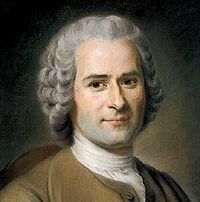
3. Jean-Jacques Rousseau
Rousseau was a brilliant polemicist known to many as the “Father of the French Revolution.” His theorizing about the social contract is ample fodder for political science courses. Slightly less well-known is his counter to Hobbes’ description of a brutish state of nature in his savage noblesse, whose supposedly gentle nature implied civilization was a corrupter of man, rather than a life-edifying social arrangement, thus making him influential with the environmental left. His ideas can still be felt today in artificial constructs of society versus nature, particularly in regards to the industrial revolution. A bit of a sexual pervert, he enjoyed sado-masochism, like fellow leftist the Marquis de Sade.
4. Robespierre
The bloody French revolutionary known as Robespierre is perhaps the emblematic figure of The Enlightenment gone awry. His steely insistence on classically liberal concepts animated his deep desire to destroy the Ancien Regime and all it stood for. Unfortunately, the unethical means he advocated to accomplish his goals did not match his occasionally moral ends. His name would become synonymous with la Terreur; if Rousseau was the Father of the Revolution, Robespierre is the Father of Terrorism.
5. Immanuel Kant
Ayn Rand considered Immanuel Kant to be the arch-enemy of reason, mind, truth, and happiness. Through such works as the Critique of Pure Reason, Kant divorced reality from man’s ability to perceive it, and posed that reason was prostrate to directly know anything. Instead, he argued that men were imprisoned by their senses and doomed to grope in the dark for as long as they existed. His influence is widespread and ephemeral; Kant’s dark impress can be felt in the Zeitgeist since his day, expressed in extreme skepticism and pessimism. His works have done much to demoralize and infantalize man.
6. G.W.F. Hegel
One of the pre-eminent left-wing thinkers of modern times, he is known as an Uber-statist and the mentor of Karl Marx. One of the most significant contributions to the radical cause is his conceptualization of historical inevitability. He is widely acknowledged as among the first philosophers to imbue teleology into his thinking, and influence one sees in Marx’s pronouncement of the eventual triumph of socialism. Writing with an esoteric and borderline incomprehensible style, he is the archetype of the indecipherable intellectual. Rightfully called the Father of Totalitarianism.
7. Arthur Schopenhauer
A Gremlinesque figure whose scrawlings are extremely pessimistic and grim. His main argument is that all phenomena and universal life-force can be reduced to the Will. The universe wills itself to exist, like human beings will themselves to survive. His borderline nihilistic synopsis of the quintessence of life and existence presages Heidegger, and his emphasis on Will marks a transition point to Nietzsche’s Will to Power, so popular later with the National Socialists. His thoughts and works can be grouped with Kant’s and Hegel’s as reflective of German Idealism, staples of early (European) Continental Philosophy.
8. Ludwig Feuerbach
An often overlooked philosopher on the right, his views on religion are among the purest expressions of secular humanism one can find. Feuerbach was an atheist who believed that God is a projection of human beings’ self-alienated desires. God’s eternal nature is man’s wish for immortality; His Holiness is man’s wish to become sinless and pure; Heaven is a manifestation of man’s desire for a perfect world; and the Trinity is symbolic of desiring to become part of something while retaining identity. Feuerbach’s influence can also be seen in existentialist, atheist, and psychoanalytical circles.
9. Karl Marx
Probably the best known and most influential leftist of them all. Marx’s inversion of Hegelian dialectics in a materialist mode sought to destroy what he saw were class relations of exploitation and oppression. A perpetual gold-digger and deadbeat dad reliant upon the funding of his associate Friedrich Engels, his life is an outstanding example of how the left thinks the world should work. Marx believed foremost that “all that exists deserves to perish,” and he constructed his theory around that imperative. His adaptation of Ricardo’s debunked Labor Theory of Value, utilization of the discredit Iron Law of Wages, and contradictory argument that one’s philosophy is materially determined by class relations, are useful anti-capitalist myths the left have invoked for generations.
10. Friedrich Nietzsche
A morose, brooding figure whose thinking defies right and left classification, and indeed, many deny that he was a philosopher, as if such a guild exists. Nietzsche is best known as a nihilist, or someone who did not believe there were such actual things as good and evil, but he grappled with this insight his entire literary career. An ardent attacker of religion, he deemed Christianity to be an internalized “slave morality,” and claimed that what are considered to be sins among the masses are merely the virtues of the rulers. In his view, the Will to Power underlay the rhetoric of the masters, and moralizing is merely an instrumental abuse of language for personal gain (whether altruistic in form or not). Went mad in his later years.
11. Mikhail Bakunin
Looking like the slightly more disheveled twin of Karl Marx, Bakunin was an anarchist flamethrower from the early 19th century. With Sergei Nechaev he co-wrote the influential left-wing guidebook The Catechism of a Revolutionist, a nineteenth century “Rules for Radicals,” if you will.. He was probably the more theoretically minded of the destructive duo, whose advocacy of revolutionary violence laid the groundwork for anarchist and socialist circles throughout the century and beyond. His presence can still be felt among such modern self-styled anarchists as the Black Blok, the more strident arm of left-wing movements like Occupy.
12. Sigmund Freud
The Father of Psychoanalysis, as he became known, is one of the key figures of modern psychology. His musings on human sexuality, as unprovable as they are, have been influential in imbuing psychosexual motives to a wide range of human behavior. One of his more charming heuristics is that men are possessed to kill their fathers in order to debauch their mothers. His formulation of the subconscious has become an omnipresent understanding of Western discourse, and is often invoked as a literal catch-all explanation of human motivation. A chief theoretician adapted and integrated by the New Left.
13. V.I. Lenin
Born Vladimir Ilyich Ulyanov, he became radicalized and intensely interested in Marxist theory after his brother was executed for plotting to kill the Tsar. Lenin would adapt Marxism from a theory proclaiming the inevitable triumph of the proletariat to a call to action for a cadre of intellectuals to usher in socialism’s realization. His putsch of Russia in October 1917 and surrender to Germany in WW I would hasten in a ravaging Civil War. Economic dislocation due to War Communism led to trauma among the peasantry, who were finally allowed petty marketing under his New Economic Plan. He died after a sudden stroke in 1924, paving the way for the even more ruthless Stalin.
14. Leon Trotsky
A superb orator and intellectual, Lev Davidovich Bronshtein, as he was born, was initially a leader of the so-called Menshevik faction of world communists. Early on, he supported the argument that Russia should be propelled through the historical stages outlined by Marx in order to reach the socialist end-goal. Later, he became famous as an advocate of “perpetual revolution” in order to forestall any reversion of the socialist revolution into authoritarian statism. For this innovation, Trotsky became a hated rival of Joseph Stalin, whose contributions to leftism are not so much intellectual as they are practically brutal in implementation. Trotsky would be hunted down while in exile and killed by a Stalin-hired assassin in Mexico.
15. Antonio Gramsci
Continuing the tradition of frizzy-haired radicals, the great strategician of the cultural Marxists was the Italian communist Antonio Gramsci, whose contributions to the left’s grand strategy of cultural destruction cannot be overemphasized. Gramsci’s argument was the capitalism’s contradictions were held together by cultural hegemony, or domination, which should be undermined and used to further the effort to simultaneously transform the economic base. Gramsci’s demand for a “long march” through the West’s institutions is the master key that unlocks one’s understanding of the modern left.
16. Gyorgy Lukacs
Hungary’s Minister of Culture under the short-lived Bela Kun government of 1919, Lukacs was a primary advocate of sexualizing youth in order to destroy Christian culture. Lukacs’s argument was that the use of the education system to teach the young sexual perversion would “liberate” them from Christianity, and cause them to rebel against their parents. This would make them more irresponsible and thus more receptive to state authority and communism. He was thrown out of power by outraged Christians in one of the few effective uprisings against a communist regime. His influence can be seen with such figures as Safe Schools Czar Kevin Jennings, known to have prurient interests in youth sexuality.
17. Theodore Adorno
One of the least mentioned and most important voices on the New Left, he was a critical early influence in the Frankfurt School, a circle of intellectuals exiled from Hitler’s Germany. Established at Columbia’s Institute for Social Research, Adorno would work on the influence of mass media in obstructing or furthering the socialist cause. A specialist on music theory and the medium of radio, he argued that repetition itself ‘demystified’ the romantic and individualistic nature of Western art, an insight that helps explain the primary role of repetition in modern culture. He is perhaps best known popularly for his specious theory of the inherent “authoritarian personality” of all conservatives.
18. Max Horkheimer
Adorno’s mentor (and rumored by some on the left to be his gay lover), Max Horkheimer was a founding member of the Frankfurt School. He was a collaborator with Adorno on the Dialectic of Enlightenment, which explicitly sought to reverse the Enlightenment’s historical gains. Their theorizing would produce the seminal texts of Critical Theory, which is an idea based on unremitting criticism of Western philosophy without the need for justifying a viable alternative. Critical Theory would evolve to become a guide for tactics as well, breaking up the left into complementary “social justice” movements aimed tacitly at destroying Western culture. These architects of “political correctness” should be well-known to every American conservative.
19. Herbert Marcuse
Marcuse co-founded the Frankfurt Institute for Social Research with Theodore Adorno and Max Horkheimer. He has also been credited with developing Critical Theory, a type of Neomarxism influenced by Hegelian Idealism, psychoanalysis and existentialism. His primary motive was to build an aesthetic critique of capitalist culture, since Marx’s economic critiques were widely acknowledged to have failed. Best known popularly for his book Eros and Civilization, and the slogan “Make Love not War.” His work would help revitalize Freud and Hegel on the Marxian left.
20. Erich Fromm
Known as an expert on Freud, the Critical Theorist Erich Fromm was somewhat of a quack whose speculation on human psychology ran afoul of Herbert Marcuse, who condemned him as a revolutionary who had fallen into de facto support for the status quo. In typical left-wing fashion, as credibility comes from out-radicalizing one’s critics, Fromm rebuffed Marcuse as a dogmatist. Perhaps Fromm’s most interesting and twisted work is Escape from Freedom, in which he argued mankind was tormented by the Enlightenment’s version of freedom, and is thereby alienated from his community.
21. John Maynard Keynes
One of the most influential economists in world history, John Maynard Keynes developed a leading reputation during and after the Paris Peace Conference of 1919. His strongest imprint would be felt at the post-World War II Bretton Woods Conference, however, and his thinking has dominated the academic and political world ever since. Argued by many pragmatists and other statists to be a capitalist “reformer,” his policies of unending state market intervention, such as boosting aggregate demand in an economic downturn, would justify constant government meddling, unmeddling, and scapegoating of capitalism for the state’s inevitable economic failures.
22. John Dewey
Recognized by some as the Father of American Education, Dewey’s radicalism is difficult to expose in a compressed space. His pragmatism would situate morality temporally, thus removing the concept of universal ethical application. An ardent believer in pure democracy, or what many would identify as social democracy, his ideas when applied through such institutions as education and journalism break down the Western moral and political order. A Deweyan world would thus be one where all would be up for vote and morality would be contextually bound by historical circumstances, in many ways the antithesis of American Constitutional government.
Heidegger is best known perhaps as the philosopher who both sympathized with, and who was adapted by, the Nazis. His primary contribution would be to existentialism in his argument that the essence of life is existence, and that the notion of there being a meaning to life is absurd. His anti-humanistic philosophy would break down man into a creature no better than animals, one ridiculously inflated in self-importance. Heidegger’s impact can be seen in modern form in the leftist movement of radical environmentalism, a program non-coincidentally bearing many resemblances to fascism.
24. Saul Alinsky
Born to Russian immigrants, Saul Alinsky would become a master political tactician. His texts, Reveille for Radicals and the better-known Rules for Radicals, would be seized upon as bibles for left-wing operators ranging from the average street thug or shakedown artist to political heavyweights like Hillary Clinton and Barack Obama. His Machiavellian emphasis on unabashed power-seeking combined with an ends-justify-the-means mentality would become vital to forming the remorselessly destructive and unscrupulous left. Many of his tactics can be seen throughout the media today, such as the persistent use of ridicule by the left to delegitimize conservative opposition.
25. Noam Chomsky
Chomsky is as notorious for his public criticism of “neo-conservative” policies as he is for his contributions to linguistics. His unapologetic support for anarchism or “libertarian socialism” has made him a prominent intellectual leader on the contemporary left. In Manufacturing Consent, he points out three media biases: the profit motive, advertising, and reporting news favorable to the government since it is a main source of news. He then goes on to argue that “flak,” or how special interest groups mobilize against criticism, “anti-communism” and in the post-Cold War setting “The War on Terror,” silence news outfits. Political Correctness is an infinitely more potent journalistic bias than either of his two above-named forms of bias.
26. Michel Foucault
Foucault’s deconstruction of literature and history in terms of power relationships provides a critical link in the transition from early Critical Theory to “post-structural” techniques of advancing the leftist cause. The French philosopher’s main contribution, and thereby his central means of indoctrinating students into the leftist cause, is his argument that power relationships are absolutely inescapable. In other words, all works of art and literature reflect the preferred power relationship bias of their creators, spawning modes of “feminist” or “black” critiques. His work attracted the criticism of fellow left-wing intellectuals Jean-Paul Sartre and Richard Rorty, who are important in their own right, but who will only be mentioned in passing here.
27. Jacques Derrida
Derrida is alternatively a post-modernist or a post-structuralist, depending on which leftist you ask. His method of exegesis is a standard benchmark of literary departments around the world, and has famously been captured in his phrase “there is nothing outside the text.” Derrida explains that his process is one of constant contextualization and re-contextualization of the text. As he describes himself as a historian, one sees the influence of the Continental Philosophy concept of historicism in his work, meaning, the limiting of truth to historical circumstance. Such a program attempts to deprive The Enlightenment of its universalistic claims of truth, and to “get beyond” its modernizing locus.
28. Jurgen Habermas
Considered to one of the most influential Neomarxists alive, Habermas is known for his theories of intersubjective discourse, communicative rationality, and the operations of the public sphere. The innovation of Habermas’ theorizing is to transform rationality from its understanding as a tool for man to understand the universe to one fulfilling the communicative goal for man to be mutually understood. His drawing on hermeneutics, pragmatism, and social psychology thus renders communication and reason as impotent means to understanding the world, instead emphasizing their essentially social role. In some ways, a living contributor to the Frankfurt School.
29. Slavoj Žižek
A favorite among contemporary anarchists, his views are a hodge-podge defying academic or philosophical description. His views are variegated, but center around the Critical Theory agenda of intense criticism of capitalism and Western society. A featured speaker at the Occupy Wall Street protest, he has become somewhat of a darling among young radicals. The cogency of his vision and his academic rigor, however, is questionable. Nonetheless, he has provided ample fodder for endless college bull sessions, and his simultaneous advocacy of “politicizing the economy” and anarchism is a poignant exemplar of the modern left’s refusal to believe in contradictions.
30. Barack Obama?
Perhaps the most complete personification of radical ideologies and agendas, Barack Obama is both a cunning Alinskyite street operator and a media-styled intellectual aloof from philosophical categorization. The leftist influences on his thoughts and actions, however, are clear. As he himself bragged, “To avoid being mistaken for a sellout, I chose my friends carefully, the more politically active black students. The foreign students. The Chicanos. The Marxist professors and structural feminists.” But in his person, he defrays the argument that he is a Marxist radical: through his clothes, effete mannerisms, soothing pre-meditated lectures, to the fact he himself is the result of a racially mixed relationship. Barack Obama is Critical Theory. And he has been specifically reared to “fundamentally transform” America from a free nation based on liberty to a Marxian superstate. We must fully understand him and refuse to let him.
CDN:
Patriotic Americans are raised with a respect for our Founding Fathers: Benjamin Franklin, Thomas Jefferson, James Madison, Alexander Hamilton, and George Washington being among the most famous. But there is a sizable segment of our population who have little respect for these intellectual and political titans; instead they admire a roster of radicals, revolutionaries, and reprobates.
Rather than regurgitate a stale description of these great thinkers’ ideas, which is available all over the Internet, we shall take an irreverent look at what makes these figures significant in the minds of leftists. A quick look at the “Dirty Thirty” will hopefully be on some counts informative and illuminating.
1. Plato
Proto-communist philosopher of ancient Greece. Non-coincidentally lived just prior to the fall of Athens. His Republic doesn’t so much resemble the self-titled system of government than a communist oligarchy ruled by philosopher-kings. Stratified by role, Plato’s ideal society is enforced by Guardians, a KGB-like police force that cracks down on the sheeple at the behest of the philosopher kings. Plato’s pre-Kantian notion of Forms would fuse with Christianity to dominate the aptly named Dark Ages. His advocacy of banishing private property was aptly rebuffed by Aristotle.
2. Sir Thomas Moore
Sir Thomas More is revered for being a “saintly” figure in both Catholic and left-wing lore. His seminal novel Utopia, a Greek word meaning “Nowhere,” has stimulated countless flights into otherworldly fancy, and numerous quixotic and sometimes bloody attempts to superimpose fantasy on reality. In More’s novel, a world traveler regales the protaganist about a wonderful world where there is no private property, and everyone’s needs are provided for through compulsory labor. His book would inspire an entire genre of works categorized only as “utopian.”
3. Jean-Jacques Rousseau
Rousseau was a brilliant polemicist known to many as the “Father of the French Revolution.” His theorizing about the social contract is ample fodder for political science courses. Slightly less well-known is his counter to Hobbes’ description of a brutish state of nature in his savage noblesse, whose supposedly gentle nature implied civilization was a corrupter of man, rather than a life-edifying social arrangement, thus making him influential with the environmental left. His ideas can still be felt today in artificial constructs of society versus nature, particularly in regards to the industrial revolution. A bit of a sexual pervert, he enjoyed sado-masochism, like fellow leftist the Marquis de Sade.
4. Robespierre
The bloody French revolutionary known as Robespierre is perhaps the emblematic figure of The Enlightenment gone awry. His steely insistence on classically liberal concepts animated his deep desire to destroy the Ancien Regime and all it stood for. Unfortunately, the unethical means he advocated to accomplish his goals did not match his occasionally moral ends. His name would become synonymous with la Terreur; if Rousseau was the Father of the Revolution, Robespierre is the Father of Terrorism.
5. Immanuel Kant
Ayn Rand considered Immanuel Kant to be the arch-enemy of reason, mind, truth, and happiness. Through such works as the Critique of Pure Reason, Kant divorced reality from man’s ability to perceive it, and posed that reason was prostrate to directly know anything. Instead, he argued that men were imprisoned by their senses and doomed to grope in the dark for as long as they existed. His influence is widespread and ephemeral; Kant’s dark impress can be felt in the Zeitgeist since his day, expressed in extreme skepticism and pessimism. His works have done much to demoralize and infantalize man.
6. G.W.F. Hegel
One of the pre-eminent left-wing thinkers of modern times, he is known as an Uber-statist and the mentor of Karl Marx. One of the most significant contributions to the radical cause is his conceptualization of historical inevitability. He is widely acknowledged as among the first philosophers to imbue teleology into his thinking, and influence one sees in Marx’s pronouncement of the eventual triumph of socialism. Writing with an esoteric and borderline incomprehensible style, he is the archetype of the indecipherable intellectual. Rightfully called the Father of Totalitarianism.
7. Arthur Schopenhauer
A Gremlinesque figure whose scrawlings are extremely pessimistic and grim. His main argument is that all phenomena and universal life-force can be reduced to the Will. The universe wills itself to exist, like human beings will themselves to survive. His borderline nihilistic synopsis of the quintessence of life and existence presages Heidegger, and his emphasis on Will marks a transition point to Nietzsche’s Will to Power, so popular later with the National Socialists. His thoughts and works can be grouped with Kant’s and Hegel’s as reflective of German Idealism, staples of early (European) Continental Philosophy.
8. Ludwig Feuerbach
An often overlooked philosopher on the right, his views on religion are among the purest expressions of secular humanism one can find. Feuerbach was an atheist who believed that God is a projection of human beings’ self-alienated desires. God’s eternal nature is man’s wish for immortality; His Holiness is man’s wish to become sinless and pure; Heaven is a manifestation of man’s desire for a perfect world; and the Trinity is symbolic of desiring to become part of something while retaining identity. Feuerbach’s influence can also be seen in existentialist, atheist, and psychoanalytical circles.
9. Karl Marx
Probably the best known and most influential leftist of them all. Marx’s inversion of Hegelian dialectics in a materialist mode sought to destroy what he saw were class relations of exploitation and oppression. A perpetual gold-digger and deadbeat dad reliant upon the funding of his associate Friedrich Engels, his life is an outstanding example of how the left thinks the world should work. Marx believed foremost that “all that exists deserves to perish,” and he constructed his theory around that imperative. His adaptation of Ricardo’s debunked Labor Theory of Value, utilization of the discredit Iron Law of Wages, and contradictory argument that one’s philosophy is materially determined by class relations, are useful anti-capitalist myths the left have invoked for generations.
10. Friedrich Nietzsche
A morose, brooding figure whose thinking defies right and left classification, and indeed, many deny that he was a philosopher, as if such a guild exists. Nietzsche is best known as a nihilist, or someone who did not believe there were such actual things as good and evil, but he grappled with this insight his entire literary career. An ardent attacker of religion, he deemed Christianity to be an internalized “slave morality,” and claimed that what are considered to be sins among the masses are merely the virtues of the rulers. In his view, the Will to Power underlay the rhetoric of the masters, and moralizing is merely an instrumental abuse of language for personal gain (whether altruistic in form or not). Went mad in his later years.
11. Mikhail Bakunin
Looking like the slightly more disheveled twin of Karl Marx, Bakunin was an anarchist flamethrower from the early 19th century. With Sergei Nechaev he co-wrote the influential left-wing guidebook The Catechism of a Revolutionist, a nineteenth century “Rules for Radicals,” if you will.. He was probably the more theoretically minded of the destructive duo, whose advocacy of revolutionary violence laid the groundwork for anarchist and socialist circles throughout the century and beyond. His presence can still be felt among such modern self-styled anarchists as the Black Blok, the more strident arm of left-wing movements like Occupy.
12. Sigmund Freud
The Father of Psychoanalysis, as he became known, is one of the key figures of modern psychology. His musings on human sexuality, as unprovable as they are, have been influential in imbuing psychosexual motives to a wide range of human behavior. One of his more charming heuristics is that men are possessed to kill their fathers in order to debauch their mothers. His formulation of the subconscious has become an omnipresent understanding of Western discourse, and is often invoked as a literal catch-all explanation of human motivation. A chief theoretician adapted and integrated by the New Left.
13. V.I. Lenin
Born Vladimir Ilyich Ulyanov, he became radicalized and intensely interested in Marxist theory after his brother was executed for plotting to kill the Tsar. Lenin would adapt Marxism from a theory proclaiming the inevitable triumph of the proletariat to a call to action for a cadre of intellectuals to usher in socialism’s realization. His putsch of Russia in October 1917 and surrender to Germany in WW I would hasten in a ravaging Civil War. Economic dislocation due to War Communism led to trauma among the peasantry, who were finally allowed petty marketing under his New Economic Plan. He died after a sudden stroke in 1924, paving the way for the even more ruthless Stalin.
14. Leon Trotsky
A superb orator and intellectual, Lev Davidovich Bronshtein, as he was born, was initially a leader of the so-called Menshevik faction of world communists. Early on, he supported the argument that Russia should be propelled through the historical stages outlined by Marx in order to reach the socialist end-goal. Later, he became famous as an advocate of “perpetual revolution” in order to forestall any reversion of the socialist revolution into authoritarian statism. For this innovation, Trotsky became a hated rival of Joseph Stalin, whose contributions to leftism are not so much intellectual as they are practically brutal in implementation. Trotsky would be hunted down while in exile and killed by a Stalin-hired assassin in Mexico.
15. Antonio Gramsci
Continuing the tradition of frizzy-haired radicals, the great strategician of the cultural Marxists was the Italian communist Antonio Gramsci, whose contributions to the left’s grand strategy of cultural destruction cannot be overemphasized. Gramsci’s argument was the capitalism’s contradictions were held together by cultural hegemony, or domination, which should be undermined and used to further the effort to simultaneously transform the economic base. Gramsci’s demand for a “long march” through the West’s institutions is the master key that unlocks one’s understanding of the modern left.
16. Gyorgy Lukacs
Hungary’s Minister of Culture under the short-lived Bela Kun government of 1919, Lukacs was a primary advocate of sexualizing youth in order to destroy Christian culture. Lukacs’s argument was that the use of the education system to teach the young sexual perversion would “liberate” them from Christianity, and cause them to rebel against their parents. This would make them more irresponsible and thus more receptive to state authority and communism. He was thrown out of power by outraged Christians in one of the few effective uprisings against a communist regime. His influence can be seen with such figures as Safe Schools Czar Kevin Jennings, known to have prurient interests in youth sexuality.
17. Theodore Adorno
One of the least mentioned and most important voices on the New Left, he was a critical early influence in the Frankfurt School, a circle of intellectuals exiled from Hitler’s Germany. Established at Columbia’s Institute for Social Research, Adorno would work on the influence of mass media in obstructing or furthering the socialist cause. A specialist on music theory and the medium of radio, he argued that repetition itself ‘demystified’ the romantic and individualistic nature of Western art, an insight that helps explain the primary role of repetition in modern culture. He is perhaps best known popularly for his specious theory of the inherent “authoritarian personality” of all conservatives.
18. Max Horkheimer
Adorno’s mentor (and rumored by some on the left to be his gay lover), Max Horkheimer was a founding member of the Frankfurt School. He was a collaborator with Adorno on the Dialectic of Enlightenment, which explicitly sought to reverse the Enlightenment’s historical gains. Their theorizing would produce the seminal texts of Critical Theory, which is an idea based on unremitting criticism of Western philosophy without the need for justifying a viable alternative. Critical Theory would evolve to become a guide for tactics as well, breaking up the left into complementary “social justice” movements aimed tacitly at destroying Western culture. These architects of “political correctness” should be well-known to every American conservative.
19. Herbert Marcuse
Marcuse co-founded the Frankfurt Institute for Social Research with Theodore Adorno and Max Horkheimer. He has also been credited with developing Critical Theory, a type of Neomarxism influenced by Hegelian Idealism, psychoanalysis and existentialism. His primary motive was to build an aesthetic critique of capitalist culture, since Marx’s economic critiques were widely acknowledged to have failed. Best known popularly for his book Eros and Civilization, and the slogan “Make Love not War.” His work would help revitalize Freud and Hegel on the Marxian left.
20. Erich Fromm
Known as an expert on Freud, the Critical Theorist Erich Fromm was somewhat of a quack whose speculation on human psychology ran afoul of Herbert Marcuse, who condemned him as a revolutionary who had fallen into de facto support for the status quo. In typical left-wing fashion, as credibility comes from out-radicalizing one’s critics, Fromm rebuffed Marcuse as a dogmatist. Perhaps Fromm’s most interesting and twisted work is Escape from Freedom, in which he argued mankind was tormented by the Enlightenment’s version of freedom, and is thereby alienated from his community.
21. John Maynard Keynes
One of the most influential economists in world history, John Maynard Keynes developed a leading reputation during and after the Paris Peace Conference of 1919. His strongest imprint would be felt at the post-World War II Bretton Woods Conference, however, and his thinking has dominated the academic and political world ever since. Argued by many pragmatists and other statists to be a capitalist “reformer,” his policies of unending state market intervention, such as boosting aggregate demand in an economic downturn, would justify constant government meddling, unmeddling, and scapegoating of capitalism for the state’s inevitable economic failures.
22. John Dewey
Recognized by some as the Father of American Education, Dewey’s radicalism is difficult to expose in a compressed space. His pragmatism would situate morality temporally, thus removing the concept of universal ethical application. An ardent believer in pure democracy, or what many would identify as social democracy, his ideas when applied through such institutions as education and journalism break down the Western moral and political order. A Deweyan world would thus be one where all would be up for vote and morality would be contextually bound by historical circumstances, in many ways the antithesis of American Constitutional government.
Heidegger is best known perhaps as the philosopher who both sympathized with, and who was adapted by, the Nazis. His primary contribution would be to existentialism in his argument that the essence of life is existence, and that the notion of there being a meaning to life is absurd. His anti-humanistic philosophy would break down man into a creature no better than animals, one ridiculously inflated in self-importance. Heidegger’s impact can be seen in modern form in the leftist movement of radical environmentalism, a program non-coincidentally bearing many resemblances to fascism.
24. Saul Alinsky
Born to Russian immigrants, Saul Alinsky would become a master political tactician. His texts, Reveille for Radicals and the better-known Rules for Radicals, would be seized upon as bibles for left-wing operators ranging from the average street thug or shakedown artist to political heavyweights like Hillary Clinton and Barack Obama. His Machiavellian emphasis on unabashed power-seeking combined with an ends-justify-the-means mentality would become vital to forming the remorselessly destructive and unscrupulous left. Many of his tactics can be seen throughout the media today, such as the persistent use of ridicule by the left to delegitimize conservative opposition.
25. Noam Chomsky
Chomsky is as notorious for his public criticism of “neo-conservative” policies as he is for his contributions to linguistics. His unapologetic support for anarchism or “libertarian socialism” has made him a prominent intellectual leader on the contemporary left. In Manufacturing Consent, he points out three media biases: the profit motive, advertising, and reporting news favorable to the government since it is a main source of news. He then goes on to argue that “flak,” or how special interest groups mobilize against criticism, “anti-communism” and in the post-Cold War setting “The War on Terror,” silence news outfits. Political Correctness is an infinitely more potent journalistic bias than either of his two above-named forms of bias.
26. Michel Foucault
Foucault’s deconstruction of literature and history in terms of power relationships provides a critical link in the transition from early Critical Theory to “post-structural” techniques of advancing the leftist cause. The French philosopher’s main contribution, and thereby his central means of indoctrinating students into the leftist cause, is his argument that power relationships are absolutely inescapable. In other words, all works of art and literature reflect the preferred power relationship bias of their creators, spawning modes of “feminist” or “black” critiques. His work attracted the criticism of fellow left-wing intellectuals Jean-Paul Sartre and Richard Rorty, who are important in their own right, but who will only be mentioned in passing here.
27. Jacques Derrida
Derrida is alternatively a post-modernist or a post-structuralist, depending on which leftist you ask. His method of exegesis is a standard benchmark of literary departments around the world, and has famously been captured in his phrase “there is nothing outside the text.” Derrida explains that his process is one of constant contextualization and re-contextualization of the text. As he describes himself as a historian, one sees the influence of the Continental Philosophy concept of historicism in his work, meaning, the limiting of truth to historical circumstance. Such a program attempts to deprive The Enlightenment of its universalistic claims of truth, and to “get beyond” its modernizing locus.
28. Jurgen Habermas
Considered to one of the most influential Neomarxists alive, Habermas is known for his theories of intersubjective discourse, communicative rationality, and the operations of the public sphere. The innovation of Habermas’ theorizing is to transform rationality from its understanding as a tool for man to understand the universe to one fulfilling the communicative goal for man to be mutually understood. His drawing on hermeneutics, pragmatism, and social psychology thus renders communication and reason as impotent means to understanding the world, instead emphasizing their essentially social role. In some ways, a living contributor to the Frankfurt School.
29. Slavoj Žižek
A favorite among contemporary anarchists, his views are a hodge-podge defying academic or philosophical description. His views are variegated, but center around the Critical Theory agenda of intense criticism of capitalism and Western society. A featured speaker at the Occupy Wall Street protest, he has become somewhat of a darling among young radicals. The cogency of his vision and his academic rigor, however, is questionable. Nonetheless, he has provided ample fodder for endless college bull sessions, and his simultaneous advocacy of “politicizing the economy” and anarchism is a poignant exemplar of the modern left’s refusal to believe in contradictions.
30. Barack Obama?
Perhaps the most complete personification of radical ideologies and agendas, Barack Obama is both a cunning Alinskyite street operator and a media-styled intellectual aloof from philosophical categorization. The leftist influences on his thoughts and actions, however, are clear. As he himself bragged, “To avoid being mistaken for a sellout, I chose my friends carefully, the more politically active black students. The foreign students. The Chicanos. The Marxist professors and structural feminists.” But in his person, he defrays the argument that he is a Marxist radical: through his clothes, effete mannerisms, soothing pre-meditated lectures, to the fact he himself is the result of a racially mixed relationship. Barack Obama is Critical Theory. And he has been specifically reared to “fundamentally transform” America from a free nation based on liberty to a Marxian superstate. We must fully understand him and refuse to let him.
Subscribe to:
Posts (Atom)