Wednesday, March 6, 2013

Eurozone recession deepens: official data

March, 6, 2013


A giant logo of the Euro currency stands in front of the European Central Bank (ECB) in the banking district of Frankfurt, western Germany, on July 31, 2012. The 17-nation eurozone sank further into recession in the last three months of 2012 as the debt crisis continued to exact a heavy price, official data showed Wednesday.
AFP - The 17-nation eurozone sank further into recession in the last three months of 2012 as the debt crisis continued to exact a heavy price, official data showed Wednesday.

The eurozone economy shrank 0.6 percent in the fourth quarter of 2012 compared with the third quarter when it contracted 0.1 percent, the Eurostat data agency said, confirming initial estimates given in February.

For the full 27-member European Union, the economy was 0.5 percent smaller in the fourth quarter after a marginal gain of 0.1 percent in the third, Eurostat said.

A recession is counted as two consecutive quarterly economic contractions.

Compared with fourth quarter 2011, the eurozone economy was down 0.9 percent and the EU 27 off 0.6 percent.

Among the major economies, European powerhouse Germany shrank 0.6 percent in the fourth quarter after a gain of 0.2 percent in the third and France slipped 0.3 percent after growth of 0.1 percent.

Non-euro Britain lost 0.3 percent after sharp growth of 1.0 percent in the third quarter, boosted by the London Olympics.

Among the fourth quarter best performers were Estonia, which grew 0.9 percent and Lithuania, up 0.7 percent, while bailed-out Portugal was the weakest, with its economy shrinking 1.8 percent.

Eurostat said that for 2012 as a whole, the eurozone economy contracted 0.6 percent and the EU 0.3 percent.

Data so far for 2013 suggests the European economy is stabilising after a very bad 2012 but the outlook remains weak and uncertain.

Liberty University now biggest in U.S.

March 6, 2013

Graduates play with beach balls before their commencement ceremony at Liberty University in Lynchburg, Virginia on May 19, 2007. (UPI Photo/Alexis C. Glenn) License photo
LIBERTY, Va., March 5 (UPI) -- Liberty University in Virginia, founded in 1971 by Jerry Falwell as Lynchburg Baptist College, has become the largest private university in the country.

The university now has more than 74,000 students, almost 62,000 of them studying on line, The Washington Post reports. At the end of 2012, Liberty reported more than $1 billion in net assets, 10 times the amount in 2006.

Liberty grew fast under Falwell, the pastor of the Thomas Road Baptist Church in Lynchburg and one of the country's leading conservative evangelical leaders. But its growth has been explosive since his death in 2007.

Only 47 percent of its students get degrees within six years of enrolling, the Post said. The national average is 58 percent.

Jerry Falwell Jr., who now serves as chancellor and president, said the school strives to provide opportunity for people seeking college degrees.

"We believe that Liberty will redefine what is considered an academically prestigious university in the future," he said.

Liberty's loan default rate is below average, suggesting it has avoided piling its students with loads of debt.

Falwell also said Liberty has shifted away from its original mission. He wants Liberty to be the evangelical equivalent of Notre Dame or Brigham Young.

"We're not the Moral Majority anymore," he said. "We're not a church. Our mission is to educate."

Mexico's lower house passes bill to remove lawmaker immunity

March 6, 2013

Mexico's President Enrique Pena Nieto gestures during the Central American Integration System (SICA) summit in San Jose February 20, 2013. Credit: Reuters/Juan Carlos Ulate

(Reuters) - Mexico's lower house of Congress voted overwhelmingly Tuesday to strip federal lawmakers of criminal immunity, part of a larger reform push in Latin America's second-largest economy.

The vote was 376 in favor to 56 opposed, with five abstentions.

The bill aims to amend the country's constitution to make federal senators and deputies subject to the country's criminal justice system, but still protect lawmakers from being detained for the duration of their terms in office.

The proposal, which would also apply to other high-ranking federal officials, now moves to the Mexican Senate for consideration.

The bill is part of a larger reform push aimed at fostering more transparency by new President Enrique Pena Nieto of the centrist Institutional Revolutionary Party, or PRI, and the party's allies in Congress.

Hypocracy 101: Michelle Obama hosts dinner at pizza parlor same day as Let's Move chat

March, 6, 2013

Let's MOOoove!!!!!

Every now and then, even Michelle Obama deserves a big slice of pizza. However, as with many Obama outings, she chose exactly the wrong time. Earlier today, the first lady held a highly publicized Google hangout promoting her ”Let’s Move” campaign to end obesity. Yet tonight, she’s holding a dinner meeting at Capitol Hill’s popular We The Pizza.

So, Michelle, are we having a salad tonight? Oh, and your guests are all staying away from those calorie-licious slices of cheesy goodness … riiiiiiiight?

MUCH More>>


Shocker: Venezuelan President Hugo Chavez dead after battle with cancer

March 6, 2013

To whom it may concern: A good cover up can only last so long... Followers of this blog knew 3 months ago the announcement would only be made once his successors and the military had all the dominoes in place to maintain power. 


CARACAS, Venezuela – Some in anguish, some in fear, Venezuelans raced for home on Tuesday after the government announced the death of President Hugo Chavez, the firebrand socialist who led the nation for 14 years.

Vice President Nicolas Maduro's voice broke and tears ran down his face as he appeared on national television to announce that Chavez died at 4:25 p.m. local time 3:55 p.m EST "after battling hard against an illness over nearly two years."

He did not say what exactly killed Chavez, although the government had announced the previous night that a severe new respiratory infection had severely weakened him.

Just a few hours earlier, Maduro made a virulent speech against enemies he claimed were trying to undermine Venezuelan democracy.

But as he announced the death, Maduro called on Venezuelans to be "dignified inheritors of the giant man" Chavez was.

"Let there be no weakness, no violence. Let there be no hate. In our hearts there should only be one sentiment: Love. Love, peace and discipline."

All across downtown Caracas, shops and restaurants begin closing and Venezuelans hustled for home, some even breaking into a run.

Many had looks of anguish and incredulity on their faces.

"I feel a sorrow so big I can't speak," said Yamilina Barrios, a 39-year-old clerk who works in the Industry Ministry, her face covered in tears.

"He was the best this country had," she said, disconsolately weeping. "I adore him.

"I hope the country calms down and continues the work that he left us, continues in unity and the progress continues," Barrios said.

Among the nervous was Maria Elena Lovera, a 45-year-old housewife.

"I want to go home. People are crazy and are way too upset."

In the only immediately known incident of political violence, a group of masked, helmeted men on motorcycles, some brandishing revolvers, attacked about 40 students who had been protesting for more than a week near the Supreme Court building to demand the government give more information about Chavez's health.

The attackers, who wore no clothing identifying any political allegiance, burned the students' tents and scattered their food just minutes after the death was announced.

"They burned everything we had," said student leader Gaby Arellano. She said none of the attackers fired a shot but that she saw four with pistols.

Maduro called on Venezuelans to convene in the capital's Bolivar Square, named for the 19th century independence hero Simon Bolivar, who Chavez claimed as his chief inspiration.

The vice president also called on the opposition to respect "the people's pain."

"Those who never supported the comandante Hugo Chavez, respect the pain of the people. This is the moment to think of our families, of our country."

Chavez leaves behind a socialist political movement firmly in control of the nation, but with some doubt about how a new leadership will be formed.

Chavez's illness prevented him from taking the oath of office after he was re-elected to a new term on Oct. 7 and under the constitution, National Assembly chief Diosdado Cabello apparently would take over as interim president.

But there was no sign of Cabello on the podium as Maduro announced Chavez's death.

The constitution also says that elections should be called in 30 days. Chavez had specified that his supporters should support Maduro as his successor.

The man Chavez defeated in October, the youthful Miranda state Gov. Henrique Capriles, would be expected to represent the opposition.

Venezuela's defense minister also appeared on television to announce that the military will remain loyal to the constitution in the wake of Chavez's death.

Admiral Diego Molero appealed for "unity, tranquility and understanding" among Venezuelans.

The announcement stunned Venezuelans, if it did not surprise them.

Earlier in the day, Maduro used a more belligerent tone as he announced the government had expelled two U.S. diplomats from the country and said "we have no doubt" that Chavez's cancer, which was first diagnosed in June 2011, was induced by "the historical enemies of our homeland."

He compared the situation to the death of the Palestinian leader Yasser Arafat, claiming Arafat was "inoculated with an illness."

Chavez's inner circle has long claimed the United States was behind a failed 2002 attempt to overthrow him, and he has frequently played the anti-American card to stir up support. Venezuela has been without a U.S. ambassador since July 2010.

Maduro has been taking on a larger role since Chavez urged Venezuelans to choose him as president before disappearing in early December to undergo a fourth round of cancer surgery in Cuba.

He accused U.S. Embassy's Air Force attache Col. David Delmonaco of spying on Venezuela's military and seeking to involve officers in "destabilizing projects." Maduro gave Delmonaco 24 hours to leave, and U.S. officials said he had already departed the country.

Maduro said Tuesday that the government was "on the trail of other elements that figure in this entire venomous scenario and are seeking to stir up trouble."

Later Tuesday, Foreign Minister Elias Jaua said a second U.S. Air Force attache was being expelled, also for alleged espionage.

"Let's remember that active participation of the United States in the fascist coup of 2002," Jaua said.

Chavez has run Venezuela for more than 14 years as a virtual one-man show, gradually placing all state institutions under his personal control. But the former army paratroop commander, who rose to fame by launching a failed 1992 coup, never groomed a successor with his same kind of force of personality.

The campaign for the upcoming election to replace him, though undeclared, has nevertheless already begun.

Maduro has frequently commandeered all broadcast channels, Chavez-style, to tout the "revolution" and vilify the opposition.

Maduro on Tuesday repeated government claims that Capriles met in the United States over the weekend with right-wing U.S. conspirators and was planning to meet over the weekend with Roberta Jacobsen, assistant U.S. secretary of state for the hemisphere.

One personality on state TV also accused the Capriles family of buying a New York City apartment with stolen funds.

Capriles responded via Twitter Tuesday by calling Maduro a liar.

"Lie after lie in every speech," he said.

Chavez, long famed for his marathon appearances at televised events, had neither been seen nor heard from, except for photos released in mid-February, since submitting to a fourth round of surgery in Cuba on Dec. 11 for an unspecified cancer in the pelvic area. It was first diagnosed in June 2011.

The government said Chavez returned home on Feb. 18 and has been confined to Caracas' military hospital ever since.

Maduro said last week that the president had begun receiving chemotherapy around the end of January.

Among those stunned by the announcement was 38-year-old soft drink seller Nelson Ramirez, who sympathized with the fallen president.

"This is the worst thing that could have happened to our country," he said. "Without Chavez, I don't know what will happen here. We poor people could be forgotten again."

On the other side of Venezuela's political divide was Carlos Quijada, a 38-year-old economist who said he was sad that death rather than an election defeat had written Chavez's political obituary.

"Now there is a lot of uncertainty about what is going to happen," he said.

source

Tuesday, March 5, 2013

More reporters grumbling about nasty treatment from White House

March 5, 2013
by Allahpundit

(HotAir) - You can tell the New York Post is a right-leaning paper from the fact that Maureen Callahan didn’t include the standard “I’m sure the president would disapprove if he knew!” disclaimer that no one actually believes.

Incidentally, how many anecdotes about persistent abusiveness from the White House towards reporters will it take before the Lightbringer no longer gets the benefit of the doubt about his supposed ignorance? You’ve got people as reliably left as Jonathan Alter complaining here, for cripes sake.

“I had a young reporter asking tough, important questions of an Obama Cabinet secretary,” says one DC veteran. “She was doing her job, and they were trying to bully her. In an e-mail, they called her the vilest names — bitch, c–t, a–hole.” He complained and was told the matter would be investigated: “They were hemming and hawing, saying, ‘We’ll look into it.’ Nothing happened.”…

One correspondent says that when he inquired about a staging choice for the president’s speech, he was steamrolled. “There was one specific White House aide calling me up, yelling and screaming,” he says. “It was condescending and abrasive: ‘Why is this a story? Why are you doing this? This is of no consequence. You’re making a mountain out of a molehill.’”

This went on for two days. “All I wanted,” says the reporter, “was an answer to a question. It’s not like I was looking to do a 12-page exposé to take down an aide. It was unnecessary vociferousness.” He eventually got his statement.

Another White House correspondent says that last week’s blowup over pool reporters’ access to the president’s golf game with Tiger Woods — which was none — is indicative of a larger problem. “Today’s a perfect example,” he says. “Jack Lew is sworn in” — as US Treasury secretary, on Thursday — “and they didn’t even allow a photographer in there. A reporter asked [press secretary] Jay Carney why, and his answer was, ‘It’s a family ceremony.’ No! This is a high-ranking government official whose salary is paid for by taxpayers. No.”

Why the extra jerkiness towards the press that’s always given them flowery coverage? One theory in Callahan’s piece is that they’re jerky because they can afford to be: In the age of YouTube and cameo Oscar appearances, the White House doesn’t need the media if it wants face time with the public. There’s truth to that, but I think it’s also a function of the basic “adult in the room versus the most radical wingnuts since Goldwater” message that Team Hopenchange has been pushing since 2009 (or even before). When a reporter challenges the White House, especially when they (wittingly or unwittingly) ventilate a Republican criticism of O in doing so, they’re undermining the “reasonable” party in Washington and aiding and abetting a side that the White House wants the public to see as fundamentally unreasonable and illegitimate. Every bit of negative coverage they get from the media, unless it’s from the left, lends a tiny bit of credence to the GOP, and of course it’s unconscionable to lend credence to “extremism” — especially if, as a member of the media, you’re supposed to be on the left’s team. So when Obama draws media scrutiny, it’s not just that the press is being unhelpful to the Democrats’ agenda. It’s that they’re delivering the country into the hands of the tea partiers who want to destroy blah blah blah. If you viewed the world that way, or rather if you wanted the rest of the world to view the world that way, then you’d be mighty irritable too when, say, some reporter reminded the public that not only did your boss sign the sequester into law, he actually proposed the damned thing.

Speaking of which, here’s Jay Carney throwing a jab at George Will at today’s briefing. Although in Carney’s defense, he did this only after he’d been hit by a roundhouse.


Paradise Lost: California is not too big to fail.

March 5, 2013

One early December morning, Las Vegas police moved in on the Silverton Hotel and Casino, just off the Strip and known for its 117,000-gallon aquarium. There, having located a getaway black Audi with no license plates, they arrested 31-year-old Ka Pasasouk​—​a Laotian immigrant with a violent history who had eluded deportation as well as imprisonment. The Dragnet-style work came less than 24 hours after police back in Northridge, a Los Angeles suburb known for a state university campus, discovered what they called a “very grisly tableau.”

Outside an overcrowded boarding house, described in press accounts as unlicensed, lay the bodies of two men and two women, whom Pasasouk has now been charged with murdering. The story captured attention up and down the already tense state, where the phrase “grisly tableau” could easily have found wide use in the ubiquitous conversations about California’s economic, political, and social decay. America’s promised land has turned dystopian.

Especially in the movies, Californians do love to imagine how the forces of darkness could bring an Armageddon-like end to their earthly paradise. That is because, as they leave the theater, it has always still been paradise. Lately, however, life outside the cineplex has also turned dark.

The image of idyllic California, as cable watchers from coast to coast know, took another devastating blow in mid-February, when the disgruntled former LAPD officer Christopher Dorner went on his wild, manifesto-driven killing spree. In the frantic, weeklong manhunt, during which police officers managed to shoot innocent civilians who stumbled in their way, a sense of unloosed anarchy descended.

Dorner and Pasasouk. The first a crazed ex-cop who, amid his quadruple murders, managed to tweak a race-troubled LAPD history into a PR campaign that stymied public information officers and even, appallingly, gathered a measure of public admiration. The second a near-perfect symbol of the breakdown of liberal institutions. Both accentuating the sense that everything is falling apart in the storied state.

A civic unease runs through California these days. Premonitions abound of terrible things ahead. Not the space invaders or blade-runners of cinematic imagination, but padlocked -public services, interminable DMV lines, closed classrooms, off-limits recreational areas, public employee strikes, inadequate or nonexistent police, fire, and medical responses.

Just days before the Northridge slaughter, San Bernardino city attorney Jim Penman addressed a crowded city council meeting in the wake of an elderly woman’s murder, telling residents of the bankrupt municipality to “lock their doors and load their guns.” Penman was not alone among California city officials forced to slash law enforcement budgets. Nor did he back down amid the predictable media tut-tutting: “You should say what you mean and mean what you say.”

California voters in November overwhelmingly pulled the lever for a one-party state. Democrats control the governorship, statewide offices, and veto-proof legislative majorities​—​all beholden to powerful state employee unions. If the recent standoffs with such unions in Wisconsin and Michigan seemed dramatic, just wait for the coming epic in California, a state known for manufacturing drama. No prospective Scott Walker or Rick Snyder, the governors of Wisconsin and Michigan, appears on the political horizon. But that doesn’t mean peace with the unions—the money to buy it doesn’t exist. So there will be a budget war of multiple battles and skirmishes. With Republicans already prostrate, some joke darkly​—​this, mind you, in the land of Reagan and “sunny optimism”​—​of adopting a Leninist approach: Let it all collapse .  .  . break the whole egg carton .  .  . build on the ruins .  .  . make lots of morning-after omelets. A dark scenario indeed, but name another more likely for Republicans.

To be sure, and before the joke is taken seriously, Lenin actively instigated disorder and turmoil, the better to erect his totalitarian structure and, yes, his one-party state. The gallows humor of California Republicans is strictly passive; they are resigned to let nature take its course, the better to dismantle failed structures and launch productive, pluralistic systems consistent with freedom. The state’s new political dispensation gives Republicans no alternative other than to be ready with workable proposals after the fall.

The grim conversations begin and end with public safety, but every conceivable policy issue​—​the economy, education, the environment​—​has made its way into the crucible, testing whether a state can survive with a prosperous, enlightened populace under the political left’s expensive, freedom-killing programs. Our Burkean libertarianism tells us that California’s current travails will prove it cannot.

Take Ka Pasasouk (please). Now charged with orchestrating four homicides, the Laotian had stuck his thumb in the eye of California’s criminal justice and immigration bureaucracies for more than five years. Charged with felonies ranging from auto theft and assault to illegal drug possession, Pasasouk, against probation department recommendations, last September was moved from jail to a drug diversion program by the Los Angeles District Attorney’s Office. Upon his release from state prison in 2008, authorities sought to deport him but failed to file requisite paperwork, the Southeast Asian thus becoming emblematic of government failure to serve and protect the public.

With California already under a U.S. Supreme Court mandate to relieve inmate overcrowding by multiple thousands, the Pasasouk case pricked the anxieties of a public already alarmed by what violent crimes may await them. At the end of the year the Sacramento Bee reported that gun sales had jumped dramatically​—​600,000 last year alone, up from 350,000 in 2002. Giving credence to the argument that more guns equal fewer crimes, gun injuries and deaths also plummeted over a corresponding period, the latter by 11 percent, though the Bee, not without an ideologically satisfactory explanation, attributes the improved numbers to “a well-documented, nationwide drop in violent crime.” Sure.

More recently, reports the San Francisco Chronicle, Oakland police last year arrested 44 percent fewer suspects on violent and other charges than in 2008​—​not because of shrinking crime rates but because of a triage policy adopted in the face of lower budgets. Notoriously, Oakland maintains the state’s highest crime rate. Last year saw “a 23 percent spike in murders, muggings and other major offenses.”

The political left may chortle that gun purchasers are panicking, but the reality is that more municipalities are likely to fall into bankruptcy (Moody’s warns of 30 more, joining Stockton and San Bernardino), severely cutting police, court, and jail budgets. State Treasurer Bill Lockyer, a man of the left, in December commissioned an economist and a research group to create a “default probability model” for city bonds.

Stirred into the state’s social instability are the swelling legions of school-aged youths now taking to the streets. Oakland-based Children Now’s research director Jessica Mindnich reports that, over the past dozen years, the number of young people neither in schoolrooms nor in workplaces has grown by 200,000, or 35 percent, disquieting to those who assumed that future generations, if cradled in good intentions, would surpass the achievements of their elders.

In a recent Google search of “prisoner release,” before we could finish typing the second, perfectly appropriate word, the screen suggested instead “prisoner realignment,” which is the Democrats’ euphemism for their response to the Damoclean order by the Supreme Court from May 2011. The idea was to shift “non-violent, non-serious, non-sex offenders” from the state’s prisons into already over-burdened county jails or alternatives such as home detention.

Some 9,000 prisoners were released under the program, with projections of more than three times that number to be freed. Over the nine months before the Public Safety Realignment Act of 2011 was enacted, according to law enforcement officials, property crimes had dropped 2.4 percent. In the nine months following its passage in early April of that year, property crimes rose 4.5 percent. Naturally, scholars are available to tutor the public on the difference between correlation and causation. The public​—​not to mention the law enforcement community​—​is not reassured.

Which brings us to the governor, 74-year-old Jerry Brown. Before defeating Republican Meg Whitman in 2010, Brown put in time as state attorney general and mayor of the aforementioned Oakland, not to mention two antic terms as governor back in the 1970s and ’80s​—​when many who voted for him this time around were not yet born. They might have heard about him as a colorful, iconoclastic, “Zen” chief executive who slept on the floor and dated a rock star, and who at least was not the dread millionaire Meg Whitman. But they knew little else and took the leap.

Unless they were public employees voting out of gratitude, the new-generation, low-information voters likely didn’t know it was Brown who, in his moonbeam years, allowed state workers to unionize in the first place, a decision that propelled the Golden State into decades of budgetary troubles and brought it to its current precipice. Besides placating unions, he also saddled businesses with a slew of environmental regulations and halted highway construction, the makings of a 30-year plague.

Let it not be said that Brown fails to tease and confound commentators, who need him to be fresh. Even in his first gubernatorial incarnation, as he marched to the left, he could come across as a kind of New Age conservative, pinstriped and looking for all the world like a young Churchill in the glow of a parliamentary speech. On alternate days he would make his “small is beautiful” philosophy seem to apply to state government, which to the sober-minded raised questions about his credibility.

In this January’s “State of the State” speech to the legislature, Brown, strangely complimenting his audience for their fiscal discipline, treated us to more of his philosophical eclecticism. He quoted the biblical story of Joseph, cited the Catholic principle of subsidiarity, and, as the pièce de résistance, offered this from Montaigne: “The most desirable laws are those that are the rarest, simplest, and most general; and I even think that it would be better to have none at all than to have them in such numbers as we have.”

Such messages may quicken the libertarian pulse, but only the most naïve could imagine the governor means to roll back big government rather than spread confusion about his direction. Last November, when voters approved his Proposition 30 to raise both income and sales taxes by $50 billion, he spread confusion to a national audience. CNN’s Candy Crowley, invoking the state’s property tax-limiting Proposition 13 of 1978, asked if he thought the birthplace of the tax revolt could now be “the start of a tax-increase sweep.” Brown answered:

Yeah, I do. I was here in 1978, when [the late Prop. 13 author] Howard Jarvis beat the entire establishment, Republican and Democrat, because the property taxes had just gotten out of control. Now the cutting, the cutting and the deficits are out of control. Our financial health, our credibility .  .  . as a nation that can govern itself, is on the chopping block.

Of course, he didn’t specify any “cutting” or “chopping” that he had in mind. Californians with long enough memories know that he was a ferocious opponent of the Jarvis amendment. Once voters overwhelmingly approved it, the “maverick” young governor miraculously remade himself into the measure’s chief exponent and champion. That sort of fast footwork made him legendary and, on occasion, a presidential contender, if usually too clever by half.

He’s still capable of the occasional magic act. A mere month after last fall’s election he announced—abracadabra!—a balanced budget. A “breakthrough,” he called it, pretending his ingenious abstemiousness had taken a giant step toward restoring California’s economic health. One Facebooking schoolteacher even suggested the governor was more frugal-minded than that notorious Republican budget cutter, Wisconsin representative Paul Ryan. Oddly enough, no disgruntled public employees emerged to produce a television spot of Governor Brown wheeling Grandma over a cliff.

Why not? Well, for one thing, Brown claimed that, while balancing the books, he had managed to find $2.7 billion more for schools and an extra $500 million for the university system while keeping a $1 billion reserve fund. Truly, a miracle worker. Moody’s, on record as expecting municipal meltdowns, was sufficiently impressed to keep the state’s ranking at A1​—​with the caveat that the presumed surplus would be used to pay down the debt. Standard & Poor’s upgraded its rating by a single notch.

Only one problem. The vanished deficit may be the least credible trick Jerry Brown has pulled in his cynicism-breeding career. Wyatt Buchanan of the San Francisco Chronicle explained the “convenient budget trick that helped make this possible.”

Over the past decade, lawmakers have balanced the state budget in part by borrowing money from special funds, revenue that’s raised by specific fees and taxes. Lawmakers have borrowed from those funds in the very lean times, and promised to pay them back.

Brown did this as well, and although he had planned last year to pay back special funds by $5.2 billion in the 2013-14 year, he now proposes to pay $4.2 billion. Turns out, says H.D. Palmer, spokesman for the California Department of Finance, that those special funds “had higher balances” or fewer needs than had been projected.

Buchanan also found a November projection by the Legislative Analyst’s Office that California would see a deficit in 2013-14 of $1.9 billion, “absent the lower debt payments to special funds.”

There remains, as the governor acknowledged, a “wall of debt” amounting to $28 billion. Brown straight-facedly presented a timeline, beginning this July and lasting into 2017, in which the wall would be knocked down in payment increments from $4.2 billion to $7.3 billion.

But that $28 billion, reported the Los Angeles Times, constitutes only a small, if delectable, appetizer to be served up to the Debt Monster over the next four years. The Times:

Numerous reports by state agencies, think tanks and academics have shown the wall of debt to be many stories higher than $28 billion​—​hundreds of billions of dollars over the next few decades. Brown’s repayment plan does not significantly reduce the sizable debt to Wall Street or account for promises the state has made to its current and future retirees but is not setting enough money aside to cover.

The amusing idea that Brown could play the moderate, or, in the words of the Orange County Register, put “a stop sign in front of his fellow Democrats in the California Legislature,” could turn grim, as disgruntled teachers and state employees, their guaranteed pensions suddenly in doubt, grab their pitchforks and pivot in the direction of the septuagenarian wonderboy. There’s still time to produce those TV spots of Grandma at the cliff, with Brown pushing.

It will not take much for the state union leadership to ally with the more ideologically committed legislators, of whom there are many, to create dramatic tensions and turmoil in Sacramento. And those of us who want to restore California’s fiscal health, not to mention the California dream, cannot count on a Scott Walker-style standoff. There is no Scott Walker, only Jerry Brown, who, loving to confound, could conceivably stand his ground. But that scenario strikes us as pure Hollywood. Brown does owe his political life to the unions, after all.

The governor’s giddy idea that his successful tax increase could sweep the nation runs up against another, more disturbing, trend: The looming municipal meltdown is not just a California problem but one faced by all the big-spending, high-taxing states, such as Illinois, Connecticut, Maryland, and New York. A day of reckoning is likely “at the national level,” according to University of Chicago economist Brian Barry, “no matter what happens to federal taxes or health care spending.”

We’re talking about as much as $4 trillion in unfunded pension liabilities courtesy of these financially troubled big states, whose governors doubtless hope to pass on their woes to Washington. The ever resourceful conservative idea man Grover Norquist, picking up on Barry’s prediction, suggests congressional Republicans exact from acquiescent Democrats a trade. He would exchange for bailout funds a plan to block-grant Medicaid and other entitlements to the states, thereby eliminating the costly, one-size-fits-all federal requirements that so bedevil state budget-makers. It could help.

As could a plan circulated by renowned supply-side economist Arthur Laffer, who would, among other solutions, have California march back to the Jarvis era, reversing Brown’s tax-hike bandwagon. He would moreover have California​—​in some rankings the worst state in which to do business​—​leave the 26-state bloc of forced unionism and join the 24 right-to-work states, many of which enjoy higher productivity, personal income, and population growth than their progressive counterparts. Sacramento as currently constituted won’t allow any of it.

Meanwhile the malaise. The once-Golden State now has the country’s highest poverty rate, more than 23 percent. Also depressing: California, whose population is 12 percent of the nation’s, is home to a third of the country’s welfare recipients. A hardened underclass, as Chapman University urbanologist Joel Kotkin has put into uneasy relief, is emerging as a source of social, economic, and political strife.

Laudably, Kotkin wants to see the unemployed raised up via a blue-collar boom, with housing, infrastructure-building, and energy, where the promise of undeveloped natural gas fields could lead the way. Again: Not bloody likely if Sacramento has any say.

Already, as Kotkin points out, the once-prosperous middle class has shrunk essentially to state retirees and those still living in homes protected by the Proposition 13 property tax limits. Allergic as they have historically been to class analysis and warfare, Republicans must answer by showing how a vigorous, free-enterprise economy can jump-start growth, spread prosperity, and lessen the chasm between the hyper-successful creative class on the coasts and the lumpenproletariat left behind on public assistance.

When multimillionaire golfer (and Republican) Phil Mickelson grumbled about his tax burden and threatened to leave the state, he found little sympathy among the suffering Californians who, their personal finances far more modest, are thinking of joining the growing out-migration of middle-class producers. A rebuilding GOP of necessity will have to direct its message to them and to ethnic groups, from the inner cities to the Central Valley, for whom the California dream of self-advancement still resonates.

The class anxieties were forced into relief when Texas’s Republican governor Rick Perry, in radio spots and personal appearances, put the welcome mat out for struggling businesses. As Perry knows, enclaves of California expats are mushrooming in Dallas and Austin suburbs. With exquisite symbolism, the national financial newspaper Investor’s Business Daily announced its plan to relocate its production facilities to the Lone Star State​—​not the first business to do so.

Brown’s inelegant response? Perry’s ad was but a “fart.” California’s glorious coastline, majestic mountains, and fair climate, reasoned the governor, would keep businesses slaving under his spell. But Perry, the bumbling cowpoke of last year’s presidential debates, has outfoxed him, perhaps having taken Benjamin Franklin’s counsel to “fart proudly.” Let the coastal breezes do their work.

What then, as Lenin might say, is to be done? We may dream that this rhetorically gifted performer might retire, perhaps to join his predecessor, Arnold Schwarzenegger, in a box-office stinkaroo. He does have plenty of experience with make-believe crime-fighting, always a Hollywood favorite.

Other than that, the political choices are excruciatingly limited. Republicans can marshal the constructive ideas of the Laffers and Kotkins while rebuilding an opposition party, but it will require quiet patience and resolve not to join the multitudes of out-migrants. The California we love always offers the most sensual solaces; Brown is not wrong about its natural glories. We must cherish them. That, and sit back serenely in our cushioned movie-house loges, popcorn at the ready, and watch as the horror show unfolds.


Shawn Steel, a former chairman of the California Republican party and current member of the Republican National Committee, is an attorney in Los Angeles. K. E. Grubbs Jr. is a longtime California journalist, now based in Washington, D.C.

Source: Weekly Standard

Breaking: A Few Liberals Finally Discover Who They Are, New York Times Reports it as News

March 5, 2013

Students and faculty members packed Finney Chapel at Oberlin College on Monday for a discussion about a recent flurry of hate-related incidents.
OBERLIN, Ohio — Oberlin College, known as much for ardent liberalism as for academic excellence, canceled classes on Monday and convened a “day of solidarity” after the latest in a monthlong string of what it called hate-related incidents and vandalism.

At an emotional gathering in the packed 1,200-seat campus chapel, the college president, Marvin Krislov, apologized on behalf of the college to students who felt threatened by the incidents and said classes were canceled for “a different type of educational exercise,” one intended to hold “an honest discussion, even a difficult discussion.”

In the last month, racist, anti-Semitic and antigay messages have been left around campus, a jarring incongruity in a place with the liberal political leanings and traditions of Oberlin, a school of 2,800 students in Ohio, about 30 miles southwest of Cleveland. Guides to colleges routinely list it as among the most progressive, activist and gay-friendly schools in the country.

The incidents included slurs written on Black History Month posters, drawings of swastikas and the message “Whites Only” scrawled above a water fountain. After midnight on Sunday, someone reported seeing a person dressed in a white robe and hood near the Afrikan Heritage House. Mr. Krislov and three deans announced the sighting in a community-wide e-mail early Monday morning.

“From what we have seen we believe these actions are the work of a very small number of cowardly people,” Mr. Krislov told students, declining to give further details because the campus security department and the Oberlin city police are investigating.

A college spokesman, Scott Wargo, said investigators had not determined whether the suspect or suspects were students or from off-campus.

Several students who spoke out at the campuswide meeting criticized the administration, saying it was not doing enough to create a “safe and inclusive” environment and was taking action only when prodded by student activists. But beyond the chapel, many students praised the administration for a decisive response.

“I was pretty shocked it would happen here,” said Sarah Kahl, a 19-year-old freshman from Boston. “It’s a little scary.” She said there was an implied threat behind the incidents. “That’s why this day is so important, so urgent.”

Meredith Gadsby, the chairwoman of the Afrikana Studies department, which hosted a teach-in at midday attended by about 300 students, said, “Many of our students feel very frightened, very insecure.”

One purpose of the teach-in was to make students aware of groups that have formed, some in the past 24 hours in dorms, to respond.

“They’ll be addressing ways to publicly respond to the bias incidents with what I call positive propaganda, and let people know, whoever the culprits are, that they’re being watched, and people are taking care of themselves and each other,” Dr. Gadsby said.

The opinion of many students was that the incidents did not reflect a prevailing bigotry on campus, and may well be the work of someone just trying to stir trouble. “It seems to bark worse than it bites,” said Cooper McDonald, a 19-year-old sophomore from Newton, Mass.

“I can’t see many of my classmates — any of my classmates — doing things like this,” he said. “It doesn’t reflect the town, either.”

He added: “The way the school handled it was awesome. It’s not an angry response, it’s all very positive.”

The report of a person in a costume meant to evoke the Ku Klux Klan added a more threatening element than earlier incidents. The convocation with the president and deans, originally scheduled for Wednesday, was moved overnight, to Monday. “When it was just graffiti people were alarmed and disturbed. But this is much more threatening,” said Mim Halpern, 18, a freshman from Toronto.

There were few details of the sighting, which occurred at 1:30 a.m. on Monday, Mr. Wargo said. The person who reported it was in a car “and came back around and didn’t see the individual again,” he added.

Anne Trubek, an associate professor in the English department, said that in her 15 years at Oberlin there had been earlier bias incidents but none so provocative. “They were relatively minor events that would not be a large hullabaloo elsewhere, but because Oberlin is so attuned to these issues they get addressed very quickly,” she said.

Founded in 1833, Oberlin was one of the first colleges in the nation to educate women and men together, and one of the first to admit black students. Before the Civil War, it was an abolitionist hotbed and an important stop on the Underground Railroad.

source: new york times

Obama’s Thirteen Words

March 5, 2013
by John Hinderaker


(Powerline)- Remember George W. Bush’s famous “16 words”? They came from Bush’s 2003 State of the Union speech, where Bush said: “The British Government has learned that Saddam Hussein recently sought significant quantities of uranium from Africa.” That was a true statement, but it caused immense controversy, for reasons that are now hard to remember.

Fast forward to 2013, and President Obama’s State of the Union, where he said, talking about global warming: “Heat waves, droughts, wildfires, and floods – all are now more frequent and intense.” That statement was demonstrably false, as SEPP’s The Week That Was points out:

The claim is so factually challenged that it is a wonder it got by the White House staff. Looking at the weather stations that have 80 years of data shows heat records were set in the 1930s, the Palmer drought index shows the 1930s and the 1950s were hotter and dryer with the 1930’s dust bowl lasting a decade. … Increased floods are not supported by the data, and, according to the National Interagency Fire Center, wildfires are declining.

Obama was wrong about Hurricane Sandy, too:

“We can choose to believe that Superstorm Sandy….a freak coincidence…” Sandy was neither unique nor extreme. Hurricane direct hits on NYC occurred in 1815, 1821 and 1893 in prior active periods.

What are the chances that Obama’s false 13 words will become as controversial as Bush’s true 16 words? Slim and none, obviously. Of course, there were so many other untrue statements in Obama’s SOTU that it is understandable that the 13 words on global warming got lost in the shuffle.

That’s All Folks

March 5, 2013

Would you rather learn that your worst forebodings had been true; that things were not only as bad as you had feared, but worse than you could have imagined? Or would you prefer the consolation of empty hope, no matter how slender … and change no matter how slow … and hope … and change … and hope …?

Former State Department adviser Vasili Nasr, “a university professor who was seconded in 2009 to work with Richard Holbrooke, Mr Obama’s special envoy to Afghanistan and Pakistan, records his profound disillusion at how a “Berlin Wall” of domestic-focused advisers was erected to protect Mr Obama” in a new book.


“The president had a truly disturbing habit of funnelling major foreign policy decisions through a small cabal of relatively inexperienced White House advisers whose turf was strictly politics …

Admiral Mike Mullen, who was chairman of the Joint Chiefs of Staff until September 2011, is quoted lamenting how little support Mrs Clinton received from the White House, even though she remained on good personal terms with Mr Obama. “They want to control everything,” Admiral Mullen is quoted as saying …

“American foreign policy has been on a four-year autopilot, which I argue has been excessively risk averse and domestically focused. I don’t see any clear decision yet to change that,” said Mr Nasr in an interview with The Daily Telegraph.


Foreign Policy, which has more excerpts from Nasr’s book has many quotes which basically serve to disculpate Richard Holbrooke and Hillary Clinton from a looming policy disaster. It paints the picture of a President who would do almost anything to do nothing.

Are you safe? Are you kidding?

The president has marketed the U.S. exit from Afghanistan as a foreign-policy coup, one that will not only unburden America from the region’s problems but also give the country the freedom it needs to pursue other, more pressing national security concerns. … This is an illusion.

But we should not kid ourselves that the rhetoric of departure is anything more than rhetoric; the United States is taking home its troops and winding down diplomatic and economic engagement — but leaving behind its Predators and Special Forces. We should not expect that the region will look more kindly on drone attacks and secret raids than it did on invasion and occupation.

If you’re not completely surprised count yourself in company with Ralph Peters, who saw disaster amble up the road, casually set up shop and make itself at home. Writing before Nasr’s book and without making apologies for anyone in the State Department Peters wrote in the NY Post that, “like Garbo, President Obama wants to be left alone.” Nobody needs to bother him with the facts.

The world annoys him. His personal interests and political agenda are domestic in focus: “An economy that works for everybody” (without everybody working for the economy, of course) is his dream. But foreign-policy crises will be his second-term nightmare.

Obama and his party behave as isolationist Republicans did in the 1930s, when they refused to take Hitler or Japanese imperialism seriously. Obama’s infamous Cairo speech, pandering to Islamists and Israel-haters, is likely to be seen by historians in a light similar to Charles Lindbergh’s giddy infatuation with the Nazis.

And Benghazi was strictly trouble on training wheels.

We have a president whose self-esteem and regal taste for power is exceeded only by his naivety about the rest of the world. Now the question isn’t whether we’ll face foreign crises — perhaps, disasters — but which crisis will strike first or hit the hardest.

Any rational person would want Nasr and Peters to be wrong. Any human being who values his safety, life and property would like to believe that these two gentlemen to be completely and utterly mistaken.

Unfortunately Nasr is writing under the goad of professional self-preservation. He probably knows, better than most, how bad things are. How high the water in the hold of the Titanic is. To mix the metaphors he can hear the powder train creeping ever closer to the magazine and would like more than life itself to make sure than when it blows that someone besides Hillary and Richard Holbrooke are holding the bag.

His account, however self-serving, has the authentic ring of fear. Still it sheds new light on some of the foreign policy mysteries that have puzzled observers. If Nasr right, the administration spends more time infighting than combating America’s enemies. And it spends more time politicking than anything else.

Therefore events in Libya, Syria, North Korea and China ought to be viewed not through the prism of national interest calculus but through the lens of domestic political advantage for President Obama. Only then can they be properly understood. None of that game theory crap. It’s “who sent you?” The foreign policy of a great state is being run not by foreign policy professionals but by political hacks from Chicago.

What could go wrong? Quite a lot apparently. Given the administration’s blunders Peters lists the places from which a catastrophe could suddenly emerge. The flashpoints he lists include, but are not limited to:

1. Russia;
2. Venezuela;
3. Mexico;
3. The Arab Spring Revolutions;
4. Afghanistan (“we’ve lost”);
5. Pakistan;
6. Islamist extremism;
7. Syria;
8. North Korea;
9. Iran;
10. China.

He adds, “And that’s not all, folks:”

Around the world, dozens of countries face looming economic crises (much of the European Community, Egypt, Argentina) or crises of governance (Cuba, Sri Lanka, Bangladesh, Congo, Zimbabwe, etc.), and the world is now so interconnected that none of these dangers, no matter how small they seem, can be dismissed. Threats develop in unexpected ways.

Our president means to ignore them until they explode.

Hey Mr. Nasr, come back here! Come back!


source: Richard Fernandez - PJMedia

Children of Privilege: Malia & Co Hit Chelsea

March 5, 2013

The sight of First Daughter Malia Obama at a dinner this weekend with her friends prompted one spy to describe the meal as a “young girl’s social power club gathering.”

On Saturday night, President Obama’s elder daughter, 14, was spotted at giant Chelsea restaurant Buddakan with eight of her friends, including a daughter of New York Giants chairman Steve Tisch.

According to witnesses, the girls were chaperoned by four parents and five security guards who dined at the table directly next to them. “She was in the middle of a gaggle of young girls,” one source told us, while Secret Service remained a comfortable distance behind them — and deterred other customers from bothering them.

The presidential teenager was dressed “very casual, jeans and ponytail.” Malia and her friends were overheard saying, “This place is so hip” while they dined on rock shrimp, edamame dumplings, short ribs, lobster fried rice and noodles.

An Obama rep didn’t get back to us.

New York Post


Big Government Likes To Inflict Pain To Avoid Cuts

March 5, 2013
By Thomas Sowell

Back in my teaching days, many years ago, one of the things I liked to ask the class to consider was this: Imagine a government agency with only two tasks: (1) building statues of Benedict Arnold and (2) providing life-saving medications to children. If this agency's budget were cut, what would it do?

The answer, of course, is that it would cut back on the medications for children. Why? Because that would be what was most likely to get the budget cuts restored. If they cut back on building statues of Benedict Arnold, people might ask why they were building statues of Benedict Arnold in the first place.

The example was deliberately extreme as an illustration. But, in the real world, the same general pattern can be seen in local, state and national government responses to budget cuts.

At the local level, the first response to budget cuts is often to cut the police department and the fire department. There may be all sorts of wasteful boondoggles that could have been cut instead, but that would not produce the public alarm that reducing police protection and fire protection can produce. And public alarm is what can get budget cuts restored.

The Obama administration is following the same pattern. The Department of Homeland Security, for example, released thousands of illegal aliens from prisons to save money — and create alarm.

The Federal Aviation Administration says it is planning to cut back on the number of air traffic controllers, which would, at a minimum, create delays for airline passengers, in addition to fears for safety that can create more public alarm.

Republicans in the House of Representatives have offered to pass legislation giving President Obama the authority to pick and choose what gets cut — anywhere in the trillions of dollars of federal spending — rather than being hemmed in by the arbitrary provisions of the sequester.

This would minimize the damage done by budget cuts concentrated in limited areas, such as the Defense Department. But it serves Obama's interest to maximize the damage and the public alarm, which he can direct against Republicans.

President Obama has said that he would veto legislation to let him choose what to cut. That should tell us everything we need to know about the utter cynicism of this glib man.

The sequester creates more visible damage and more public alarm than if the president were given the authority to trim a little here and a little there in the vast trillions of dollars spent by the government, in order to make a relatively small "cut" that still leaves total federal spending higher than last year.

Only in Washington is a reduction in the rate of growth of spending called a "cut." Moreover, costly boondoggles not covered by the sequester can continue and grow.

Obviously Obama wants public alarm, which he can use to help defeat the Republicans in the 2014 elections, so that Democrats can take back control of the House of Representatives.

When Obama was offered the authority to make the spending cuts wherever he chooses, anywhere in the government's multitrillion dollar budget, it was the only power that this power-grabbing president has rejected.

Why? Because with this new power would go responsibility for the consequences of his choices. And responsibility for consequences is precisely what both the Obama administration and the Senate Democrats have been avoiding for years, by refusing to pass a federal budget, as required by the Constitution of the United States.

Democrats prefer to get the political benefits from handing out goodies, while Republicans can be blamed for not subsequently raising enough taxes to pay for the Democrats' spending spree.

If Obama succeeds in maneuvering the Republicans into positions that cause them to lose control of the House of Representatives in the 2014 elections, then as a president who never has to face the voters again, he would be in an ideal position to create a big spending liberals' heaven.

But it will be far from heaven for the economy, with Obama-appointed bureaucrats burying businesses in red tape and job-killing costs, while expanding the size and arbitrary powers of government. We could become the world's largest banana republic.

IBD

The Trouble With Already Being Dead: Chavez's breathing problems worsen..

March 5, 2013


People hold lit candles during a praying ceremony for the health of Venezuelan President Hugo Chavez in Caracas February 22, 2013.

CARACAS - Venezuelan President Hugo Chavez's breathing problems have worsened and he is suffering from a "severe" new respiratory infection as he struggles to recover from cancer surgery, the government said in a somber medical update on Monday.

The 58-year-old socialist leader has not been seen in public nor heard from in almost three months since undergoing the operation in Cuba. It was his fourth surgery since the disease was detected in mid-2011.

"Today there is a worsening of his respiratory function, related to his depressed immune system. There is now a new, severe infection," Information Minister Ernesto Villegas said, reading the latest brief statement on Chavez's condition.

Chavez made a surprise pre-dawn homecoming two weeks ago with none of the fanfare and celebration that had accompanied previous returns from treatment in Havana. The government said he is now fighting for his life at a Caracas military hospital. Armed guards are providing heavy security outside.

"The president has been receiving high-impact chemotherapy, along with other complementary treatments ... his general condition continues to be very delicate," Villegas said.

Chavez suffered multiple complications after the December 11 surgery, including unexpected bleeding and an earlier severe respiratory infection that officials said had been controlled.

The government said he had trouble speaking because he was breathing through a tracheal tube, but that he was giving orders to ministers by writing them down.

"The commander-president remains clinging to Christ and to life, conscious of the difficulties that he is facing, and complying strictly with the program designed by his medical team," Villegas said.

Chavez had undergone several grueling rounds of chemotherapy and radiation treatment, which at times left him bald and bloated. He twice wrongly declared himself cured.

The only sight of the former soldier since his latest operation were four photos published by the government while he was still in Havana, showing him lying in a hospital bed.

Following an emotional Mass at the military hospital on Friday, Vice President Nicolas Maduro - Chavez's preferred successor if he is unable to carry on as president - said the president had decided for himself several days earlier that he would return to Venezuela from Cuba.

Chavez was going to begin a "tougher and more intense" phase of his treatment, Maduro said, and he wanted to be in Caracas.

CHAVEZ'S HOMECOMING

Maduro said that included chemotherapy - prompting some in the opposition to question whether chemotherapy can be successfully given to patients in such a delicate state.

The government is furious at rumors in recent days that Chavez might have died, blaming them on an opposition plot by "far-right fascists" to destabilize the OPEC nation, which boasts the world's biggest oil reserves.

"We call on all our people to stay alert, untouched by the psychological war deployed by foreign laboratories with the corrupt Venezuelan right, seeking to generate violence as a pretext for a foreign intervention," Villegas said.

"At this time, unity and discipline are the bases to guarantee political stability," he said, adding that the government was accompanying Chavez's children and other relatives in "this battle full of love and spirituality."

Opposition leaders have accused Maduro of repeatedly lying about the president's real condition. Several dozen anti-government student protesters have chained themselves up in public to demand proof that Chavez is alive and in Venezuela.

"I can't even imagine the party they're going to have tomorrow with this news," pro-Chavez commentator Mario Silva said on state TV on Monday night. "But we all have to keep faith."

Should the Venezuelan leader step down or die, an election would be held within 30 days and would probably pit Maduro against opposition leader Henrique Capriles, who lost to Chavez in a presidential election in October.

The stakes are also high for the rest of Latin America. Chavez has been the most vocal critic of Washington in the region and has funded hefty aid programs for leftist governments from Bolivia to Cuba.

source

additional editing: mine

Nationalized Healthcare Udpate: 75-year-old Japanese man dies after 25 hospitals refused to admit him to their emergency rooms 36 times over 2 hours

March 5, 2013

A 75-year-old Japanese man died after 25 hospitals refused to admit him to their emergency rooms 36 times (Jiji Press/AFP/Illustration)


TOKYOA 75-year-old Japanese man died after 25 hospitals refused to admit him to their emergency rooms 36 times over two hours, citing lack of beds or doctors to treat him, an official said Tuesday.

The man, who lived alone in a city north of Tokyo, called an ambulance after suffering breathing problems at his home in January.

Paramedics rushed to his house but were told in turn by all 25 hospitals in the area that they could not accept the man because they did not have enough doctors or any free beds, a local city official said, adding some institutions were contacted more than once.

The ambulance eventually made a 20 minute drive to a hospital in neighbouring Ibaraki prefecture, but the man was pronounced dead shortly after arrival. The cause of death has not been made public.

One of the paramedics told Jiji Press they had never experienced "a patient being rejected so many times".

The city of Kuki, where the man lived, in Saitama prefecture, has asked hospitals in the region to improve their emergency room capacity, the official said.

Public healthcare in Japan is heavily subsidised and generally of a high global standard.

But commentators warn that with a population that is living longer and with fewer young people entering the workforce, healthcare operators could become increasingly strained over the coming decades.

source

Man dressed as Batman delivers wanted man to police station

March 5, 2013


West Yorkshire Police have released stills of the man dressed as Batman


A man dressed as the caped crusader Batman has handed over a wanted man at a Bradford police station before disappearing into the night.

Police said the costumed crime-fighter marched the 27-year-old man into Trafalgar House Police Station, in the early hours of 25 February.

The man was charged with handling stolen goods and fraud offences.

Police said: "The person who brought the man in was dressed in a full Batman outfit. His identity remains unknown."

Despite speculation on social media the arrested man could know the mysterious crime-fighter, West Yorkshire Police said: "We do not know the identity of the man dressed as Batman and do not know if he is friends with the man who was handed in."

Local accent

The suspect will appear before Bradford magistrates on Friday, police said.

A fancy dress store owner believes she sold the costume to the masked man.

Kathryn Sutcliffe, of Kirkgate Market's The Joke Shop, said she sold a Batman outfit to a man in his 20s a couple of days before the incident.

She said: "Usually they want the Dark Knight costume but he wanted this one. He wanted the one with the muscly chest as well. It's like the one Del Boy wears in Only Fools and Horses."

Mrs Sutcliffe said the man had a local accent and was tall with curly black hair.

She may be one of the few people who knows the Bradford Batman's name, as he paid with a credit card and she has the receipt, but she said she would keep his identity a secret.

The neighborhood police team for the Buttershaw area of Bradford, wrote about the incident on its Facebook page.

'Promptly vanished'

They said: "Last week we had a very strange occurrence at the police station when a male wanted for an offense on our area was 'escorted' into our helpdesk at Trafalgar House by Batman.

"Batman came into the helpdesk, stated to the staff 'I've caught this one for you' and then promptly vanished into the night to fight crime and the fear of crime in Bradford.

The officers added: "This post is meant as a bit of a light-hearted news."

One comment posted in the name of the neighborhood police team even said: "We know the male set this up himself."

bbc

Live video: Chief executive of the NHS, Sir David Nicholson, faces questions from MPs

March 5, 2013

The Health Committee is hearing evidence from Sir David Nicholson, the chief executive of the NHS in England, on the public inquiry into the failings of the Mid Staffordshire NHS Foundation Trust.

The public inquiry, chaired by Robert Francis QC, published its report on 6 February, calling for wide-ranging reforms of the NHS, including suggesting that hospitals that cover up doctors' mistakes and offer patients poor treatment should face fines and possible closure.

An estimated 400 to 1,200 patients died as a result of poor care between January 2005 and March 2009 at Stafford Hospital, a small district general hospital in Staffordshire.

Twenty Conservative MPs are calling for Sir David's resignation over the scandal.


TO WATCH THIS LIVE EVENT, CLICK HERE>>>

Freedom Under Fire: Democrat lawmakers in Colorado advance their uncostitutional gun control bills

March 5, 2013
By IVAN MORENO and ALEXANDRA TILSLEY

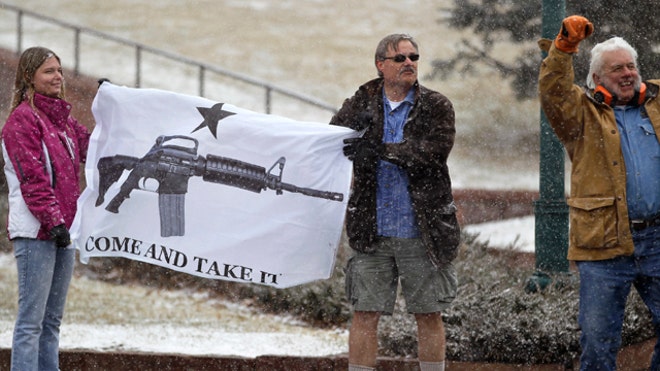
Opponents of proposed gun control bills being considered by the Colorado Legislature hold a sign depicting an assault rifle. (AP)

DENVER (AP) — Firearm restrictions pitched by Colorado Democrats advanced Monday, as the battle over them intensified with hundreds of gun rights supporters cramming the state Capitol and circling the building all day with car horns blaring. Inside, the husband of former U.S. Rep. Gabrielle Giffords urged lawmakers to pass universal background checks and victims of mass shootings in Connecticut and a suburban Denver movie theater pleaded for more gun controls.

Colorado has become a focus point in the national debate over what new laws, if any, are needed to prevent gun violence in the wake of recent mass shootings, including an attack at a suburban Denver movie theater last summer — a massacre that brought to mind the Columbine High School shooting of 1999 for many in the state and across the nation.

Lawmakers in the politically moderate state are considering a package of gun control measures, including plans that would limit ammunition magazines to 15 rounds and expand background checks to include private sales and online purchases. Both measures cleared Democratic-controlled committees on 3-2 party-line votes but still need approval from the full Senate, which could debate the bills as soon as this week.

Retired astronaut and Navy captain Mark Kelly told lawmakers that he and his wife support the Second Amendment, but he said the right to bear arms shouldn’t extend to criminals and the mentally ill.

Kelly compared the different background check requirements for private and retail sales to having two different lines at the airport, one with security and one without.

‘‘Which one do you think the terrorist is going to choose?’’ he asked.

Giffords, a former Democratic congresswoman from Tucson, Ariz., was severely wounded in a mass shooting in January 2011 while meeting with constituents.

Gun control opponents say the proposals will not reduce violence. They say lawmakers should focus on strengthening access to mental health services for people who could be dangerous to communities.

The bill hearings were at times testy, and included some outbursts from the audience. After one bill passed, someone leaving the committee yelled ‘‘That sucks!’’ to lawmakers.

‘‘I've never seen such unprofessional behavior,’’ Democratic Sen. Irene Aguilar told the audience at one point.

Meanwhile, gun rights advocates complained that lawmakers limited testimony time and many didn’t have a chance to speak on proposals.

The commotion at the Capitol underscored the attention the debate has generated nationally from gun rights groups, such as the National Rifle Association, to victims’ families and White House officials.

Several bills before state senators already have cleared the House. And because Democrats control both chambers of the state Legislature, some of the proposals have a strong chance of passing.

Other measures that picked up initial Senate approval would place new restrictions on gun ownership by people convicted in domestic violence cases, and another requires gun buyers to pay for their own background checks.

The state’s Democratic governor, John Hickenlooper, supports magazine limits and expanded background checks. He hasn’t indicated where he stands on other measures, including whether he supports a proposal that would hold sellers and owners of assault weapons liable for shootings by such firearms.

Gun rights supporters walked the Capitol halls wearing stickers that read, ‘‘I Vote Pro-Gun.’’ Several dozen people outside the Capitol waved American flags as light snow fell, and a small plane flew overhead carrying a banner with a message for the governor, ‘‘HICK: DO NOT TAKE OUR GUNS!’’

One of the nation’s largest producers of ammunition magazines, Colorado-based Magpul, has threatened to leave the state if lawmakers restrict the size of its products. Its founder said smaller magazines can be easily connected to each other and the company fears it would legally liable if people were to do that.

About 20 Colorado sheriffs opposed the expanded background checks and the magazine limits. Standing shoulder-to-shoulder in front of lawmakers in committee, they said that both bills were unenforceable.

‘‘This bill just doesn’t make any sense from our perspective,’’ Pueblo Sheriff Kirk Taylor said about the bill to limit magazine sizes.

Victims who have lost relatives to gun violence say it’s time for legislators to take action.

Tom Sullivan, whose son Alex was among the 12 killed in the Aurora, Colo., theater shooting, was among the people urging lawmakers to pass magazine restrictions.

‘‘He was enjoying the movie one second, and then the next second he was dead,’’ Tom Sullivan said.

Jane Dougherty, whose sister, Mary Sherlach, was a psychologist killed in the shooting rampage at Sandy Hook Elementary School in Newtown, Conn., has been lobbying Colorado lawmakers to pass new gun laws. She said she doesn’t understand gun owners who worry the bills are putting a burden on their rights.

She said the Connecticut shooter used ‘‘the same type of weapon that we use in war’’ to ‘‘slaughter these babies’’ and asked lawmakers for stricter gun laws.

‘‘We cannot wait for yet another massacre to transpire,’’ Dougherty said.

___

Associated Press writer Kristen Wyatt contributed.

Monday, March 4, 2013

Kerry gives $250 million to Muslim Brotherhood

March 4, 2013

RIYADH, Saudi Arabia — Secretary of State John Kerry announced Sunday that the United States would provide $250 million in assistance to Egypt after Egypt’s president promised to move ahead with negotiations with the International Monetary Fund over economic reforms.

In a statement issued after his two-hour meeting with President Mohamed Morsi, Mr. Kerry said the aid decision reflected Egypt’s “extreme needs” and Mr. Morsi’s assurance that Egypt would reach an agreement with the I.M.F. after more than a year of talks over a $4.8 billion loan package.

The statement issued by Mr. Kerry noted that he and Mr. Morsi had discussed the need to ensure the fairness of Egypt’s coming elections, but it did not mention any specific political commitments the Egyptian president had made to receive the aid.

Parliamentary elections are scheduled for April. Some opposition groups have said they will boycott the vote because of what they see as an effort by Mr. Morsi and his Muslim Brotherhood movement to dominate Egyptian politics.

American officials say that Mr. Kerry asserted that moving ahead with difficult economic changes in Egypt would require a degree of political consensus and was implicitly a promise of some political change.

The aid announced Sunday consists of two parts. One is a $190 million infusion for Egypt’s budget intended to address what Mr. Kerry said was the country’s “extreme needs.” That assistance has already been approved by Congress.

Mr. Kerry also pledged $60 million for the creation of a fund to support small businesses, which will provide “direct support to key engines of democratic change in Egypt, including Egypt’s entrepreneurs and its young people.”

As an incentive for Mr. Morsi to conclude an agreement with the I.M.F., Mr. Kerry said that he would work with Congress to get additional funds approved for Egypt once a deal was reached.

In May 2011, President Obama pledged $1 billion to support Egypt’s democratic revolution. The $190 million in aid announced on Sunday is the first disbursement of that pledge.

“In all my meetings, I conveyed a simple but serious message: The brave Egyptians who stood vigil in Tahrir Square did not risk their lives to see that opportunity for a brighter future squandered,” Mr. Kerry said. “I encouraged President Morsi to implement the homegrown reforms that will help his country secure an I.M.F. agreement, put Egypt on the path to establishing a firm economic foundation and allow it to chart its own course. He agreed and said that he plans to move quickly to do so.”

The I.M.F. wants Egypt to carry out a number of economic policy changes, including raising taxes and cutting energy subsidies, and it is seeking assurances that Mr. Morsi can rally the political support needed for those changes.

Mr. Kerry’s departure from Cairo was briefly delayed, news agencies said, because hundreds of supporters of the soccer club Al Ahly, known as ultras, blocked the road to the airport in a protest related to a court case about a soccer riot in Port Said last year.

But the motorcade made it to the airport, and Mr. Kerry flew to Saudi Arabia, his seventh stop on his nine-nation trip.

New York Times